His text came at 5:12 on Thursday morning, while I was filling the coffee urn for the third time.
Alive. 51st and 145th. Twenty-two poles down in a row like somebody kicked them. Kansas crews here by noon. Feet wet since nine. I’m telling you because you said tell you.
I read it standing at the sink in the community center kitchen with the water running into the urn. Then I wrote back the only thing I could think of that wasn’t asking him to come home.
Dry socks in your truck?
Mama put six pair behind the seat in November.
Then change them.
Nothing for a minute. Then: Yes ma’am.
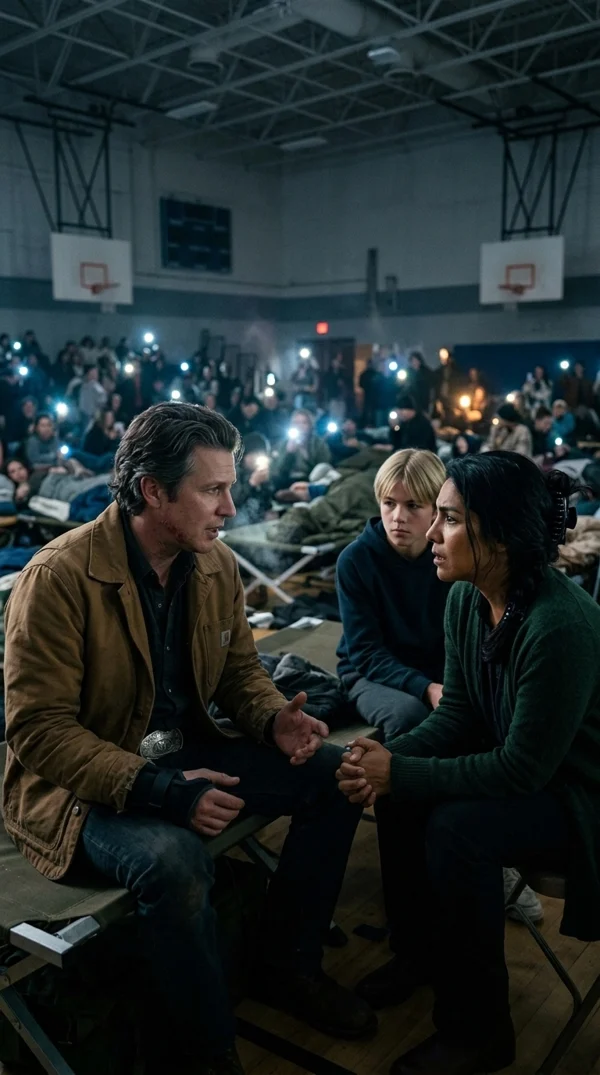
By seven there were two hundred and eighty people in the gym.
Priscilla had all of them in her book. She’d slept two hours on a cot behind the sign-in table and come awake at four when the door opened, and she’d been writing ever since. Names, ages, medicines, who needed power for a machine. She’d made a second list of people who’d come without their pills and a third of whose dogs were in the hall. At six she’d given the Red Cross woman a clean copy of all three, in her careful print, and the woman had stood there holding it as if she’d been handed a cake.
The generator truck roared outside the side door. It ran the lights at one end of the gym and the kitchen and a row of power strips along the wall where people sat on the floor with their phones plugged in, in a line, like birds on a wire. The far end of the gym was dim and cold. You could see your breath by the bleachers.
The rows of cots ran the length of the floor. Old couples who’d lain down in their coats. A family of six sharing three cots pushed together. The man with the oxygen tank, whose name was Mr. Bledsoe, with a power strip of his own and a Red Cross volunteer who checked his gauge every hour.
Nobody was crying. Nobody was doing much of anything. That’s what I’ll remember. Not fear. Waiting. Three hundred people in their coats, waiting for the lights the way you wait in a doctor’s office, reading the same sign on the wall over and over.
The radio said the courthouse was closed through Friday. Dorinda texted at 7:30 to say Zeke’s bond hearing was off, and that she’d called the clerk’s recording and the recording had said the same thing three times.
At eight I set up a table by the locker room door with a folding chair in front of it and a hand-lettered sign Deena made on the back of a Red Cross flyer. HAIR. FREE. NO WATER, SO DON’T GET FANCY.
You can’t wash hair in a shelter. You can do almost everything else.
I’d brought combs and brushes and a box of elastics and every can of dry shampoo from Laverne’s shelf. Deena came at nine with her mother, who went straight to Mr. Bledsoe and the Red Cross woman and didn’t come back. Deena took the folding chair next to mine.
We braided the old women first. Women who’d gone to sleep in their sets and woken flat on one side, who’d been sitting on cots since midnight looking at their hands. You sit them down and put a cape over their coat and brush it out slowly, from the ends up, and they close their eyes. A French braid down the back, tucked. A twist at the nape and two pins. A part moved a half inch to the left so the flat side doesn’t show. It takes ten minutes. It’s the most useful ten minutes I know how to give anybody.
At ten a young woman sat down with two little girls holding onto her coat, one on each side. Four and six, maybe. Blond, both, with hair that hadn’t been brushed since Wednesday morning, and a mother who looked as if she hadn’t slept since then either.
“Can you do two braids?” she said. “They fight if one gets something different.”
“Two braids on two girls is four braids.”
“I know,” she said. “I’m sorry.”
“Don’t be sorry.”
Her name was Tasha Lockett. They lived in Elm Creek, the new addition on the south side, in a house they’d closed on in July. I didn’t say anything when she said the name. I started on the six-year-old.
“It went off like a bomb,” Tasha said. “The transformer. The green box in the yard. About nine Wednesday night. There was a flash, and then a bang that shook the windows, and then everything was dark and it smelled like something burning.” She held the four-year-old on her lap. “My husband’s in Texas on a job. I put the girls in the car and drove here with the heater going.”
“I’m sorry.”
“The co-op guy who came to put tape around it said it was one of those stolen ones. From that supply place on the news. He said they’d been changing them out all week and hadn’t gotten to ours yet.” She shook her head. “I didn’t even know a transformer could be stolen. I thought they came from the electric company.”
I put an elastic on the end of the first braid. I didn’t trust my voice for a second.
“Most people did,” I said.
The news crew came at noon. A young woman reporter in a red parka and a cameraman with a light on top of his camera. They filmed the rows of cots and the Red Cross table and the generator truck, and Mr. Bledsoe’s oxygen gauge, with his permission. Then the camera came to my table, and stayed.
The reporter waited till I’d finished pinning a twist for an old lady named Mrs. Coe. Then she crouched beside my chair.
“You’re the woman from the window,” she said quietly. “From the salon on Main. Aren’t you?”
“I’m the woman braiding Mrs. Coe.”
“I’d love two minutes, once you’re done. About your husband, and the theft case. The co-op. The man who was shouting at the dinner.”
“No,” I said.
She blinked. I don’t think people often said no to her in that parka.
“Film the braids if you want,” I said. “Film Priscilla’s book. She’s done the whole shelter by hand since four. That’s a story.”
The cameraman filmed the braids. I saw him do it. A tight shot of my hands in Mrs. Coe’s white hair, and then a wide one of the whole table, the line of women in their coats waiting for a chair. They went over to Priscilla after that. Priscilla answered every question in complete sentences and never looked at the camera.

 100 to start reading with.
What did you think?