Good People, chapter 2 of Ask Who Drove
My mother lives on the second floor of the Pellam Lutheran Home, in a room with a window that looks at the parking lot and a bulletin board that says TODAY IS FRIDAY in letters somebody changes every morning. On good days she reads it and tells me what day it is. On bad days she reads it and tells me it’s wrong.
Friday was a medium day.
“You cut your hair,” she said, when I came in.
“I dyed it.”
“It’s darker.”
“It’s for the show.”
“Your hair was so light. Like milkweed.” She frowned at the bulletin board as if it had been involved. “Your sister has my hair. Dark. Poor thing.”
Denise Sund was sitting on the edge of the bed with my mother’s left hand in her lap, rubbing lotion into the knuckles with her thumbs. She looked up and smiled at me, a quick, apologetic smile, like I’d caught her doing something too kind.
“Hi, honey.”
“Hi, Denise.”
The lotion came from a pump bottle on the nightstand, the size of a fire extinguisher, with a purple label: LAVENDER FIELDS, INSTITUTIONAL SIZE. The whole room smelled of it. The whole floor did. The Home bought it by the case, Denise told me once, because the residents’ hands cracked in the dry heat and because lavender was supposed to calm people, though she had her doubts. “Some of them it calms,” she’d said. “Some of them it makes them think they’re at a funeral.”
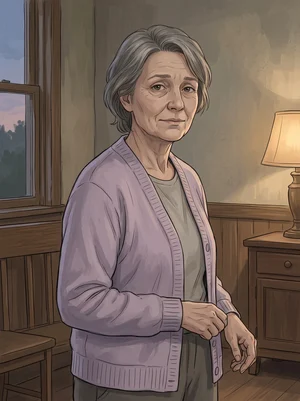
Denise had been my mother’s aide since my mother moved in, two years ago. She was sixty-three, soft-spoken, with reading glasses on a beaded chain and long sleeves in every season, and she was the reason I could live in Chicago without hating myself more than the normal amount. She was also Callie’s mother. In Red Water she’d been the voice people wrote to me about: the woman who’d waited fourteen years for anyone to care, who had said on tape, “I don’t need it to be him. I just need it to be someone.” When Wes was convicted she’d hugged me on the courthouse steps so hard my microphone clip broke.
I don’t know how to describe what it’s like to be loved for the worst thing that ever happened to someone. You get used to it, is the problem.
“How’s she sleeping?” I asked.
“Better than you, by the look of you.” Denise switched to my mother’s right hand. Her sleeve slid back an inch. There was a bruise on the inside of her left wrist, yellow at the edges, purple in the middle, the size of a thumb. She saw me see it and pulled the cuff down with two fingers, without hurrying. “Stupid. Shut it in the dryer door.”
“Ouch.”
“I bruise if you look at me.” She squeezed lotion into her palm. “Where are they putting you? Not Bev’s.”
“Bev’s. Room fourteen. The one with the ice machine outside that screams all night.”
“Oh, Tick, no, you should stay with us, we’ve got the whole basement—” She stopped. Her thumbs stopped. “Tekla. Sorry. Britt used to call you that. She talked about you all the time, when she visited your mom. I’ve got it stuck in my head.”
“It’s fine.”
It wasn’t fine. It was the second time in two days that name had come at me. But Denise had loved Britt, in the uncomplicated way older women loved Britt, because she showed up and fixed their printers and didn’t make them feel stupid. Of course she’d heard it. Of course it was stuck in her head.
My mother pulled her hand out of Denise’s lap and reached for mine. Her fingers were slick and smelled like a closet full of sachets.
“Britt,” she said to me.
“It’s Tekla, Mom.”
“Britt, put the truck back before your father wakes up.”
Denise’s thumbs stopped on my mother’s knuckles. At the time I noticed only my mother’s grip, which was stronger than it had any right to be.
“Dad’s truck’s fine, Mom,” I said. “It’s in the barn.”
My father had been dead seven years. The barn had been sold with the farm. My mother nodded, satisfied, and let go of my hand, and asked Denise whether there would be pudding at lunch.
At three o’clock Denise’s shift ended, and Ray came to get her.
You heard Ray Sund before you saw him. His wrecker was a red 2011 International with SUND TOWING & REPAIR in gold script on the doors and an amber light bar across the roof of the cab, and he drove it everywhere, because, he said, you never knew when somebody was going to put a Buick in a ditch. He pulled in across three spaces. The light bar wasn’t on, but I could see the little rotating mirrors inside the plastic, waiting.
He climbed down and opened his arms when he saw me.
“Hollywood!”
“Hi, Ray.”
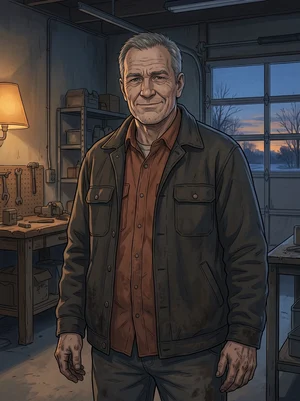
He hugged the way large men hug when they’ve decided it’s their job: completely. He was sixty-six, broad, his grey beard trimmed square, wearing a canvas work coat with a pen and a tire gauge clipped in the breast pocket. In season one, he was the one who’d made people cry. Not Denise. Ray. Grown men had emailed me to say they’d had to pull their cars over during episode three.
RED WATER, Episode 3: “The Long Night.”
RAY SUND: She didn’t come home. Denise was beside herself. Around midnight I got in the wrecker and I just drove. Bowling alley lot. The river landing. Out to the dam. Every road she might’ve walked. I didn’t think of the marsh. Not till four in the morning. God forgive me, it was the last place I looked.
TEKLA: Why the last place?
RAY SUND: Because she loved it out there. You don’t look for somebody in the place they love. You think, she’s safe there.
I’d put cello under that. I’m not proud of it. It worked.
“How’s the big show?” he said. “Denise says they’re making a movie.”
“A TV series. Maybe.”
“Who’s playing me? I want somebody with hair.”
Denise came out of the side door with her coat over her arm and her bag on her shoulder, and Ray’s face did a thing that I would have called softening if I’d been writing it. She glanced at the clock on the wrecker’s dash as she climbed toward the passenger door. Three-oh-six. I’d seen her do that inside, too, at five to three, looking at the wall clock above the nurses’ station like it had told her something unkind.
“I wanted to tell you something before you hear it from somebody else,” I said. “The Free Wes people might be escalating.”
Ray’s eyebrows went up. “Escalating how?”
I had the envelope in my bag. I’d told myself I wouldn’t show it to anyone until I’d thought about it, and I’d been thinking about it for twenty-six hours, to no purpose. Denise and Ray had more right to know than anybody. If someone was going to start a campaign claiming Wes was innocent, it would land on them first.
I took out the card and held it so they could both see.
Denise’s keys hit the asphalt.
She bent for them fast, apologizing, and I bent too, and our heads nearly knocked. When we straightened up her face had gone the grey of old snow.
Ray didn’t drop anything. He took the card out of my fingers, gently, and held it at arm’s length, the way men his age read things now.
“Well,” he said. “That’s a dirty trick.”
“It’s her handwriting, Ray.”
“It’s somebody who’s seen her handwriting.” He turned it over and looked at the back, at the little 2/1. He looked at the pinholes, too, and rubbed one with his thumb, the way he’d test a weld. Then he turned it face up again and handed it back to me. “That Ostrander girl would forge God’s signature on a parking ticket if she thought it’d get her brother out. You know what she put on that page about Denise last spring? About Callie?”
“I saw.”
“You take this to Lyle.” Lyle Brandvold was the sheriff. Ray had been fishing with him for forty years. “You let him deal with it. You don’t let them get in your head, kiddo. That’s what they want.”
Denise said, very quietly, “You should go to the sheriff.”
“I’ll think about it.”
“How’s that little car running?” Ray said. “Britt’s car. That Outback.”
“Fine. Pulls left.”
“Bring it by the shop. Leave it with me overnight, I’ll do the alignment, go over the whole thing. No charge.” He grinned. “I already didn’t charge you once. I keep track, you know. I’ve got every car I ever hooked since 1985 written down in a ledger. August twenty-third, 2025, one green Subaru Outback, Vang Marsh reservoir to Mill Street, no charge. It’s in the book.” He patted his breast pocket as if the book were in it. “My accountant says I’m the only man in Wisconsin who keeps a receipt for a favor.”
“Ray,” Denise said.
“What? I’m proud of it.”
He helped her up into the cab. He shut her door for her. He waved to me as he backed out of his three parking spaces, and the wrecker rolled away down Elm Street with its light bar dark, and I stood in the lot with the card in my hand and a feeling I couldn’t name, something like having said a word out loud in a church.
Desmond Feld called at nine that night. I was in room fourteen, lying on the bedspread, listening to the ice machine.
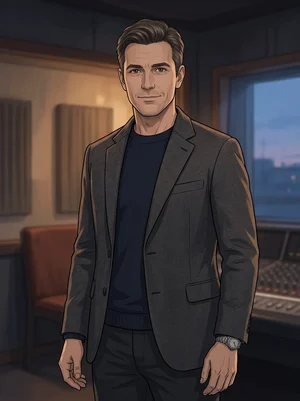
“Talk to me about the card,” he said. Desmond was the executive producer of Red Water and the reason it existed, in the sense that he was the one at Lantern who’d said yes. He was forty-four and spoke at the speed of a man whose watch was always telling him something. I’d texted him a photo of it at noon, against my better judgment, because he was going to be onstage with me in eight days and I didn’t want him surprised.
“It’s a card.”
“In your dead sister’s handwriting.”
“In handwriting that looks like my dead sister’s.”
“Tekla.” He paused, which for Desmond was a speech. “That’s a season.”
“It’s a hoax.”
“A hoax is a season. Who’s sending it? Why now? Nine days before the live show, a week before the streamer announcement? Either somebody wants to hurt you, which is a story, or somebody knows something, which is a better story.” I could hear him walking. “Don’t do anything with it yet. Don’t post. Don’t talk to anyone.”
“I already showed it to Callie’s parents.”
“Okay. That’s fine. That’s actually fine. How’d they react?”
I thought about Denise’s keys on the asphalt, and Ray’s thumb on the pinhole.
“Like people who’ve had enough,” I said.
“I’ll be there Monday. I’ve still got that box of Britt’s production stuff from the archive. I’ll bring it.”
“What box?”
“The box. From her apartment. The notebooks, the drives.” A pause. “You told me to take it, Tekla. At the funeral. You said you couldn’t look at it.”
I didn’t remember saying that. I remembered the funeral as a series of casseroles.
“Bring it,” I said.
I slept badly, which is my normal, and woke at six to the ice machine having what sounded like a heart attack. I had a visiting slot at Kettle River at two. At eleven I went to the office to settle the week’s bill and steal a second coffee.
Bev Kunkel had owned the Tamarack Motel since the Carter administration. She sat behind the front desk in a cardigan with a cat on the counter and the room keys hanging on little brass hooks on the wall behind her, actual keys on plastic diamond fobs, like it was 1978 and always would be. The mail carrier was just going out the door as I came in.
“Mail for you, hon,” Bev said, sorting. “Huh. Somebody knows your room.”
She held out a white envelope. Block capitals. TEKLA MOEN, TAMARACK MOTEL, RM 14, PELLAM WI. Postmarked Pellam, October 9.
It smelled of lavender.
I opened it at the counter, with Bev and the cat watching, because my hands had decided before I had.
Rhonda saw the truck. Nobody asked her who was driving. You didn’t.
On the back, in the corner: 2/2.
What did you think?