Visiting Hours, chapter 3 of Ask Who Drove
Kettle River Correctional Institution is ninety minutes north of Pellam, past the last of the marshes, where the sand gives way to jack pine and the radio stations give way to God. I drove Britt’s Subaru with both cards in an envelope on the passenger seat and the radio off. Every few miles the car pulled left, gently, like it had somewhere else in mind.
Rhonda saw the truck.
Rhonda Pilz had been the hinge of season one. Sixty-four at the time, retired night clerk from the Gas-n-Go on County K, who had kept a handwritten log of every shift for thirty years. On October 11, 2008, at 11:40 p.m., driving home north on Dike Road, she had passed a blue Ford pickup with a white tailgate going south. Wes Ostrander’s truck. There was only one in the county with that tailgate; he’d replaced the original after backing into a culvert. For fourteen years Wes had said he drove home from the bonfire at ten-thirty. Rhonda’s log put his truck on Dike Road an hour later, heading toward pump house three and bed nine.
Britt found her. I made her famous. A jury believed her.
Nobody asked her who was driving.
I had called Kettle River on Friday morning, after Krista, expecting to be told that a person who had helped convict an inmate could not simply put her name down and show up. The woman on the phone checked a screen and said, “You’re already on his list, ma’am. Approved since March of last year.” I asked her to check again. She said she didn’t need to.
The visiting room was painted the color of weak tea. Vending machines along one wall, a play corner with a plastic kitchen, round tables bolted to the floor. A guard at a raised desk. Families at half the tables: a woman with a toddler on her hip, an old man in a church suit holding his son’s hand across the table without saying anything.
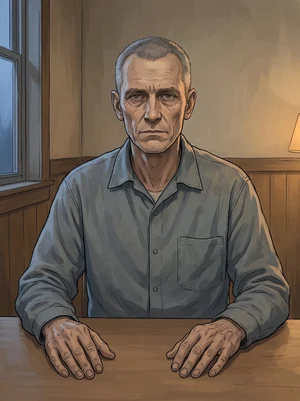
Wes came in through the far door in state greens and sat down across from me and didn’t offer his hand, which was a rule, and didn’t smile, which wasn’t.
He was forty-two now. Six foot three, thinner than at trial, his hair cut close, grey coming in at the temples. In 2022 he’d talked to me for four hours on a porch in Plover with his leg jiggling the whole time. Now he was very still.
“Huh,” he said. “She said you’d come.”
“Who?”
“Your sister. She asked me to put you on the list. Said you’d show up eventually and I should let you in.” He looked at my hands, which were folded on the table, then at my face. “She said I’d want to see your face when you figured it out.”
“Figured what out?”
“I don’t know. She didn’t tell me. She said she had to tell you first.” He leaned back. The chair didn’t move with him; it was bolted too. “Then she didn’t tell anybody anything, did she.”
The toddler in the play corner banged a plastic pan on a plastic stove.
“Your sister says Britt wrote you eleven letters,” I said.
“Twelve. Krista only has eleven. I kept the last one.”
“What was in them?”
“Questions, mostly. Some apologies. Some stuff about her life, which I didn’t ask for but I read anyway, because you read everything in here. You’d read a cereal box.” He studied me. “You came up here to ask me what your sister wrote. You didn’t come to say anything.”
“I’m not sure what I’d say.”
“Sure you are. You’re a professional.” There was no heat in it. That was worse. “Go on. Ask your questions. You’re good at questions. I’ve heard.”
I’d brought a notebook. I didn’t open it. I’d also brought a recorder, out of habit, and left it in the car, out of something that wasn’t habit, and I was aware of my hands wanting it, patting for it like a phone in the wrong pocket.
“Tell me about the night,” I said. “Not the version from the show.”
“There’s only one version now. I gave it to you on the porch.”
“You gave me two.”
“Yeah.” He looked at the vending machines. “First I said I drove home. Ten-thirty. I’d been saying that since 2008. I had an OWI from 2006. If I’d said I was that drunk at ten-thirty, with my truck right there, somebody’d ask how my truck got home, and the honest answer was it didn’t, and the next question would be, so how’d you get home, and I’d have to say I walked across Vangs’ fields drunk at night, which is true but sounds like exactly what a guy would say who drowned his ex-girlfriend. So I said I drove. And the longer I said it, the more I had to keep saying it. And then you came along with Rhonda Pilz and her little book.”
“And then you said you walked.”
“And then I said I walked, which was the truth, and you played the two tapes back to back with a little piano between them.” He did the thing with his eyebrows that Krista did. They had the same eyebrows. “You know what that sounds like. You made it sound like that.”
I didn’t argue. I had made it sound like that. That was the job, I’d have said, three years ago. You put the contradiction next to the contradiction and let the listener feel it.
“Where were the keys?” I asked.
“Visor. Always. Everybody knew. Half the county borrowed that truck. Pete Vang borrowed it to haul a deer once and gave it back with hair all over the bed.” He shrugged. “I told you all this.”
“Tell me the next morning.”
He looked at me then. Really looked, for the first time.
“Dusty drove me back out to the sand pit around six-thirty to get it. It was where I left it. Fire was out. Couple beer cans. I go to get in and I can’t. I can’t get my knees under the wheel. The seat’s all the way up, as far as it goes. I’m six-three, I have it racked all the way back, always. I had to reach down and pull the bar and shove it back before I could even sit.”
“Somebody moved it.”
“Somebody small drove my truck.” He said it flatly, like a man reading off a label. “I told the deputy in 2008. Lyle Brandvold, before he was sheriff. He wrote down ‘seat moved.’ Two words. My new lawyer got the file, I’ve seen the page. Seat moved. Then nobody ever asked about it again.” He waited. “Until I told you. In 2022. On the porch. You nodded like it was interesting.”
The fluorescent light above us had a flicker in it, too fast to see, just fast enough to feel in the back of the eyes.
“I don’t remember that,” I said, and heard how it sounded.
“Your sister did. Letter four, she asks me about the seat. How far forward. Was the mirror moved. Was there anything on the floor.” His jaw worked. “Then she comes up here in April and asks me again, in person, sitting right where you’re sitting. And I tell her all the way up, and she just sits there and water comes out of her eyes. Not crying, exactly. She didn’t make any noise. Like a faucet somebody left on.”
The toddler had stopped banging the pan. The woman was holding her, rocking a little, looking at the door the inmates came out of.
“What did she say?”
“She said, ‘I’m going to fix it, Wes.’ I said, ‘Fix what? You got a time machine?’ She said she had something better. She said she had a season.” He made a small noise that wasn’t a laugh. “I didn’t know what that meant. I thought maybe she meant, like, a season of life. Like the Bible. A season for everything.”
“She meant a podcast season.”
“Yeah, I figured that out.” He leaned forward, forearms on the table, close enough that the guard at the desk looked over. “Last letter she sent me is dated August twentieth. She says it’s almost ready. She says she’s going to talk to somebody first, somebody who deserves to hear it before anybody else. Two days later she’s in the reservoir.” His voice didn’t rise. “You ever think about that, Tekla? Because I’ve had a lot of time to think, and I’m not even related to her.”
I had thought about the reservoir every day for fourteen months. I had not once thought about it like that.
“Who was she going to talk to?”
“She didn’t say. She was careful. Your sister was more careful than you.” He sat back. “You want to know what thirty years is? Thirty years is I get out when I’m seventy-two. My mom’ll be dead. Krista’s kids will have kids. I’ll come out and the Dari-Freeze will be a vape shop.” He shrugged one shoulder. “I don’t need you to feel bad. Feeling bad’s free. Everybody in Pellam feels bad on Sundays and then they go to the buffet.”
“What do you need?”
“I need you to do the thing you do.” He stood up. Our hour wasn’t over, but he stood up, and the guard watched him do it. “Except this time, ask the right person the right question. That’s all. That’s what she wanted. She just didn’t get to.”
He went to the door and waited for it to buzz. He didn’t look back. I’ve edited a lot of exits, and I’ll tell you, most people look back.
In the parking lot, I sat in Britt’s car with the engine off and opened my laptop on the steering wheel.
Every piece of tape from season one lives on a drive I carry with me and on Lantern’s server, because I’m the kind of person who makes two copies of everything, one in my bag and one somewhere else. The interviews are in folders by name and date. OSTRANDER_W_2022-06-14. Four hours, eleven minutes. Beside each raw file is a tape log, a spreadsheet I fill out as I listen back: timestamp, summary, a column for notes. The notes column is where I talk to myself. Most of my notes say things like good, USE, ask again, Desmond will love this.
I scrolled. I didn’t know what I was looking for until I found it.
01:12:40 — seat thing. cut: irrelevant, slows ep 5.
My own handwriting, so to speak. My own initials in the cell beside it, the way I sign off on every cut.
I put my earbuds in. I dragged the playhead to 01:12:30. There was porch noise, a dog somewhere, the hiss of my old recorder. Then Wes’s voice, younger, faster, his leg jiggling against a deck board so I could hear it thump.
“—and when I go to get in, I can’t. The seat’s all the way up. Like a kid had been driving it. I told the deputy that. Nobody cared.”
A pause. A beat of room tone, the dog again.
Then my voice, bright, efficient, the voice I use when I’ve decided where an episode is going.
“Okay. Let’s go back to when you left the fire.”
What did you think?