The Pre-Interview, chapter 4 of Ask Who Drove
I spent Sunday in room fourteen with my headphones on, listening to myself.
It’s a specific kind of hell. Every interviewer has tics, and you learn to hear them in other people’s work. You don’t learn to hear them in your own. By eleven at night I’d found four places in season one where a witness started to go somewhere and I said, brightly, “Okay,” and brought them back to where I wanted them. Four that I could find. I stopped looking because I didn’t want to find a fifth.
On Monday Desmond flew into Central Wisconsin Airport and drove the rest of the way in a rented Tahoe, as if Pellam might have terrain.
He found me at the Opera House, in the green room, which was a former coat check with a mirror and a mini fridge. He was wearing the fleece vest that men like Desmond wear to signal they are not in a city, and he hugged me with one arm because the other was carrying a banker’s box.
“You look terrible,” he said. “Good terrible. Haunted. We should shoot some stills.”
“Is that it?”
“That’s it.” He set the box on the counter between the mini fridge and a bowl of complimentary mints. BRITT, the label said, in Lantern’s office-label font. PROD S1. “Notebooks, two hard drives, a folder of releases, some receipts. I scanned the releases for legal. Everything else is how it was.”
“You opened it.”
“I archived it.” He took off the vest. “Tekla. She was a credited producer on the biggest show we’ve ever made. Her raw tape is an asset. There’s bonus content in there for the streamer, if we do it right. Behind the scenes, the sister who found the witness. People would eat it up.”
His laptop was open on the counter. On the screen, a waveform, half edited, in a project file named BRITT_BTS_v3.
Version three.
I looked at it, and Desmond watched me look at it, and neither of us said anything for long enough that the mini fridge’s compressor kicked on to fill the gap.
“How long have you had her voice in a project file?” I asked.
“Since the option. Since before. It’s my job to know what we’ve got.” He closed the laptop, not quickly. “You think I’m sending you cards.”
“I think you had her notebooks.”
“I had her notebooks in a box in a storage room in the West Loop with a sign-out sheet. You can call Priya. Nobody’s signed it out but me, and I signed it out this morning, at O’Hare, to put on a plane.” He spread his hands. “I want a season two. I’m not hiding that. I’d pay for one. I wouldn’t fake one. Faked ones get found out and then you don’t get a season three.”
It was the most honest thing he’d said to me in five years, and I believed it, and I hated that the reason I believed it was that it was so cynical.
The box had come out of her apartment the week after the funeral, while I stood in her kitchen with a garbage bag. I remembered the kitchen better than the funeral. When we were making season one she’d covered the corkboard over her table with index cards, one story beat per card, colored yarn running between them like a detective show she said she was making fun of. That August the board was empty. Nothing on it but pushpins, dozens of them, in rows where the cards had been. I’d stood in front of it and thought, she was cleaning up, and that was the moment I believed the coroner.
He left me alone with the box. He’s good at knowing when to leave a room; it’s half of producing.
Britt’s notebooks were the cheap kind, black-and-white marbled composition books, the kind you buy for a dollar in August. There were six of them for season one, labeled on the covers in her backward lean: RW 1. RW 2. Inside, her handwriting raced: names, phone numbers, directions to farmhouses (turn at the dead silo, NOT the live one), lists of who hated who, notes from phone calls written so fast the words broke apart.
I found the Rhonda page in book three.
4/9/22. Rhonda P., Gas-n-Go (ret.), 1418 Birch. Kept shift logs 30 yrs!!! Saw W’s truck 10/11/08, 11:40, Dike Rd southbound, near bed 4 culvert. White tailgate. SURE of it. Told a deputy in ’08 at the counter, nobody wrote it down (Lyle’s nephew??).
Then nothing. The next page was gone. Not cut. Torn, close to the binding, so that a ragged stub of paper stood up from the stitching like a broken tooth. The page after that started a new day, a new name.
I ran my thumb down the stub. Britt pressed hard when she wrote. She always had. In third grade a teacher had sent a note home about it, Britt is going through her paper, and our mother had framed it.
I took a pencil from the box and turned to the page that had been under the torn one, and laid the pencil almost flat, and rubbed.
It’s a trick from a children’s mystery novel. I felt ridiculous doing it. Grey came up under the graphite, mostly nothing, a smear, and then, in the middle, ghost letters, pale where the pressure had been:
…small… up close to the…
…asleep on the…
And at the bottom, pressed so hard that the indentation had nearly gone through:
DON’T TELL T
I read it the way a producer reads it, because that’s what I am. Rhonda had given Britt something in April 2022 that would have muddied a clean episode, a detail, a doubt, and Britt had made an executive decision on my behalf. She’d torn it out so I wouldn’t have to choose. I sat in the green room and was furious with her for about a minute, and then I was something worse than furious, which was grateful, because I knew exactly what I’d have done with a doubt in April 2022, with Lantern waiting and the first three episodes already cut.
Thanksgiving 2024, our mother’s first at the Home. They put on a dinner in the activity room, paper turkeys, a tray of something orange. Britt came late. She’d been drinking again since spring, and she’d gotten good at it, which is the worst stage, the stage where it’s barely visible. She sat next to me and ate cranberry sauce out of the can-shaped mold with a fork, and halfway through she put the fork down and said, “Tick. We have to talk about Rhonda.”
I was on my phone. The streamer had sent notes on the treatment that morning, and I was answering them under the table.
“Not at Thanksgiving,” I said.
“When, then?”
“After. Call me next week.”
“You won’t pick up.”
“I’ll pick up.”
She looked at me. She had a way of looking at you that made you feel like a sign she was trying to read from far away.
“You turned her into a theme song,” she said. “You know that? She’s the bit before the ads now.”
“She’s the reason a killer’s in prison.”
Britt picked up her fork again and didn’t say anything else, and our mother asked who had died, and Denise came over to wipe her chin. I remember thinking, she’s drunk, she’s picking a fight. I remember being relieved.
Rhonda Pilz lived at 1418 Birch, in a yellow ranch house with a wooden goose on the porch wearing a tiny raincoat. She was sixty-eight now and she remembered me fondly, which made it worse. She sat me at her kitchen table and gave me coffee in a mug that said WORLD’S OKAYEST GRANDMA, and she brought out the log.
Not the 2008 one. That one was in an evidence locker in Kettle County. She brought out 2026, to show me she’d kept it up after she retired. Oct 11. 48°, overcast. Gas $3.09 at the old place. Tekla M. on radio re: big show.
“You put me in your log.”
“You’re news, hon.”
I had a recorder in my bag. I didn’t take it out. I told myself it was because she’d talk more freely without it, which was true, and which was also the kind of thing I’d always told myself.
“Rhonda. When you saw the truck that night. Did you see who was driving?”
She looked at me, surprised, and then something else. Pleased, almost.
“Well, would you look at that,” she said. “Somebody finally asked.”
RED WATER, Episode 4: “The Tailgate.”
TEKLA: Did you see who was driving?
RHONDA PILZ: Well, it was dark, hon.
TEKLA: But it was his truck.
RHONDA PILZ: Oh, it was his truck. No question. That tailgate.
I’d listened to that exchange maybe two hundred times in edit. I had heard it as confirmation. I hadn’t heard what it actually was: a woman starting to answer one question and being handed a different one.
“Your sister asked me,” Rhonda said. “The first time. Before you came with your microphone. She sat right there.” She pointed at my chair. “And I told her what I’m going to tell you, which is I didn’t see a face. It was dark and it was quick. But I saw a shape. Whoever was driving was little. Sitting way up close to the wheel, like my granddaughter does, like they’re scared of it. Hands up high.” She lifted her own hands to show me, ten and two, elbows tucked in. “And somebody in the other seat with their head against the window. Light hair. Long. Flat against the glass. Asleep or drunk, I figured. I figured kids.”
The kitchen clock ticked. It was shaped like a rooster.
“Did you tell the jury that?”
“Nobody asked me. The lawyer for the Ostrander boy asked did I see the driver’s face, and I said no, I didn’t, which was the truth.” She frowned. “Should I have said?”
“What did Britt say? When you told her.”
Rhonda thought. She took her time. She was a woman who wrote down the price of gas every day for thirty years; she wasn’t going to rush a memory now.
“She went white,” she said. “I thought she was going to be sick. I asked was she all right and she said she’d skipped lunch. I gave her a muffin.” A pause. “Then when she left, she stopped in the door, and she said, ‘Tekla is going to come ask you about the truck. Just answer what she asks.’ And I figured, well, that’s how you people do it. Somebody asks the questions and somebody else decides which ones.” She looked at me kindly. “Did I do it wrong?”
“No,” I said. “You didn’t do anything wrong.”
Light hair. Long. Mine had been long in 2008. So had every girl’s in Kettle County. I put that thought exactly where I’d put Wes’s seat in 2022, in the column marked irrelevant, and I noticed myself doing it, and I did it anyway.
I drove away with it running in my head the way I’d run it in an edit. Two kids in Wes’s truck at 11:40, a small one driving and a drunk one asleep. Kids who’d grabbed the keys out of the visor at the bonfire. Kids heading south on Dike Road, toward the pump house, an hour after Callie walked that way. Whoever they were, they’d been on that road at the worst possible time, and nobody had ever asked them a single question, because I’d made sure the only question anyone asked was about a tailgate.
I don’t remember the rest of the drive back to Main Street. I remember parking badly. I remember Carol from the box office coming out to the sidewalk with an envelope held up between two fingers, like something that smelled.
“This one came to the Opera House again,” she said. “Same as the first. You want me to start throwing them out?”
I took it. Lavender. Block capitals. Postmarked Pellam.
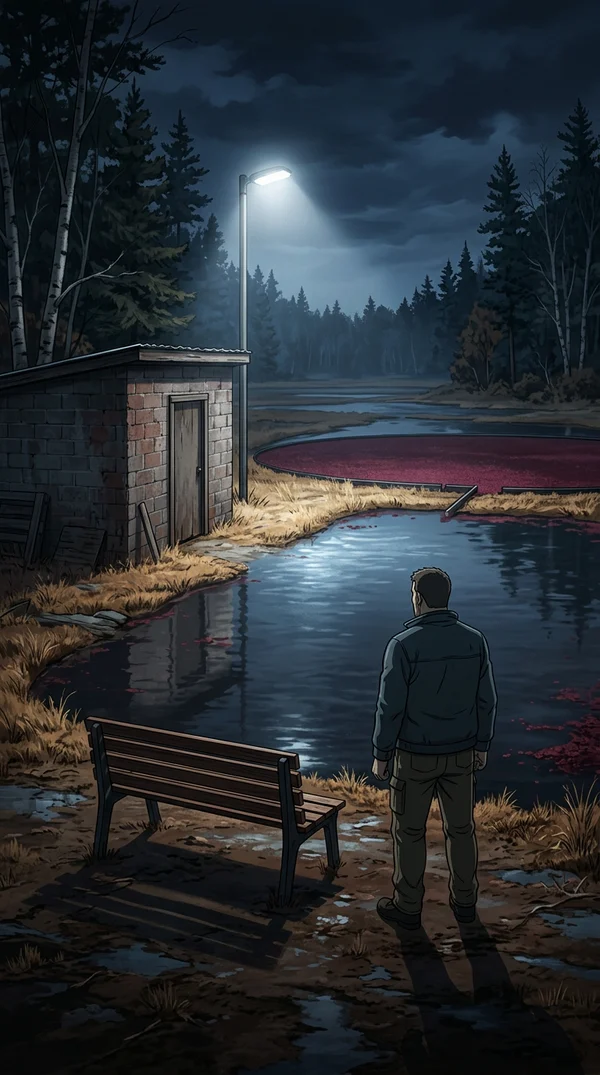
12:40. Pump house 3. The light was on, and so was the amber.
I turned it over. In the corner: 2/4.
I had two, then four. Somebody was counting, and somebody had skipped three.
What did you think?