Pinholes, chapter 5 of Ask Who Drove
The Dari-Freeze doesn’t open until eleven in October, so Krista let me in the side door at nine and sat me in the back booth under a poster of a sundae the size of a toddler. She set a shoebox on the table. Then she set her phone on the table beside it, screen up, with a red dot in the corner.
“I’m recording,” she said.
“Okay.”
“I record everything now. Every call with Wes’s lawyer, every call with the DA’s office, every time somebody from church says they’ll pray for us. Since your show.” She sat down across from me. “You taught me that. People say one thing to your face and then the tape says another.”
The shoebox was from a pair of children’s snow boots, size thirteen. Inside, eleven envelopes, addressed to Wes at Kettle River in Britt’s backward lean, rubber-banded in order. Krista slid them across with one finger, like she was passing me something hot.
“He sent them to me to keep. They toss cells up there. He didn’t want them getting lost.” She watched me take the rubber band off. “Go ahead. They’re not love letters, if that’s what you’re scared of. She was very clear about that. Every single one starts with ‘This isn’t that kind of letter.’”
It did. Wes, this isn’t that kind of letter. I’m the sister of the person who put you in there and I think she was wrong. January 2025. The handwriting was hers, every cramped backward stroke of it.
I took my own envelope out of my bag and laid the three cards in a row beside the letters. The letters were on lined notebook paper, the cards on index stock, but the hand was the same hand, down to the hooks. The same pressure, so heavy you could read the words from the back of the page like Braille. The same crossed sevens, a European habit she’d picked up from a substitute teacher in fourth grade and never dropped. No wobble, no place where a pen had stopped and started again, the way it does when someone is copying shapes instead of writing words.
“You think I could do that?” Krista said. “I can’t forge my own kids’ permission slips. I’ve tried.”
“Somebody could.”
“Somebody could be the Pope.” She picked up one of the letters, the fourth, and tapped a line. “Read that.”
I’m making something. It’s mostly for my sister. It’s the only way she listens to anything, if it has episodes.
I read it twice. Then I turned the cards over, all three, and looked at the backs.
2/1. 2/2. 2/4.
And then I looked at the fronts, at the two tiny holes in the top corners of each one, and stopped hearing the Dari-Freeze.
On season one, Britt had numbered every card on the back. Season, slash, episode. The card that said RHONDA — the log book — reveal at the half had 1/4 on the back, because it was season one, episode four. I’d watched her do it a hundred times at her kitchen table, writing the beat on the front in that hard lean and then flipping it over and adding the numbers in the corner, small, like a price tag. Then she’d take a pushpin out of her teeth and stick the card on the corkboard, one pin through each top corner, because she said a card on one pin spun around and made her feel crazy.
The corkboard I’d found in August 2025, with nothing on it but pins.
“Oh,” I said.
Krista leaned in. “What?”
“They’re not forgeries.”
“I told you that.”
“No. They’re hers. They’re actually hers. Somebody didn’t copy her handwriting.” I touched the pinholes on 2/1. “They took her cards. Off her wall. This is a season. She was building a season two, and she was writing it to me. Tick. Every card starts with my name because it’s addressed to me.” I heard my voice go strange. “Episode one: ask who drove. Episode two: Rhonda. Episode four: the pump house.”
“What’s episode three?”
“I don’t know. Somebody didn’t send it.”
Krista was quiet. The phone’s red dot glowed between us.
“So somebody has her board,” Krista said.
“Somebody has her bag.” I said it before I’d thought it. “She carried everything in that bag. It was never found. They told me the reservoir kept it.”
Yesterday I’d read DON’T TELL T as a producer’s decision, my sister sparing me a doubt that would have slowed an episode. I’d been grateful. Now I sat in the Dari-Freeze and thought: she didn’t bury it. She spent the last year of her life digging it up.
Krista gathered the letters and put the rubber band back on them, in order.
“You can take pictures,” she said. “Not the originals.”
“Thank you.”
“Don’t.” She stood up. “I’m not helping you. I’m helping Wes. If the way to help Wes goes through you, fine.” She picked up her phone and stopped the recording and looked at me. “Call me when you find the rest of it. I’ll record that too.”
The Kettle County Sheriff’s Office is a brown brick building on Second Street that looks like a dentist’s office and smells like a basement. Lyle Brandvold kept me waiting twenty minutes, then came to the front himself, which I understood was a courtesy.
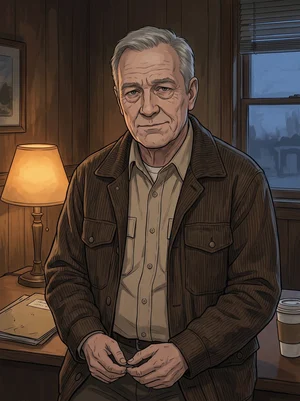
He was sixty-one, square, with a grey crew cut and reading glasses pushed up on his forehead that he never seemed to pull down. He’d been the face of the reopened investigation in season one, the sheriff who’d listened to a podcast and done the right thing. He’d been grateful to me. He’d been on a panel with me in Milwaukee.
In his office, Ray Sund was sitting in the visitor’s chair with a cup of coffee and a powdered doughnut, laughing about something. He stood up when I came in.
“Hollywood! You want me to clear out?”
“Sit, Ray,” Lyle said. “It’s a free country, she won’t be long.” To me: “Ray’s here about the county tow contract. We fish Thursdays, we do business Tuesdays. Small town. What can I do for you?”
I told him. Not everything. I told him about the cards, and I showed him the photos on my phone, all three, and I asked him whether anyone had ever looked for Britt’s bag beyond the edge of the reservoir.
He looked at the photos the way a man looks at something he’s already decided about.
“Tekla,” he said, “your sister had a blood alcohol of point one one and she went in the water in the dark. I’m sorry. I knew her. Everybody knew her. But the reservoir’s forty feet deep at the intake, and it keeps things. We dragged what we could.”
“Somebody has her index cards.”
“Somebody has some index cards.” He handed my phone back. “The Ostrander girl’s been at this three years. She’s run a website, she’s run a petition, she’s put your face on a sign with blood money written on it. Now she’s running a séance.”
“It’s not Krista.”
“How do you know?”
I didn’t have an answer that would survive his office. Because she went still. Because she can’t forge permission slips.
“Amber what?” Ray said. He’d been leaning over to look at the phone before Lyle handed it back. He was squinting at the last photo, the pump house card. “Amber alert?”
“I don’t know yet.”
“Well, if you want my professional opinion,” Ray said, and tapped his chest, “it’s somebody who’s seen too much TV.” He smiled at me, and the powdered sugar on his beard made him look like somebody’s grandfather in a Christmas ad. “Don’t let ’em run you around the county, kiddo.”
Lyle walked me out. At the door he said, not unkindly, “You came to me in 2022 with a story and I listened. Now you’ve got a different story. You see how that looks from my chair.”
“I see how it looks.”
“Good,” he said, and held the door.
I went to the marsh at dusk. I hadn’t been out there since the August Britt died, and I didn’t go near the reservoir now. I went to pump house three.
It sits at the south end of bed nine, a cinder-block shed the size of a single garage, with a corrugated roof and a big intake pipe running out of the reservoir side into a concrete canal with a steel slide gate. Bed nine was flooded for harvest. Five acres of black water, perfectly still, with the dike road running along its west side on a raised bank of sand.
Ray had built Callie’s bench in 2009. It faced the bed. Cedar, with a brass plaque: CALLIE ANN SUND, 1989–2008. SHE LOVED IT OUT HERE.
I sat on it. The light over the pump house door came on as the dusk thickened, buzzing first, then steadying. It was white. Not bluish, not pinkish. A hard sodium white that made the cinder blocks look like bone.
A white pickup came along the dike road and stopped, VANG MARSH on the door, an amber beacon bolted to the cab roof. Pete Vang got out. He was forty, three years older than Callie would have been, wearing hip waders and a face that had been up since four.
“Of course,” he said. “Of course it’s you.”
“Hi, Pete.”
“Your sister sat on that bench in July of last year. Same spot. Asked me what color that light was in 2008.” He jerked his chin at it. “I’ll tell you what I told her. White. Sodium. It’s been white since my grandfather.”
“What’s amber out here?”
He looked at me like I’d asked what was wet. Then his eyes went to his own roof, and something in his face shut, like a gate. “Beacons. Half the county runs amber after dark. Plow trucks. The co-op’s service rigs. Ray Sund’s wrecker. Ours.”
“Was yours out here that night?”
“Was mine.” He laughed with nothing in it. “I was twenty-two. I worked the office with her that fall; she did the books and I did whatever my dad yelled. I’m the one who found her, Tekla. Seven-fifty in the morning, down that bank, in waders like these. Lyle sat me in a squad car for three hours because I cried too much for a guy who was just her coworker. You had it in episode two. About ninety seconds, before you moved on to the boyfriend.”
I had. I’d cut him down from twelve minutes. He’d been dull on tape: too sad, no shape.
“Where were you at twenty to one?”
“In bed. Alone. Which is what I told Lyle, and what your sister wrote in her little book in July, and a month later she was face down in my reservoir.” He pulled the pickup door open. “So you’ll understand I’m not wild about bench conversations. And don’t park on the shoulder by nine when we’ve got it flooded. That sand’s soup in October. I had a co-op semi sink to the axles there in ’19. Took Ray two hours with the winch to get it out. Ray’s had our pump contract since the nineties; he knows that shoulder better than I do.”
He drove off with the beacon dark. I wrote three words in my notebook, under the pump house card: PETE. Amber. Office. Then I looked at them for a while and didn’t cross anything out.
At ten, back at the Tamarack, Bev looked up from her crossword as I passed the office window and called out, “Ray fixed my ice machine Friday, hon. Should be quieter.”
It wasn’t. It shrieked as I unlocked fourteen.
I’d left the cards in a manila folder on the desk, under Britt’s notebook, because I hadn’t wanted them in my coat in the wet. The notebook was still there. The folder was still there, squared to the edge of the desk, the way I’d left it.
The folder was empty.
My laptop was on the bed where I’d left it, untouched. My bag of tape drives was on the chair. The door had been locked. There was no mark on the frame. Whoever had come in had used a key, and taken only the three cards, and squared the empty folder neatly to the edge of the desk so I would know they had.
What did you think?