I didn’t call the sheriff about room fourteen. I’d sat in his office eleven hours earlier and watched him decide I was a woman being haunted by a Dari-Freeze manager. I called Bev instead, at ten-fifteen at night, and she came down the walkway in a housecoat with the cat under her arm.
“Nobody’s been at my keys,” she said, and then looked at the hooks behind the desk, the forty little brass hooks with their forty plastic diamonds, and the stool beside them, and the door to the back room where she watched her programs with the volume up because of her hearing. “Well,” she said. “Anybody could, I suppose. It’s not Fort Knox. It’s the Tamarack.”
I slept with the desk chair wedged under the doorknob, which I’d seen in movies and which turned out to work mostly as an alarm clock. I lay awake and made lists. Who knew I had the cards: Krista, Desmond, Denise, Ray, Lyle Brandvold, Bev, Carol from the box office. Who knew where I was staying: all of them. Who’d want them back: whoever had the rest of the board.
At four in the morning I stopped making lists and started thinking about card two-three, the one nobody sent. Episode three. Between Rhonda and the pump house. Whoever had the board had read it and decided I shouldn’t have it.
My mother is best in the mornings. The nurses call evenings sundowning; mornings don’t have a name, but they should. At eight, before breakfast trays, before the TV in the dayroom gets turned to the game shows, she’s sometimes almost entirely there, like a radio station that comes in clear for an hour before the weather changes.
Denise wasn’t on. A young aide named Kayleigh was doing the morning round, and she smiled at me and said Inga’d had a good night and pointed me down the hall.
My mother was sitting by her window in her blue cardigan, looking at the parking lot.
“Tekla,” she said. “You’re early.”
She knew me. I sat down on the bed and held her hand, which smelled of lavender, and I made myself not ask anything for a while. We talked about the weather. She told me the girl in the next room had a parakeet that said Jesus loves you and also something filthy. She laughed. She had a good laugh. Britt got it from her.
“Mom,” I said. “I want to ask you about a night a long time ago.”
“All right.”
“The night Callie Sund died. October of 2008. Do you remember?”
She looked at me. The radio station held.
“You were sick on the porch,” she said.
I didn’t move.
“All down the steps. I came out in my robe. I thought someone was hurt. Your father slept through it, thank God, he had those pills for his back that year, he’d have taken your head off.” She frowned, not at me, at the memory, as if it were a stain. “And there was that boy’s truck in the yard. The Ostrander boy. With the white back end on it. Right up by the porch, with the lights still on. And Britt behind the wheel.”
“Britt.”
“Fifteen years old. I nearly died. She had the seat pulled all the way up so she could reach, she looked like a little girl playing at driving. She got out and she said, Mama, Tekla couldn’t walk. She couldn’t walk, Mama, what was I supposed to do, leave her?” My mother’s voice did something on Britt’s words, went younger and more urgent, an imitation she didn’t know she was doing. “And I got you inside. You were so heavy. And she stood in the kitchen and she made me promise.”
“Promise what?”
“Don’t tell Daddy. He’d have killed her. Driving without a license, a stolen truck.” She shook her head. “And don’t tell Tekla.”
“Why not tell me?”
“She said you’d feel so bad.” My mother smiled at me, a little sadly, as if I were someone she’d been told about. “She always worried about you. You never knew that. You thought it was the other way around.”
My hand was still on hers. I didn’t know when I’d started gripping it.
“Then what happened?”
“She took it back. The truck. She said she had to, it was his, it wasn’t fair. I stood on the porch and watched the lights go up the dike road. Then I waited up. She came home walking, after one. Her shoes were all wet.” She paused. “She was very quiet. I thought she was scared of getting caught. She went straight to bed. In the morning they found the Sund girl, and she never said a word about any of it, and I never asked her.” She looked at the window, at the cars, at nothing. “I should have asked her.”
The radio station began to go. I watched it happen. It doesn’t happen all at once; it happens the way water goes out of a bath, quietly, and then there’s just the shape of where it was.
“Is she back yet?” my mother said.
“Who, Mom?”
“Britt. She’s been gone so long. She took the truck back hours ago.”
The Moen farm sits two and a half miles south of the sand pit on Dike Road. We sold it in 2019, after Dad. A Hmong family named Thao bought it and put up a greenhouse where the machine shed used to be and painted the porch a cheerful green. I parked on the road and didn’t go up the driveway. A kid’s bike lay on its side in the yard.
The porch had four steps. I’d never thought about the porch having four steps.
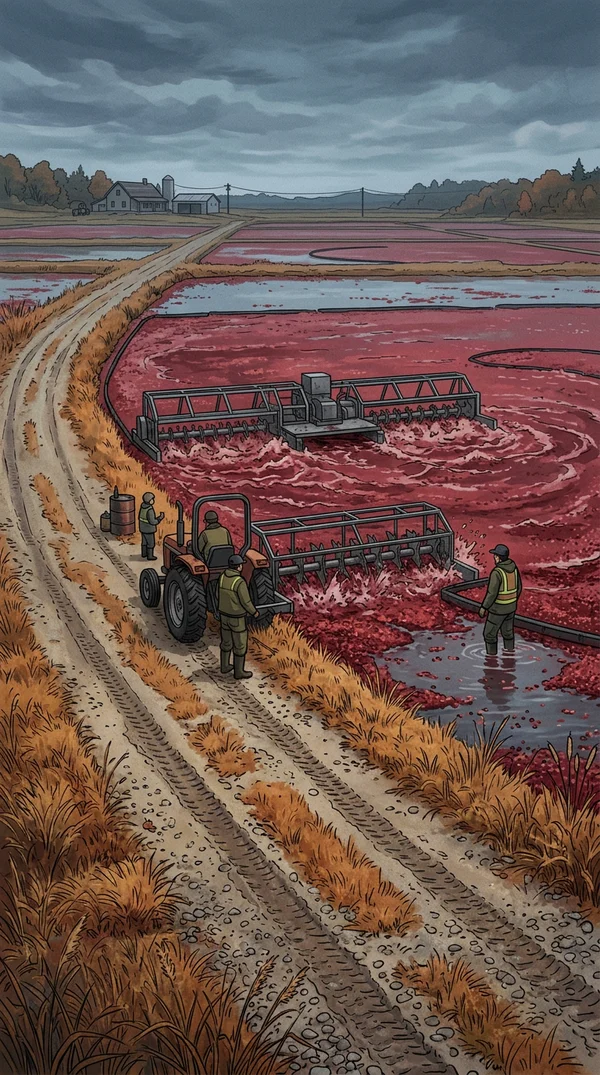
I drove to the sand pit at the north end of the marsh and turned around in the turnout where the bonfires used to be, where Wes had parked in 2008. I zeroed the trip meter and drove south on Dike Road at the speed a frightened fifteen-year-old with a six-day-old learner’s permit might drive a borrowed truck in the dark.
Past bed two. Past bed three. Past the culvert at bed four, where the road jogs, where Rhonda’s log put a blue Ford with a white tailgate at 11:40, heading south. Past bed nine on the left, flooded and black even in daylight, and the pump house turnoff, a short lane to the cinder-block shed and Callie’s bench. Past the reservoir, the long silver flat of it, which I didn’t look at. On to the farm. Two point five miles. Six minutes, at that speed.

 100 to start reading with.
What did you think?