I told Desmond at seven-thirty on Thursday morning, in the Opera House green room, with the mini fridge humming and the complimentary mints untouched between us. I told him the way I’d have told it on air: in order, with the evidence first and the feeling last. Rhonda’s small driver. The seat. My mother on the porch. The six minutes from the sand pit to the farm. The cold window.
He didn’t interrupt. Desmond interrupts everyone; it’s how he shows love. He sat on the counter with his coffee going cold and let me talk for twenty minutes without once saying okay, so.
When I finished, he put the coffee down.
“I’m sorry,” he said. “About Britt. About all of it. I mean that.”
“I know.”
“And I need you to hear me say the next thing as your friend, and not as the person who signs your checks, even though I’m also that.” He rubbed his face with both hands. “Tekla. Host discovers she’s the witness. The evidence that convicted the man was her own ride home, and her dead sister was driving. That isn’t a season. That’s the season. That’s the one they teach.”
I didn’t say anything. I’d known he would say it. What I hadn’t known was that I’d been waiting for him to, the way you wait for someone else to say the thing you’re ashamed of thinking, so you can be the one who looks shocked.
“I’m going to Wes’s lawyer,” I said. “Today. I emailed her at six.”
“Good. Do that. Of course do that.” He held up his hands. “And the lawyer will take a month to file and the state six months to respond, and Wes sits in Kettle River either way, and the live show is Saturday. Both things can be true. If you don’t tell it, somebody else will, and they’ll tell it about you.”
“Four hundred people in velvet seats. The streamer in the front row.”
“And you walk out and you say, I got it wrong, and here’s how, and here’s who. You’ve never been better than you’d be on Saturday.” He meant it as a compliment. That was the worst part. It landed as one.
“Cut me something,” I said. “A cold open. Just so I can hear it.”
“I can do that.”
“Don’t post it. Don’t show it to the streamer. Don’t show it to anyone.”
“Never without you,” he said. “You know that.”
I did know that. I’d have said it under oath.
Paula Greer called back at eight-forty. Wes’s new lawyer ran the innocence clinic at the law school in Madison, and she had the voice of a woman who’d been lied to by better liars than me and had stopped taking it personally.
“Ms. Moen. Your email is the strangest thing in my inbox this year, and I have a client who claims a goat ate his alibi.”
I told her. Shorter this time, and worse, with no Desmond nodding along.
“Okay,” she said, when I stopped. “Here’s what you’re going to do. You’re going to write it down. All of it, in order, what you know and how you know it, and what you only think. You’re going to sign it and date it. You’re not going to post it, tweet it, talk about it on a stage, or put it in a podcast. Do you understand why?”
“Because it’s evidence.”
“Because the minute it’s content, the State gets to call it content. They’ll say you’re building a season two, and they’ll be right, and a judge will read your affidavit like a press release.” Paper moved on her end. “I need you boring. Can you be boring?”
“I don’t know.”
“Learn,” she said. “I’ll be in Pellam Monday. Don’t lose anything.”
I said I wouldn’t. I’d already lost three cards. I didn’t mention them, and I added that to the list of things to feel bad about later, which was getting to be a long list.
At nine, Ray called.
“Denise hears you were up at the Home yesterday looking like the wrath of God,” he said. “Her words. I’m paraphrasing, she’d never say wrath.”
“I’m fine, Ray.”
“You’re not fine, kiddo, you’re getting index cards. Listen. I drove every road in the county that night. You want to know who was where, you ask the guy who drove it. Let me take you out. Maybe something shakes loose.”
He was right that he knew the roads. I had PETE written in my notebook and nothing under it, and a note on my phone that said AMBER: who ran beacons at the marsh in 08? Pete had said half the county. Ray would know which half. And I wanted, more than I’d wanted anything in days, to ask somebody a question who wasn’t going to look at me like I was the question.
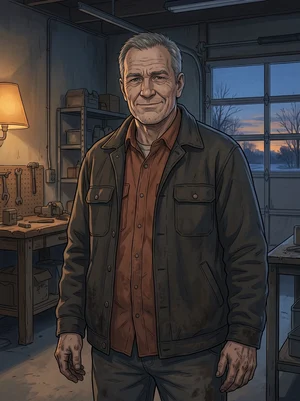
He picked me up outside the Tamarack in the wrecker. The cab was warm and smelled of coffee and orange hand cleaner. A rosary hung from the mirror. Clipped to the dash was a ledger, green cloth cover, a pencil tied to it with string.
“This year’s book,” he said, seeing me look. “The old ones are in the shop. Every hook since ’85.”

 100 to start reading with.
What did you think?