The Shoulder, chapter 3 of Caught on the Kiss Cam
The MRI was at seven in the morning at an imaging place on State Line Road, and Colt came out of it with the gown still on under his jacket and a printout of the films in a folder.
“Rao’s got them,” he said. “He’s read them.”
“And?”
“And it’s what he said it was.”
We sat in my car in the lot with the engine going and the air on, because it was the third of September and already eighty degrees at seven, and the hatchback has a hole in the floor that lets the heat of the road in.
“Show me,” I said.
He gave me the folder. I am not a radiologist and I am not going to pretend to be, but a labral tear on a sagittal cut is a thing you can see once somebody has shown you one, and Rao had shown me one in the spring on a different player. There it was: a black line through the white of the cartilage at the front of the joint, longer than it should be, with the fluid tracking under it.
Three months of that, under my hands, while I worked a strain.
I put the folder down.
“Brace,” I said.
“Leigh.”
“Brace, and you’re going to hate it for two weeks and then you’ll forget it’s on, and the first time you throw a deep out in a game you’ll be glad of it.”
“You’ve fitted one before.”
“Twice.” I put the car in gear. “The shoulder brace is a harness. It holds the head of the bone back at the end of the throw, and it has a stop with two settings. Setting one takes about nine degrees off your range. Setting two gives you four of them back. Rao and I start you on one and nobody moves it but me.”
Colt looked out the window.
“Nine degrees,” he said.
“Nine degrees at the end of the range. You won’t lose the flat and you won’t lose the crossers. You’ll lose about four yards on the deep ball and you’ll get used to throwing it earlier.”
“Four yards is a pick.”
“Four yards is a pick if you throw it late, and you’re thirty-six and you’ve been throwing late for fourteen years, so it’s two weeks of work.”
He put his head back against the seat.
“You’re still angry,” he said.
“About June? Yes.”
“Good,” he said, which I had not expected. “I’d rather you were angry than polite. Polite’s what you are with Monty.”
I drove the rest of the way with that sitting in the cab between us like a third passenger.
The brace is a black harness with straps that go under the opposite arm and across the back. Fitting it properly takes twenty minutes and involves a man’s shirt being off and a lot of small adjustments while he holds his arm in positions and says “tighter” and “that’s too tight” and “it’s pulling at the front.”
We did it in the treatment room with the door shut, on a Thursday morning when the rest of the team was on the field.
I have fitted braces on a hundred men. I have had my hands on more backs than a masseuse and I do not notice them, which is the job.
I noticed his.
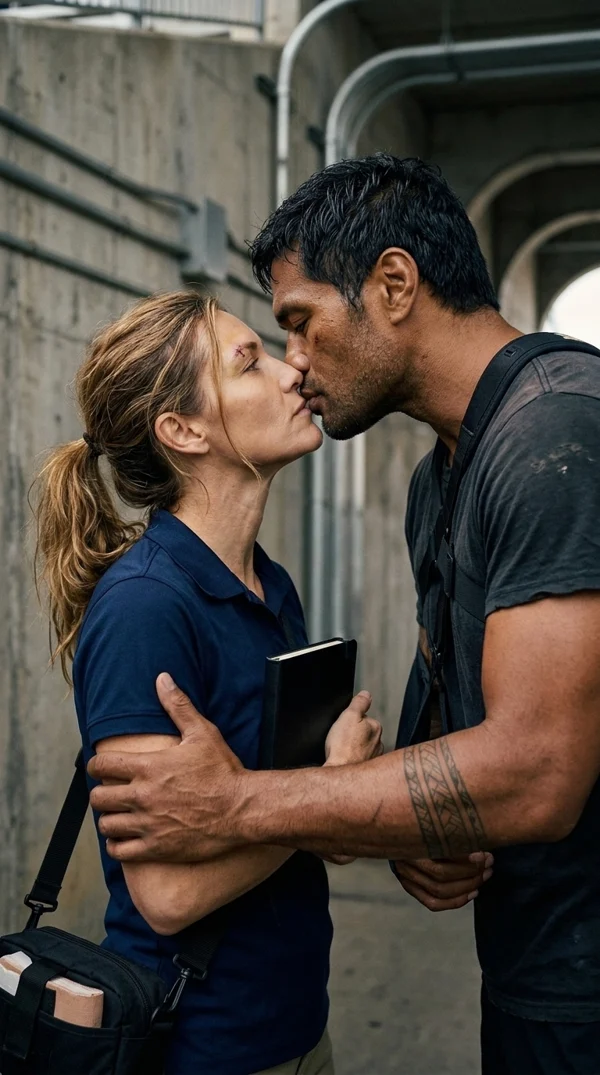
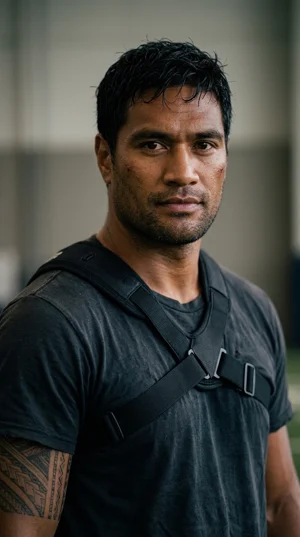
It was the stillness. He stood with his arms out and his head down and let me work the strap under his left arm, below the band of Samoan lines he has worn around it since he was twenty-two, and across the long muscle beside the spine, and every time my fingers went under the webbing to check the tension his breathing changed, and then he put it back the way it had been, deliberately, like a man setting a weight down.
“Too tight?” I said.
“No.”
“Then stop doing that.”
“Doing what?”
“Breathing like that.”
He turned his head a few degrees, not enough to look at me. “I’m standing in a room with my shirt off and your hands on me,” he said. “I’m doing well, considering.”
I finished the strap. My face was hot and the room was not.
“Lift,” I said.
He lifted.
“Higher.”
“Can’t.”
“Higher or you’ll never get it over the top.”
He got it about six inches higher and stopped, and the harness held, and the joint came to its end and stayed there instead of sliding.
“There,” I said. “That’s your new ceiling. Now throw.”
We went out to the indoor field, because the indoor field has a net.
He threw for eleven minutes. Short stuff first, then the outs, then three deep balls.
The first two deep balls died in the air. The third one carried, and it carried because he had thrown it a beat earlier, before the break instead of on it.
“Again,” I said.
“That one was good.”
“It was good because you changed your feet. Do it again and keep your feet.”
He did it again and it was good again, and the fourth one was better, and then his shoulder went and he put his hand on his hip and breathed.
“That’s it,” I said. “Ice.”
“One more.”
“One more, and then ice, and if it’s a duck we’re still going in.”
It was not a duck. It was not a rope either. It landed about where a good high school player puts it and Colt watched it land and did not say anything, and I understood that we had both just done the arithmetic about what a high school ball looked like on a professional field.
The book is a hardback notebook, black, five by eight, from the stationery store on 47th, and it cost eleven dollars.
I glued the copy of the signed page inside the front cover so that anybody who ever opened it would read the terms before they read a word of mine. Then I wrote the first entry at the desk in the office at 12:40 on the third of September.
R shoulder, labral, anterior. MRI 9/3, reviewed Rao 9/3, confirms 9/2 exam. Pain at end range, click. Brace fitted 9/3, stop at setting 1. Throwing: 11 min, 4 deep, 2 died, 2 carried with early release. Ice 20. Chart entry 9/2 stands.
Then the date, the time, my initials, and the page number.
Rao came in at one and read it over my shoulder and did not touch it.
“You’re keeping a log as well as the chart,” he said.
“The chart’s the record. The book’s the day. Every measurement, every throw, every time he says it hurts. I’ll put the summary in the chart and the chart will say the log exists.”
“Then here’s my one piece of advice.” He sat on the corner of the desk. “The two must never disagree. Not by a word. The day your book says something the chart doesn’t, the book stops being a log and becomes a second story, and in three years a lawyer will ask you which one is true.”
“They’ll say the same thing.”
“See that they do.” He took his glasses off and cleaned them on his sleeve. “And the other thing, which you already know. You’ve made yourself the keeper of a date. On the twenty-sixth of October, or sooner, you’ll walk upstairs with a page and put it in front of Delia, and she’ll do the subtraction in her head and count every day of it, and she’ll look at you and not at him.”
“I know.”
“I know you know. I’m saying it out loud so that you heard somebody say it.” He put the glasses on. “Get his initials on the bottom of every page. Not because it protects you. Because it means he reads it.”
I got his initials at the bottom of the page at ten past one. Colt came in from the field and read it, all of it, slowly, and signed it, and looked at me.
“How long do we do this?”
“Till the season ends or till you can’t. Whichever.”
“And then?”
“And then the surgery in February and the rehab somewhere warm and you’re back for camp in July, or you’re not, and either way this is the record of what you were told and when.”
He capped the pen.
“Thank you,” he said.
“Don’t thank me yet.”
By Friday the thing was in the building in the way things get into buildings.
Nate Okoye had seen the harness and asked Colt what it was, and Colt had said “back thing”, which is the answer of a man who has been asked a question in a corridor and not thought about the answer. By lunch it was a shoulder. By three it was a shoulder that would need surgery “after the season”, which was true and was not on any sheet that left the medical room.
The brace went on the team’s account at three hundred and forty dollars, and the invoice went to the medical budget, and the medical budget is Delia’s, and Delia signed it without a word, which is how a team puts money into a shoulder it intends to use.
Kosar stopped me by the field door.
“Leigh. Is he going to last the season?”
Walt Kosar is fifty-eight and has been coaching for thirty years and has the shoulders of a man who used to play the line and the patience of a man who no longer does.
“He’s going to play Saturday,” I said. “He doesn’t throw on Wednesdays from now on. Twelve deep balls a week in practice, no more, and he gets ten minutes of treatment at halftime of every game, and if I tell you he’s done for the day he’s done for the day. It’s all on the sheet.”
“That’s a lot of rules for a bruise.”
“It’s the right number of rules for that shoulder.”
“That’s not what I asked.” He looked at me. “Would you play him if he was your own money?”
“On Saturday, yes.”
“In November?”
“Ask me in November.”
He grunted and went in.
I stood on the field apron with the tape bag and the sun on the concrete, and understood, in a way I had not twenty minutes earlier, that phrase in every team’s medical policy, the one that starts the athletic trainer may be required to: required to make the call, required to write it down, required to be the one who answers for it.
And underneath it, in a building where my husband ran the messaging and the owner’s daughter ran the events, there was no version of the season where the two things did not interlock.
The away game was Saturday. Denver was a dome and a good defense and a two-hour charter, and Colt Malloy was going to play in it with a torn labrum and a harness and a book, and only two people under that roof knew all of it, and one of them was a doctor who went home at six.
He walked past on his way in and said, “Nine degrees,” and I said, “Nine degrees,” and he said, “Denver won’t know the difference,” and went in.
It was not funny and I laughed.
What did you think?