You'll Be Fine, chapter 1 of Claimed by My Father's Best Friend
Javi took the couch, the bed, the dishes, the good knife, and the dog.
I came home from a twelve-hour shift at the shipyard on a Friday in June, and our apartment in North Park was a white box with my clothes in a heap where the dresser used to be. He’d left the hangers. He’d left a Post-it, too, stuck to the wall where the fridge had been, because he’d taken the fridge.
You’ll be fine. You always are. —J
Five years. I was twenty-nine. I’d paid the deposit, the lease was in my name, and he had taken Pepper, who was my dog long before she was ever his.
I sat on the floor because there was nowhere else to sit. I called him eleven times. On the twelfth, a woman answered, laughing, said, “He’s driving,” and hung up.
So I did the stupidest thing I could have done. I called my father.
Dad was in Phoenix at a reunion. He said, “Stay put,” in his old captain’s voice, and forty minutes later a black pickup with a flatbed trailer pulled up outside, and Jack Maddox got out.
My father’s best friend. They’d done twenty years in the Navy together. Jack had been at sea or overseas for most of my childhood; I’d met him maybe a dozen times since I was grown, at barbecues and at my mother’s funeral, and every time he’d called me “kid” and I’d wanted to throw something at him.
He stood in my empty doorway, forty-nine years old and too big for it, and looked at the hangers and the Post-it and me on the floor in my work boots.
He didn’t call me kid.
“Get your things,” he said. “You’re coming home with me.”
“I’m fine,” I said.
It came out of me the way a bilge pump comes on, automatically, at a certain water level. I’d been saying it since I was eight. I’d said it at my mother’s bedside and at her grave and at every performance review I’d ever had, and I said it now, sitting on bare carpet with the imprint of a couch still pressed into it, four rectangles where the feet had been.
Jack looked at the four rectangles. Then he looked at me.
“You keep saying that,” he said. “I heard you say it to your dad. I could hear it through his phone.”
“Then you know.”
“I know you said it.”
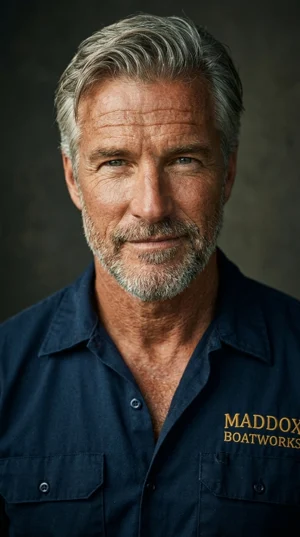
He came in. It was strange to see him inside the apartment, because the apartment had been built for people of a normal size and Jack was not one. He was six foot five and broad through the chest the way old sailors get, the kind of wide that comes from hauling things rather than lifting them in a gym, and his hair had gone gray at the sides since my mother’s funeral. He wore jeans and a navy work shirt with MADDOX BOATWORKS stitched small over the pocket, and he moved through my empty living room like he was checking a compartment for damage. Window. Closet. The kitchen, where there was a clean square on the linoleum and a coil of wire where the fridge had been unplugged and the ice line cut.
He crouched and looked at the cut line.
“He capped it,” he said. “Small mercies.”
“He was always good with his hands,” I said, and then heard it, and wanted to put my head in the oven, except he’d taken that too. No. The oven was built in. He’d left the oven.
Jack didn’t laugh. He stood up and looked at the Post-it on the wall, at eye level for him, low for me, which meant Javi had stooped to put it there. I don’t know why that was the part that got me. That he’d bent down to make sure I’d see it.
“Where’s Pepper?” Jack said.
I stared at him.
“Your dog,” he said. “Black and white. One ear up. She stole a rib off your dad’s grill at the Fourth of July and he chased her round the yard with the tongs.”
That had been three summers ago. I’d forgotten it. He hadn’t.
“He took her,” I said, and my voice did something I didn’t give it permission to do, so I stopped talking and looked at my boots.
Jack nodded once, like I’d confirmed a heading. Then he went out to the truck and came back with a box of black contractor bags and started packing my life.
He was fast. I’d forgotten that about Navy men, or maybe I’d never known it, because my father had always had someone to pack for him: first the Navy, then my mother, then me. Jack shook a bag open with one snap and did my clothes in four minutes. He didn’t fold them and he didn’t throw them. He laid them in flat, the way you’d stow line, and tied each bag off with a knot I couldn’t have untied with a marlinspike. He didn’t ask what was mine. There was nothing in the apartment that wasn’t.
I got up because I couldn’t stand to be on the floor while a man did my work, and I grabbed a fistful of hangers from the heap, and one of the cheap wire hooks went straight into the meat of my palm.
I didn’t make a sound. I’m proud of that, in a stupid way. I just stood there holding the hangers with blood running down my wrist into my sleeve, thinking, of course.
Jack took the hangers out of my hand. He turned my palm up into the light and looked at it, and his face did nothing at all, and then he went to the truck again and came back with a clean shop rag, the red kind they sell by the box, and wrapped it around my hand and tucked the end under so it held.
“Pressure,” he said, and pressed my other hand over it.
His hands were enormous and scarred and very gentle. The skin on the back of his left forearm was slick and shiny in a long patch from wrist to elbow, an old burn, the kind of thing I’d noticed at barbecues and never asked about. I looked at it now because I couldn’t look at his face.
“Hangers too?” he said.
“Yes,” I said. “The hangers too.”
It made no sense. They were a dollar for ten at the drugstore on University. But he’d left them like he was leaving me something, and I wasn’t going to give him that.
The last thing I took was the Post-it. I peeled it off the wall carefully, so the paint didn’t come with it, and put it in the back pocket of my work pants.
Jack watched me do it and didn’t ask.
He drove the way I’d always imagined he’d drive, which was like he had nowhere to be and every right to be there. We went down the 5 with the trailer rattling empty behind us, because there’d been nothing to put on it, and then up onto the Coronado Bridge.
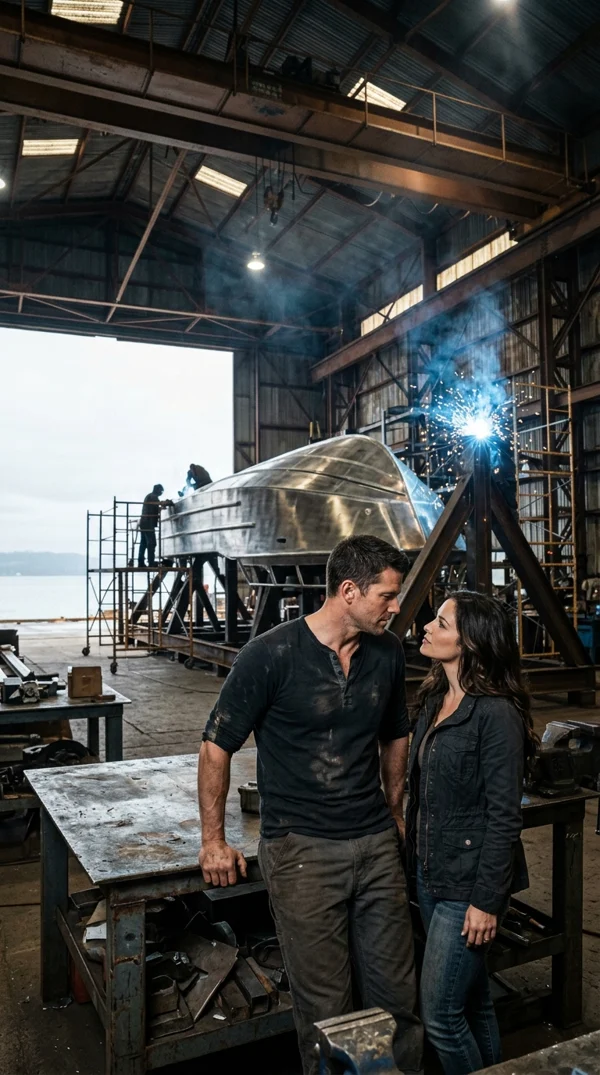
I’d crossed that bridge a thousand times, and I still couldn’t do it without looking. It goes up in a long curve, higher than you think a road should, two hundred feet over the water so the Navy can get its ships under, and at the top the whole bay opens on your right like a dark hand with rings on it. Downtown lit up. The shipyards below, where I’d spent the last twelve hours of my life, cranes standing over the dry dock like herons. Out past Coronado, at North Island, a carrier at the pier with her flight deck lights on, a gray city with its own weather.
“Dad’s in Phoenix,” I said, to say something.
“I know.”
“He didn’t have to send you.”
“He didn’t send me.” Jack changed lanes for the Coronado exit without signaling, because there was nobody else on the road. “He called me. I came.”
“Same thing.”
“No,” he said. “It’s not.”
Jack lived on the bay side of Coronado, on a street that ran out to the water and stopped. His house was gray-shingled and long and low, older than its neighbors, with a wooden gate and a jacaranda that had dropped so many purple flowers on the drive that the truck’s tires made a wet whisper going over them. When he cut the engine, I could hear water. Small slaps against pilings. A halyard clinking somewhere. The air smelled of salt and cut grass and, faintly, of varnish.
Past the house, at the end of the yard, a dock ran out into the black, and there was a boat tied to it. Wooden, I could tell even in the dark. Low and lovely, with a little pilothouse and a long, honest sheer, the kind of line you don’t see anymore because nobody wants to pay for it.
“You built that,” I said.
“Restored her. She was built in 1961. Somebody’d left her to sink in Alameda.” He took two of my bags in each hand like they weighed nothing. “Good Holding.”
“That’s an anchoring term.”
“It is.”
“It means the bottom grips. It means you won’t drag.”
He looked at me over the bags, and for a second I thought he was going to say smart kid. He didn’t.
“That’s what it means,” he said.
The guest room was at the end of the hall, with a big white bed and a window onto the water, and he put my bags on the floor and a glass of water on the nightstand and a gray T-shirt of his on the pillow, folded square. He showed me the bathroom, the towels, the lock on my door.
“It locks from your side,” he said. “There’s coffee in the morning. Three sugars.”
I’d turned to say goodnight. I stopped.
“How do you know how I take my coffee?”
“Your mother’s funeral,” he said. “You hadn’t eaten all day. I brought you a plate and a coffee, and you put three sugars in it and didn’t touch the plate.”
Four years ago. I remembered a plate appearing in my hands at the reception, a big hand taking it back an hour later, untouched, and the coffee gone. I hadn’t known whose hand.
“Goodnight, Lucia,” he said, and shut the door.
Nobody calls me Lucia. My mother did, when I was in trouble. Everyone else says Lu.
I lasted until two.
I lay in his shirt in his guest bed and listened to the water and did the thing I do with a bad hull, which is find the failure. Where it started. What load came on that the structure wasn’t built for. I went back five years and found nothing, and then found everything, every time Javi said you’re so together, babe in a voice that meant you don’t need me to try. The cut on my palm throbbed under the rag. The Post-it was in my work pants on the floor, and I could feel it there, like a splinter.
At two I gave up and went down the hall in my socks.
The back door was open. Jack was sitting on the step in the dark with a mug in his hands, looking at the water. He didn’t turn around.
“Couldn’t sleep,” I said.
“No.”
I sat down on the step beside him, not close. The concrete was cold through his T-shirt and my underwear, and I thought, briefly and with total clarity, I am sitting next to my father’s best friend in his shirt and almost nothing else, and then I thought, who cares, I’ve had a day.
My phone buzzed against my thigh.
I knew before I looked. You always know.
need my half of the deposit. $1400. venmo by monday or I keep pepper. K says shes growing on her
I read it twice. Then I just held it, lit up in my hand, K says shes growing on her, and I couldn’t make my face do anything at all.
Jack had read it over my shoulder. I knew because the mug had stopped halfway to his mouth, and stayed there.
He set it down on the step. Very carefully, the way you set something down when the alternative is throwing it.
“Tell him where you are,” he said. “Tell him to come and say it to my face.”

What did you think?