She's With Me Now, chapter 2 of Claimed by My Father's Best Friend
I sent Javi the address at 2:14 in the morning, with Jack watching me type it, and then I turned the phone face down on the step and went to bed and slept nine hours like someone had hit me with a shovel.
When I woke up, the window was white. June gloom, the marine layer sitting on the bay like a lid, the water underneath it the color of a nickel. For one second I didn’t know where I was, and it was the best second I’d had in a day.
Then my hand throbbed, and I knew.
I found Jack in the kitchen, which was big and plain and clearly cooked in: a gas range with a scorched kettle, a butcher-block counter sanded pale, a window over the sink that looked straight down the dock to Good Holding. He was making eggs. There was a mug at the end of the counter with a spoon standing up in it.
“Three,” he said, without turning around.
I drank it standing. It was too sweet and exactly right, and I had to look out of the window for a minute.
“Sit,” he said, and I sat on a stool at the counter, and he put eggs and a tortilla in front of me and then, without asking, took my left hand and turned it palm up and unwrapped the shop rag.
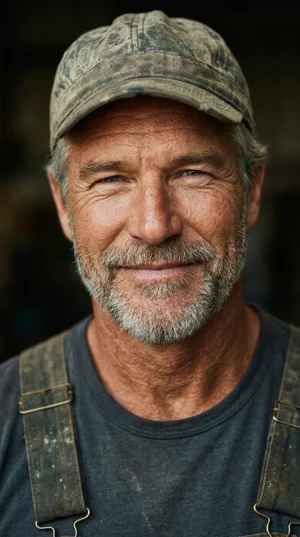
It had stuck. He wet a clean towel at the tap and held it on the rag until it let go, and the whole time he was silent, and I watched the top of his head because there was nowhere else to look. The gray went further back than I’d thought. He smelled of soap and coffee and, under that, something metallic, like the inside of a toolbox.
“Should’ve had a stitch,” he said.
“It’s fine.”
His eyes came up. Gray-green, the color of the bay right now, under the lid. He didn’t say anything about the word. He just held my look until I was the one who dropped it, and then he cleaned the cut with something that stung like a wasp and closed it with two butterfly strips and a gauze pad and tape, and his thumb rested on the inside of my wrist the whole time, light, keeping my hand where he wanted it.
It was the first time he’d touched me on purpose. I don’t mean the rag last night, which was first aid. I mean this. A thumb on the inside of my wrist where the skin is thin, keeping still.
I ate my eggs very fast afterwards.
Dad called at nine-thirty from a hotel in Scottsdale. I could hear a breakfast buffet behind him and men’s voices, the particular volume of retired officers who have been told for thirty years that everyone can hear them.
“Jack’s got you?”
“He’s got me.”
“Good. Good.” A pause. A fork against a plate. “I’m sorry, mija. I never liked him. I always said.”
He’d never said. He’d watched football with Javi every Sunday for five years and called him son.
“I know,” I said.
“I’ll be home a week from Monday. You stay with Jack, he’s got that big place. You’ll be fine.” Somebody laughed near him and he laughed with them, away from the phone, and came back. “You always land on your feet. You’re my rock.”
“Okay, Dad.”
When I hung up, Jack was drying the frying pan. He’d been drying it for a while. It was very dry.
“Is he coming home?” he said.
“A week from Monday.” I put the phone down. “He says I’ll be fine.”
Jack hung the pan on its hook. He didn’t say anything, and the not saying was so loud I had to go and put my boots on.
He had to go to the yard, he said. Saturday crew. Did I want to come or did I want the house.
I’d been alone in an empty apartment for one night and that was enough of being alone in a place to last me. I went.
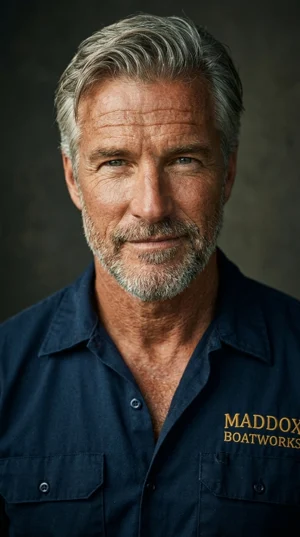
Maddox Boatworks was in National City, on the water south of the Navy base, at the end of a road lined with chain-link and boat trailers and a taco truck that seemed to be permanent. The sign was hand-painted, black on white, and needed doing again. Behind it, a big steel shed stood open to the bay at one end like a mouth, and inside, upside down on a jig of welded frames, was a boat.
I stopped walking.
She was a patrol boat, forty-two feet maybe, aluminum, built hull-up the way small yards do it so the welders can work downhand on the bottom plates. The plating was finished and gleaming soft gray under the shop lights, the chines sharp as a folded letter. Two men in hoods were working a seam on the transom, and the light off their torches jumped blue-white across the ceiling and the plate and the side of my face.
The smell hit me last. Hot metal. Ozone, the clean-electrical smell you get before a storm. Cutting oil. Coffee from a pot somebody had left on too long.
I’d spent six years in a shipyard that built ships the size of apartment blocks, where I mostly saw the steel on a screen. I’d forgotten that boats are made by people with their hands.
“Master Chief!” A short man in his sixties came out from under the hull wiping his palms on a rag. Gold tooth. Forearms like hams. “You brought company.”
“Ozzie, Lu. Lu’s Tom Delgado’s daughter. She designs ships.”
Ozzie looked at me with frank interest and then at Jack with frank interest, and I could see him add something up and decide to keep it.
“The Captain’s girl,” he said, and shook my good hand. “Your dad still cheat at dominoes?”
“Every time.”
“Good man.” He grinned at Jack. “Your architect still not answering?”
“He’s in Portland.”
“So, no.” Ozzie winked at me and went back under the boat.
Jack’s office was a box on stilts at the back of the shed, with windows on all sides so he could see the floor. There was a desk, a drafting table, a coffee maker, and a wall of drawings, and I walked straight to the wall the way a dog walks to a smell.
HARBORLINE FERRIES. HYBRID-ELECTRIC PASSENGER VESSEL, 86 FT. PRELIMINARY GENERAL ARRANGEMENT.
“You’re bidding Harborline,” I said.
“Bids close two weeks from yesterday.”
“We’re bidding Harborline.” I touched the corner of the sheet. “My yard. Pacific Basin. Kendall’s running it.” I heard myself say my yard, as if I owned the thing instead of the other way round.
“I know. They’ve got a hundred engineers.” Jack poured two coffees. “I had one. He took a job in Portland three weeks ago with my drawings half done.”
I wasn’t listening anymore. I was reading.
A monohull, eighty-six feet, a hundred and forty-nine passengers, which put her under the small-passenger rules by one seat. Diesel generators and a battery room for the electric running. The battery room was here. Aft of midships. On a flat with a floor that sat a foot and a half higher than I’d have put it, so the passenger cabin above could have a level deck.
I looked at the profile and then at the weight estimate taped beside it, and the hull in my head settled into the water fully loaded and sank by the stern, just a little, and leaned when I put the crowd on one rail, and leaned, and kept her righting arm the way a drunk keeps his balance: technically.
Not my boat, I told myself. Not my problem. I’d been at Jack’s house for fourteen hours. I wasn’t going to walk into his office and tell him his ferry was wrong.
“What,” he said.
“Nothing.” I turned around. “It’s nice. The cabin’s nice.”
He looked at me the way he’d looked at me in the kitchen, over my hand. Then he let it go, and I let my breath go, and neither of us mentioned it.
Javi came at five.
I was walking up the yard from the dock, where I’d been sitting on the end with my feet over the water pretending to read, and I heard a truck idling at the gate before I saw it. A gray Tacoma. I knew the sound of it. I’d known it come into a driveway at night for five years and known, from the sound, what kind of mood he was in.
He was out and standing at the bars of Jack’s gate in a white T-shirt and his good sunglasses. The passenger window was tinted black, and all I could see behind it was a woman’s hand on the sill with long nails, almond-shaped, the color of a peach, tapping.
“Lu.” He pushed the sunglasses up. Big smile. The smile was the worst part. “Hey. Babe. I didn’t know you knew anybody in Coronado.”
“You came for the money.”
“I came to talk.” He looked past me, up the drive, at the house, at the water, and I watched him do the math on the house. “Okay, yeah, and the deposit. I paid rent there too, Lu. That’s half mine. That’s just fair.”
“You’re not on the lease.”
“It’s the principle.”
“I paid the deposit. In 2021. From my checking account.” I could hear my voice coming out level and exact, the way it does in design reviews, and I hung onto that. “There’s no principle. There’s a bank statement.”
His jaw did something. Then the smile came back, softer, the one he did when he wanted me to feel bad for him.
“Okay. Okay, look.” He took his phone out and turned it round so I could see. “I didn’t want to do this.”
It was a photo of Pepper. She was lying on my couch. My blue couch, with the coffee stain on the left arm in the shape of Florida, in a room I’d never seen, white walls and a big window and a city view. She had her chin on her paws and her one ear up and she was looking at the camera with an expression I knew, which was where is she.
The breath went out of me like I’d been kicked.
“She’s registered to me,” Javi said. “The license is in my name.”
It wasn’t. I had the shelter papers in a folder in my car. I’d adopted her at twenty-two, alone, two years before I’d ever met him. But I couldn’t make my mouth say it. I was looking at the coffee stain shaped like Florida.
“Fourteen hundred,” Javi said gently, “and we can talk about Pepper.”
That was when Jack’s hand settled on the small of my back.
I hadn’t heard him come up behind me. A man that size shouldn’t be able to walk quietly on gravel, and he did it anyway. His palm was warm through my shirt, flat and still, low, where my spine curves in. He didn’t push. He just put it there, the way you’d put a hand on a hull to feel if the engine’s running.
Javi’s eyes went to the hand. Then up, a long way up, to Jack’s face.
“Oh,” he said. And then, because he couldn’t help it, because there’s always one more thing Javi can’t help, “Are you serious? Lu. He’s like sixty.”
“Forty-nine,” Jack said.
“Jesus. Does your dad know you’re—”
Jack took his hand off my back. I felt the cold where it had been. He walked down the last ten feet of the drive to the gate, unhurried, and stopped with the bars between them, and Javi, who is five foot ten and spends a lot of money at a gym in Hillcrest, took one step back from it without seeming to know he had.
Jack looked at him for a while. Not long. Long enough.
“She’s with me now,” he said. “Go.”
What did you think?