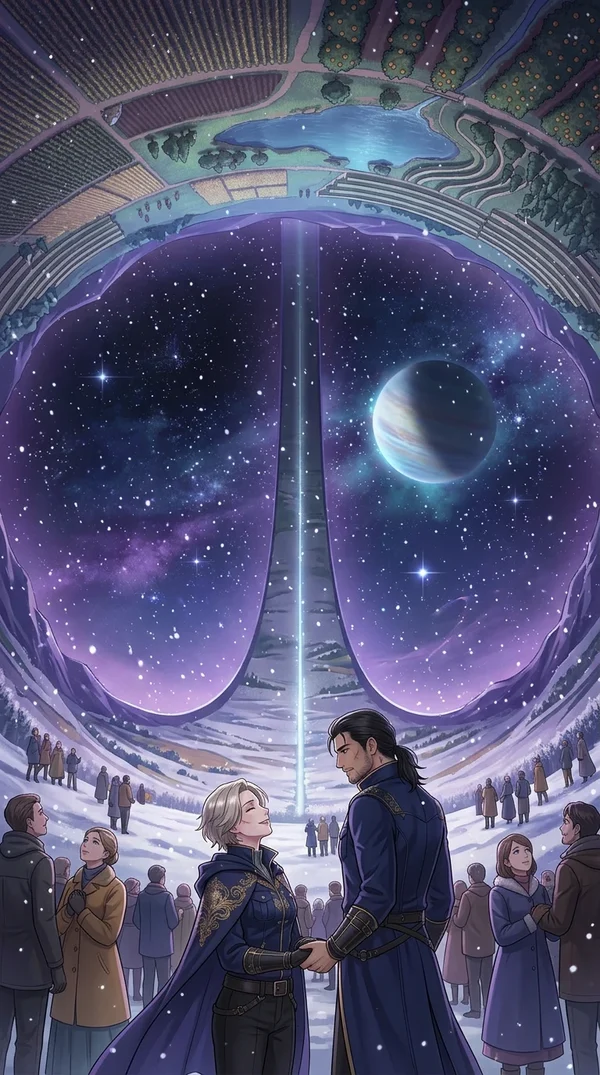
The Steward’s House stands at the top of Landing, just inside Founders’ Gate, a tall grey house with a brass bell and a garden that had been very fine once and was now mostly frost. Since the autumn Corin Vasko had lived in two rooms of it and the garden, by order of the council, with a Coldharbor fitter on the door who was there, Mina said, less to keep him in than to keep certain people out.
I was one of the certain people. The fitter was Benny’s cousin. He looked at my face and opened the door.
Vasko was in his sitting room by a small fire, in a cardigan, with a blanket over his knees and a pot of tea. He’d got old. Or I hadn’t looked at him properly in six years and he’d been getting old the whole time, while I was underneath the floor doing what he told me. He was sixty-four and he looked eighty. The Steward’s chain was gone from his neck. There was a pale line in his collar where it had sat.
He looked up when I came in, and I watched him understand why I’d come. It took about a second. He’d always been quick.
“Odessa,” he said.
“Where is it?”
He didn’t pretend. I’ll give him that, and I’ll give him nothing else. He put down his cup, folded the blanket and laid it on the arm of the chair, got up, crossed to the bookshelf, and took down a fat old copy of the Charter Code. The envelope was inside the back cover. “Mina’s wardens took my desk,” he said. “Nobody ever takes the Charter.” He held it for a moment in both hands, the way you’d hold a bird, and then he held it out to me.
My name on the front. Dess. In the small, neat capitals I walked past every morning on my chalkboard, on a line I hadn’t read.
It was sealed. The paper had gone the color of weak tea at the edges.
“I never opened it,” said Vasko. “I want you to know that.”
“Why would I care?”
“Because I didn’t need to,” he said. “He told me what was in it. He stood in this room at four in the morning on your wedding day with his bag on his shoulder and told me he’d written it all down, everything he’d found, the ice logs and the thing on the hull, because you had a right to know it. He said, ‘She’ll know what to do.’ He asked me to give it to you at the Gate, myself, before you set out.”
“And you didn’t.”
“And I didn’t.” He sat down again, slowly. “Dess, if you had read that letter at the Gate, you’d have walked straight up Stem One to the Hub and put it in front of the first Charter Office clerk you found. You’d have been right to. And the Office would have read our ice figures and pulled the Ring’s charter inside a season. Eighteen thousand people on haulers to habitats with no sky, and this,” he lifted a hand at the frost in his garden, the curve of Landing climbing away into the cold beyond it, “gone. For a flower on the hull that nobody had ever seen open. I didn’t believe in the flower. I believed in the charter.”
“You stood the hull crew down the next year.”
“So nobody else would find it. Yes.”
“You let me stand there till noon.”
“I thought,” said Vasko, and stopped, and started again. “I thought that if you didn’t know why he’d gone, you might stay. And you did. You stayed, and you took your mother’s post, and when the ice ran out you kept the Ring turning, and I thought, at least, I’ve kept her. I’ve kept the Ring. I thought I was saving you from leaving and the Ring from dying.” He looked at the fire. “I was quite proud of it, for a while.”
I stood in his sitting room with the envelope in my hand and waited to feel something about him that I could use. Anger would have been good. Anger runs hot and clean; you can drive a whole shift on it. What I felt was colder than that and much heavier, and it didn’t have anything to do with him at all.
“I’m not going to forgive you,” I said.
“No,” he said. “I wouldn’t. Not yet.”
“Not yet?”
“You’re your mother’s daughter,” said Corin Vasko. “She always fixed things eventually. Even me, once or twice.”
I left before I could hit him, or before he could make me cry, and I’m still not sure which one I was more afraid of.
I read it on the bench outside Founders’ Gate, under the founder’s statue, in the frost. Of course I did. Where else.
Dess,
Six days ago on the skin I found something folded on the outside of the Fore end that I can’t explain yet, twelve of them, mirrored, two kilometers long, like something somebody meant to open and didn’t. The same week I saw the Spinner ice logs on Vasko’s desk. The Icehouse is nearly empty. Nobody is sending more. Vasko knows. He made me swear not to tell anyone until there’s a plan, because if the Charter Office hears it before there’s a plan, they’ll close the Ring. I’m breaking that for you, because you’re not anyone.
The only berth out for a year leaves at a quarter past five on our wedding morning. I’m on it. I’m going to find ice and send it home. I don’t know how long it will take. I’m sorry about the Walk. I’m sorrier than I can write down.
Wait for me if you can. Come after me if you’d rather; Vasko will know where I’ve gone. Either way I love you, and I’ll walk it with you when I’m back, all six Gates, if you’ll still have me.
Wear the boots.
Hitch
That was all. It was short, the way he always was. I read it four times, and then I sat there under Ondine Ferrow with it in my lap and did the arithmetic, because that is what I do when I can’t do anything else.
Year 145. The first anonymous ice. A whole tanker of comet ice, a year’s burning, docked at the Hub with a manifest from a hauler crew none of us had heard of and no sender, no bill, nothing. The Steward made a speech about the generosity of the Reach. Year 147, another one. After that, nothing.
One outbound berth a year. Comet hauler wages. A man who sends every coin he earns home and takes the worst shifts on the worst rigs, the ones that cut your hand open from the knuckles to the wrist.

 100 to start reading with.
What did you think?