Thirty Lines, chapter 1 of Every Lie by Dawn
The letter of credit was perfect, and that was what gave her away.
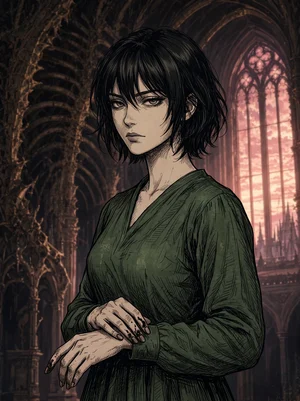
Kit knew it the moment the clerk at Merrivale’s tilted it toward the lamp. He did it the way she would have done it, slantwise, looking for the shine of a stroke that had hesitated. There wasn’t one. She had spent four nights on the director’s signature, the fat M, the loop of the l that doubled back like a man remembering his hat. It was flawless.
“Mr. Merrivale had a stroke in the spring,” the clerk said gently. “His hand shakes now. We all know it shakes.”
“How awful for him,” said Kit, and ran.
She got as far as the Exchange steps. The two men waiting there wore no watch colours, which was worse, and they did not hurt her, which was worse still. They put her in a closed carriage with her ink case on her knees and drove her not to the Watch House but uphill, past the lamplit ribs of the palace, to the Chancellery.
The Lord Chancellor of Sallowmere received forgers at midnight, apparently, in a study lined with law books, at a desk so clean it looked like an accusation.
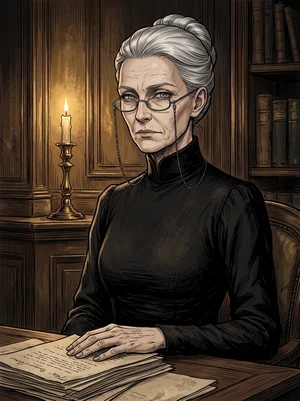
“Katrin Haddow,” said Lady Odile Sarrow. She did not look up from the paper she was reading. Silver hair, coiled hard. Spectacles on a chain. A black dress with no ornament anywhere, as though ornament were a kind of bribe. “Twenty-four. Apprenticed to the late Tansy Gorse of Gall Street. No convictions, which in your trade means competence rather than virtue. You tried to buy your brother’s blood-debt tonight with three thousand crowns of Merrivale’s money that Merrivale has never had.”
“I was going to pay it back.”
“With what?”
Kit considered the truth, which was with another forgery, and kept it.
Sarrow finally looked up. Her eyes were pale and very steady. “Sit down, Miss Haddow. I bought your brother’s debt from the Ress family in the summer. You were trying to pay me with my own crowns. I found it charming, a little.”
Kit sat. Her ink case was still on her knees. Walnut, brass at the corners, her mother’s once. She put both hands on it, which was a mistake, because Sarrow noticed.
“Fen Haddow plays cards at the Gilded Ferret,” Sarrow said. “He loses, and when he loses he talks. He told a table of strangers that his sister has hands that could make the king’s own seal blush. That if she wrote a thing down in the right ink, you would wake up and find it true.” She folded the paper in front of her, exactly in half. “Most of the table laughed.”
“Fen’s a romantic.”
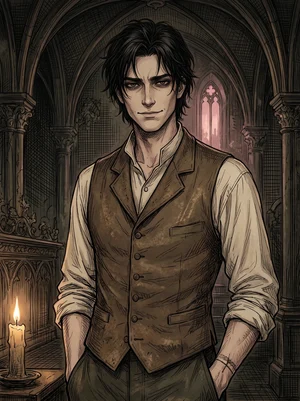
“I am not.” Sarrow turned her head. “Mr. Pike.”
There was a man by the fire whom Kit had taken for furniture. He came forward now with a portfolio under his arm, a soft-faced man with soft hands, and laid out a single sheet on the desk between them.
Kit’s stomach went cold before her mind caught up, because she could smell it. Bitter, green, faintly metallic, like an apple cut with a knife that had been in blood. Quickgall. Fresh, still green, not yet fast. Real ink, the kind notaries swore by because nothing on earth could change a page of it after its first dawn.
The hand was the most beautiful she had ever seen. That was Pike’s, then. She hated him a little, on principle.
“Read it aloud, Mr. Pike,” said Sarrow. “Miss Haddow will want to hear the shape of it.”
Pike read in a voice like a well-oiled hinge.
The party Katrin Haddow would, for thirty nights from this one, live as the betrothed of His Highness Prince Casimir Corvane, heir to Sallowmere, and attain that place by her own art. She would not speak of these terms to any soul. She would deliver into the Lord Chancellor’s hands, before the thirtieth dawn, a confession touching the death of Prince Halvard Corvane, written in the hand of Prince Casimir, the ink cut with his blood.
Upon delivery, the blood-debt of Fen Haddow would be forgiven in full and the debtor released.
Upon failure, at the thirtieth dawn, the debt would be collected in full.
“Collected,” Kit said.
“The Ress family asked for blood,” said Sarrow. “Their son died on your brother’s sword. It is a blood-debt. It is collected in blood.”
Kit looked at the page. She made herself read it a second time, slowly, the way Tansy had taught her to read anything written by someone with more power than she had: as though every word were a step on a rotten stair. A confession touching the death. Not his confession. Not a false one. In the hand of Prince Casimir. Not by her hand, either.
She said nothing. Saying nothing was the first rule of reading a contract, and she had never in her life been so careful to obey it.
“You want me to forge a prince confessing to his brother’s murder,” she said instead. “In quickgall. With his blood in it. So it comes true.”
“I want the realm to remember what it already suspects.”
“What happens to me after?”
“You go home.” Sarrow’s face did not move. “If you have a home.”
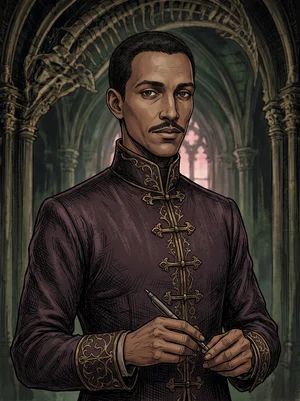
The prince. Kit knew what everyone in Lanthorn knew. Casimir, the spare. Nine years ago his elder brother had gone off the top of a tower stair at Kestrel Lodge, and Casimir, sixteen, had been the only one there, and every word he had said about it since had sounded like a lie. Not to some people. To everyone. Nobody believed the second prince. Ask him the time and you would check a clock. And in thirty nights, with the old king dying by inches, the Council of Seals would sit the Lantern Vigil and decide whether to confirm him heir.
“He’s not betrothed,” she said.
“He will be, by morning. To you.” Sarrow slid a second, older document across. A royal proclamation on hunting rights, eleven years old, signed by King Edric at the bottom in a brown, old-fashioned hand. “You’ll want a sample.”
“And if I say no?”
“Then you go to the Watch House for Merrivale’s letter, and your brother goes to the Ress family at the next quarter day, and I find another way.” Sarrow took off her spectacles. Without them she looked tired, and older, and somehow more dangerous. “I would rather not find another way. They are all worse.”
Kit looked at her hands on the ink case. Ink on the second finger of the right, the way there always was.
Fen at twelve, asleep on a bench with his arm over his face. Fen at twenty, in a Debt Tower cell, writing her a letter that began Kitty, don’t do anything stupid and ended but if you were going to.
“Give me the pen,” she said.
Pike pricked her thumb with a silver needle. Her blood went into a dish with his ink, and she signed Katrin Haddow at the foot in her own hand, the hand nobody ever saw. Sarrow signed below. The Lord Chancellor’s signature was small and upright and had no flourish at all.
For a moment nothing happened. Then something went round Kit’s left wrist like a hair being drawn tight.
She pushed her cuff back. Thirty fine black lines lay around the wrist in a narrow band, each as thin as a single stroke of a hard nib, like a bracelet drawn by someone with a ruler and a grudge. They did not wash off when she rubbed them. They were not on her skin. They were in it.
“One goes at every dawn,” said Pike kindly.
They gave her a room at the top of the Chancellery with a lamp, a table, a stack of good paper and nothing to do but ruin someone.
Kit unlocked the ink case. Inside, in their slots: her knives, her quills, a stick of sealing wax in the royal green, her little stoppered vial of quickgall. A recipe card tucked in the lid in her mother’s hand, the g’s with their long tails, the sevens crossed twice. And her ledger, green cloth, gone soft at the corners.
She opened it to the flyleaf first, out of habit.
Never forge a death. Never forge a heart. Write the price down before the ink is dry.
Below the rules, in a younger version of her own handwriting, was the first entry. Fen, apprenticed to the Bargemen. Price: my indenture. Then four more over eight years. A deed for Tansy’s shop that had cost her a winter coat. A dead man’s will that had cost her nothing she could ever find, which had frightened her more than any of the others.
Five lies in eight years. She was a careful liar. Her mother had been a liar too, and not a careful one; even Kit had known it, by the end.
Tansy had taught her the rest at the shop table, rapping the wood with a bone folder for each rule. The ink always sends a bill, girl, and it bills in kind: a roof for a roof, a coat for a coat. A lie told in another body’s name needs that body’s blood in the ink, or the page takes nothing. And a lie can be struck through, but never simply taken back. Only traded.
So that was why Sarrow had bought thirty nights and not one. A forger could learn a prince’s hand in a week. She could not ask him for a cup of his blood.
She turned to a clean page and wrote: Night 1. The Aubery betrothal. For Fen. She left the line for the price empty, the way you leave a chair for someone late to dinner.
Then she began.
Lies needed to be small to be safe and large enough to work. A betrothal to a prince could not come from nowhere. It needed a house, and a house needed a father, and a father needed to be dead, because the ink would not make a living man to fill a coat. She ran a finger down the extinct baronies in the old armorial until she found one small enough that no one would care and grand enough to pass. Aubery of Hathel Fen. Saltmarsh. Arms: a grey heron on green. The last lord died without sons. Perfect.
Katrine Aubery, only surviving child of the late Lord Edmund Aubery of Hathel Fen. Close enough to her own name that she would turn when someone called it.
She practised King Edric’s hand forty times on scrap. The old man’s capitals leaned left, as though resisting a wind. He made his d’s like someone tying a knot. By the fortieth time her wrist knew him.
Then she cut her thumb, stirred the drop into the quickgall, and wrote on the good paper in a dying king’s handwriting that eleven years ago he had promised his second son to Lady Katrine Aubery, in honour of her father’s loyal service.
At the end, because a real royal contract always had one and a forger was only as good as her details, she added: the marriage to be solemnised on the night the Prince is confirmed at the Lantern Vigil.
She sealed it in green wax with a seal she had carved herself, years ago, for a client who had wanted a pardon and got one.
She didn’t sleep. Nobody slept the night a lie was green. She sat at the window with the page on the table behind her where she could hear it, which was nonsense, paper made no sound, and watched the city go from black to blue.
Across the river the ribs of the Lantern Court stood up against the sky, yellow where the lamps still burned inside them. A whole palace built in the bones of a dead wyrm. The Corvanes said they had the wyrm’s blood. People in the Paper Quarter said that explained the tempers.
The first grey came up behind the Debt Tower.
The paper on the table did not glow or tremble or do any of the things it would have done in a ballad. She felt the change as a shift in the air of the room, the way you feel a door close somewhere in a house. When she turned round, the table was bare. The page had gone wherever an eleven-year-old royal contract ought to be, and taken its green wax with it.
Round her wrist, one of the thirty lines had gone.
Twenty-nine.
Down in the yard a carriage door banged. Hooves. A man’s voice, raised in the careful courtesy of the palace: “For Lady Katrine Aubery. With His Majesty’s compliments.”
Kit picked up the ledger to write the price, because the rule was the rule, and found she did not yet know it.
Then she saw the cover.
For eight years, in the corner of the green cloth, in white ink, it had said K. Haddow, her book. She had written it the day Tansy gave it to her, with her tongue between her teeth.
It was blank. Not scraped. Not faded. Just green cloth, as though no one had ever owned it.
Kit turned to the flyleaf, where her rules were. They were still there, in her hand. But in the first entry, where it had said my indenture for eight years, it now said an indenture, and at the bottom of the page, where she had once signed herself the ledger’s keeper, there was nothing at all.
In kind, she thought. Her name for a name. A house for a house. Somewhere down in the Paper Quarter, the landlady on Gall Street was frying bacon for a lodger she had never heard of, in a room that had always been let to someone else.
The man in the yard called again, more politely.
Kit picked up her pen. Under Price, in the steadiest hand she owned, she wrote: Me.
Then she shut the ledger, put on her coat, and went down to be a lady.

What did you think?