The Prince Who Lies, chapter 2 of Every Lie by Dawn
Lady Katrine Aubery had eleven trunks.
Kit stood in the middle of a bedchamber in the Lantern Court and watched two maids unpack them, and tried to look like a woman who had seen all of this before. Gowns in heron grey and marsh green. Gloves in a cedar box. A silver hairbrush engraved with a heron. A packet of letters tied in faded ribbon, addressed to her in a dead man’s hand she had invented eight hours ago.
The ink had been thorough. It always was. Give it a lady and it gave her stockings.
“Your father’s hand, my lady,” said the elder maid, holding out the letters with a sympathetic face. “You’ll want those by you.”
Kit took them. She would read them later, alone, and find out who she had been as a child. That was a sentence no one should ever have to think.
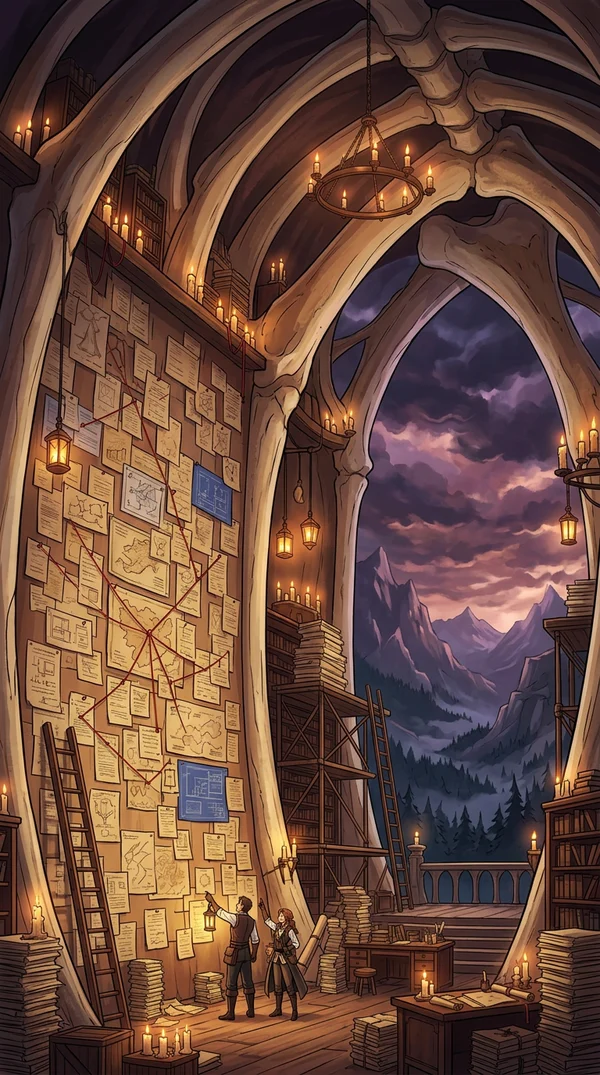
The room was on the second floor of the Bones, in what the maids called the left lung, and its outer wall was a rib. Not a beam carved to look like a rib. A rib, yellow-white and pitted and as thick as a cart horse, curving up through the plaster and out through the ceiling. Kit put her hand on it when no one was looking. It was cool and faintly greasy, like old ivory.
“Is it true they’re warm?” she asked. “The Corvanes.”
The younger maid went pink to the ears. “His Highness is, my lady. You’d know, my lady. You’ve met him.”
“Not since we were children,” said Kit, which was a guess, and from the maid’s relieved nod, a good one.
The king received her in his bedchamber, which was in the skull.
The room was round and high, with two great empty sockets for windows, glazed now, and the morning came through them in two long gold bars across the bed. Edric Corvane was a small man in a large bed. His skin had gone the colour of paper that has been in a drawer. But when he held out his hand to her, it was hot, hotter than a fever, and his eyes, faded as they were, still had the ring of gold around the iris that the coins put on all the Corvane profiles.
“Edmund’s girl,” he said. “Look at you.”
Kit curtseyed. She had practised in the carriage. It was not good, but the ink had told everyone that she had grown up in a wet house in the Fens with no mother, so perhaps it was supposed to be bad.
“He held the ford at Callow with me,” the king said. “Did he tell you? We were twenty. The Thessanes came over the water at night and Edmund stood in the river up to his waist and cursed them in three languages.” His mouth worked. “I promised him. I promised him I’d see you safe.”
His eyes were wet. He meant it. That was the horror. Somewhere inside this dying man there was now a friend who had never existed, and a river at night, and a promise, and he would carry them to his grave because she had needed a father with a good pedigree.
She knelt by the bed because her legs had decided to. “He talked about you all the time, Majesty.”
He patted her hand. His was burning.
When she stood, there was a young woman at the foot of the bed whom she had not heard come in. Fair hair braided into a crown, a gown the yellow of new butter, and an expression that could have curdled it.
“Lady Ines Brannock,” said the young woman. “My father is the Lord Treasurer. We were all so relieved to hear you’d recovered from your fever, Lady Katrine. We’d quite given you up.”
There was a whole history in that quite. Kit could hear its outline. A court that had for years assumed the prince’s betrothed was a sickly girl who would die in a marsh. A Treasurer’s daughter who had been measured for something.
“The Fens are very dull,” said Kit. “One recovers out of boredom.”
She met him in the long gallery, which was the spine.
The gallery ran the length of the palace along the ridge of vertebrae, each one the size of a small chapel, and the court had built its floor across their tops and hung lanterns from the spurs. There were musicians at the far end. There were, Kit counted, at least forty people pretending not to look at her.
Then they all stopped pretending, and she turned.
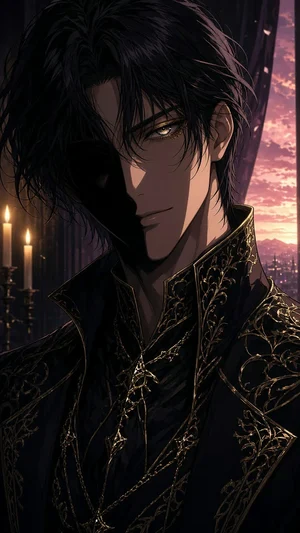
He was taller than she had expected. Most people were taller than Kit, but he was taller in a way that seemed deliberate. Black hair worn too long, as if he had forgotten to have it cut for a year out of sheer contrariness. A dark coat undone at the throat. Ink, a long smear of it, along the outer edge of his left hand, the side that drags across a page when a left-handed man writes fast. A forger’s eye went to that before anything else.
Then his eyes, which were grey, with the gold ring around them bright as a struck match.
He bowed over her hand. She felt the heat of him before his mouth came anywhere near her glove, the way you feel a stove in a room before you see it.
“Lady Katrine,” said Prince Casimir Corvane. “I’ve thought of nothing else for eleven years.”
It was a lie.
Not that it was untrue. Kit did not know whether it was true or not. It was that it sounded like a lie in a way she had never heard a sentence sound before. It went into her ear and she flinched from it, the way her eye flinched from a signature where the forger had stopped halfway through the loop to think. The hesitation stroke. Every word he said had one.
She knew about the curse, the way everyone did. Knowing about a thing was apparently different from having it said to you by a man standing close enough to warm your hand.
Somebody near the musicians laughed and turned it into a cough.
“How flattering,” said Kit. “I’ve hardly thought of you at all.”
The gold ring in his eyes seemed to brighten, which was not possible. “Then we’ve made a good start. I prefer honesty in a marriage.”
That one was so false she nearly laughed in his face.
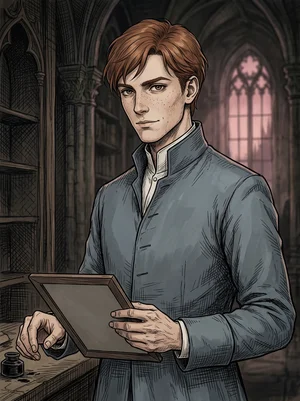
At his shoulder, half a step behind, stood a freckled young man in a secretary’s black with a writing board under his arm. He had been watching the prince’s mouth, not his eyes, and when Casimir spoke the young man smiled, small and private, as if he had heard a good joke. His fingers moved against the edge of the board, quick shapes. Casimir’s left hand answered, low by his hip, without looking.
“My secretary, Oskar Lind,” said Casimir. “He’s deaf. He thinks you’re very pretty.”
Oskar’s ears turned red, so that, at least, was true.
“Does he believe you?” Kit asked, before she could stop herself.
The prince’s mouth went still, as if she’d turned a page he hadn’t meant her to see. “He’s the only one who ever has.”
There it was again: the wrong note, the hesitation. And yet the secretary was nodding, cheerfully, as though nothing in the world were simpler. Kit filed it away in the part of her mind that kept the things she didn’t understand yet, which was getting crowded.
The musicians struck up. Somebody, she suspected Ines Brannock, had asked for a pavane, which was the slowest dance in Sallowmere and gave everyone in the room the longest possible time to stare.
Casimir held out his hand. “My lady.”
“I don’t dance well.”
“I know,” he said. “Your father wrote me.” And that, she realised with a little jolt, was a joke made for her alone, because there had been no father and no letters until dawn, and nobody else in the room could know it.
She took his hand.
The pavane was all walking and turning and stopping, and it was mostly hands. His palm against hers, flat, at the height of her shoulder. His hand at her waist for the turn, warm through two layers of green silk. You could feel the blood in him. She had heard the stories and assumed they were the kind of thing people said about kings. They weren’t.
“You’re very warm,” she said.
“It’s my nerves.” Lie. “I’m terribly shy.” Lie. “And I’ve been dreading this all morning.” That one sounded like a lie as well, but his mouth had gone wry at the corner when he said it, and she didn’t know what to do with that.
“Do you ever tell the truth?”
“Constantly.” He turned her under his arm. “It’s the most useless thing I do.”
They passed Ines Brannock, who said something behind her fan to the woman beside her, and they both looked at Kit’s hem. Kit had stepped on it twice.
“She hates me,” Kit said.
“She hates me. She was going to have to marry me.” He bent his head so that his mouth was by her ear for the length of one slow step, and his breath was warm on her neck. “I’m told I’m a murderer. I’m told I lie in my sleep. Everyone in this room is so sorry for you, Lady Katrine. Can you feel it?”
She could. It came from all sides like heat off a hearth.
The music stopped. He did not let go of her hand at once. He walked her to the window bay at the end of the gallery, where the vertebra curved up into a natural arch and someone had glazed it in small diamond panes, and the whole of Lanthorn lay below them, roofs and smoke and the brown loop of the Tamsey. The Debt Tower stood on its island in the river. Kit looked at it, and then didn’t.
“I have a gift for you,” said Casimir. “A betrothal gift. It’s customary.”
Lie, said her ear. She ignored it. He took a folded paper from inside his coat, small, sealed with a blob of plain grey wax, and put it into her gloved hand, and closed her fingers over it with his. The heat came through the glove.
“Read it alone,” he said. “It’s very romantic.”
Then he bowed, exactly correctly, and walked away down the spine of the wyrm with Oskar at his shoulder and every eye in the room following him, and not one person, Kit thought, believing a single thing he’d said.
She found an empty stair in the right lung and broke the seal with her thumbnail.
He had written it in capitals. Square, upright, plain block capitals, every letter the same height, like a sign over a shop. She knew why before she had read a word, and she felt an unwilling spark of professional admiration. Capitals had no slant. No pressure. No habits. There was nothing in a block letter you could learn and steal. It was the hand of a man who knew exactly what a forger looked for.
YESTERDAY I HAD NEVER HEARD OF HOUSE AUBERY.
THIS MORNING MY FATHER WEPT FOR YOUR FATHER, WHOM HE NEVER MET.
I REMEMBER YESTERDAY, MY LADY. I DON’T KNOW WHAT YOU ARE.
I INTEND TO FIND OUT.
C.
What did you think?