Terms of Engagement, chapter 3 of Every Lie by Dawn
The door between their rooms had two locks, one on each side, and that told Kit everything she needed to know about Corvane marriages.
“The promise suite, my lady,” the elder maid had said, turning down the bed on the second night. “For the betrothed. It’s very old.” She said it with the particular blandness of a servant who had opinions about very old things. Kit had nodded as though she had grown up expecting to sleep one door away from a prince.
She lay awake and listened to him.
Not that he made much noise. A chair scraping. The click of a lamp being turned down. Once, near midnight, a long pause, and then the sound of someone standing very close to the other side of the door, not knocking. Kit lay on her back in a stranger’s linen with a ruled band of twenty-nine lines round her wrist and did not breathe until the footsteps went away.
In the morning there was a paper on the floor, pushed under the door.
The hand had changed. Not the block capitals this time but a small, upright, crabbed script, the kind a clerk uses when he’s been told to fit a deposition on one sheet. Kit picked it up, looked at it slantwise against the window, and almost smiled. The pressure was all wrong. Heavy on the downstrokes, then light, then heavy again, as though the writer kept remembering to slow down and then forgetting. A false hand, worn like a borrowed coat. He was left-handed, and it was the hand of a man forcing his pen to stand up straight.
TERMS, it said at the top. He had underlined it twice.
1. I can’t expose you. You know why. No one would believe me if I told them the sky was up.
2. You won’t touch my papers.
3. In public we’ll be devoted. I’m told I’m very good at devoted. No one will believe that either.
4. Tell me what it cost you.
She read the last one three times. Then she sat down at the little desk under the rib, took out Lady Katrine’s notepaper with its grey heron, and wrote back in the hand she had invented for Katrine on the carriage ride, round and girlish, with a flourish on the y’s that she was already sick of.
1. Agreed, though I’m sorry about the sky.
2. I wouldn’t dream of it.
3. I’m very bad at devoted. We’ll balance.
4. Nothing I’ll miss.
She slid it under the door and heard, a moment later, paper being picked up. Then nothing. Then, very faintly, through two inches of oak, a man laughing.
On the third day the marriage contract was read in the Hall of Seals.
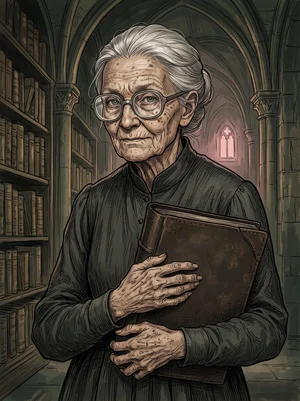
It was, Kit gathered, a formality. A royal betrothal was confirmed before the court once both parties were of age and in residence, and the Keeper of the Archive brought the original up from the vaults to be shown. The Keeper was an old woman named Dame Hollis, with a hump to one shoulder and spectacles thick as bottle ends, and she carried the contract in both hands as if it were a sleeping animal.
Kit recognised it from across the hall. Her green wax, with the seal she had carved for the pardon. Her ink, gone fast and black. The ink had put it in the vault; the ink had given it eleven years of dust.
Dame Hollis read it aloud. Kit stood beside Casimir and listened to a dying king’s promise in her own composition and thought that she had written some of it rather well.
“The marriage to be solemnised,” read Dame Hollis, “on the night the Prince is confirmed at the Lantern Vigil.”
A murmur went through the hall. Not surprise. Interest. Somebody at the back said, quite audibly, twenty-seven days, and someone else said, they’ll never have the gowns ready.
Kit stopped breathing.
She had written that line for colour. Because real contracts had a date in them, and a forger who left out the date was an amateur. She had not, at the time, been thinking that she was writing her own wedding.
Beside her Casimir did not move. But she felt him look down at her, and when she risked a glance he was watching her face with an expression of great and private interest, as though she had just done something in front of him that confirmed a theory.
“Something wrong, my lady?” he murmured. “You’ve gone white.”
“It’s the excitement.”
“Of course it is.”
Across the hall the Lord Chancellor stood among the seal-holders in plain black. When the reading was finished and the court began to break up into its knots, Lady Sarrow came over, offered her congratulations to the prince, who gave her a bow so correct it was nearly an insult, and then turned to Kit.
“Such a beautiful hand,” said Sarrow, “His Majesty had, in his youth.” She looked at the contract in Dame Hollis’s arms. “One forgets. Twenty-seven days, Lady Katrine. You must be counting.”
Kit smiled until it hurt. Under her glove, the band on her wrist itched.
The Debt Tower stood on its own island in the Tamsey, and the only way to it was a ferry that smelled of fish.
Ladies of the court were permitted charity visits. Kit brought a basket of bread and a purse of coppers for the turnkeys and wore Katrine’s plainest grey, which was still nicer than anything she had owned as herself.
“Fen Haddow?” said the turnkey at the gate, a slab of a man called Corran who had once let her in past hours for a shilling and a joke about his wife. “Third floor, east.” He looked at her with polite blankness. “Family, my lady?”
“Charity,” said Kit.
He had known her for four years. He wrote Lady K. Aubery, charity in the visitors’ book without a flicker.
Fen’s cell had a window the size of a Bible and a bed the size of a coffin. He was sitting on it with his back to the wall, thinner than she’d left him, unshaven, his good blue coat gone shiny at the elbows. He looked up when the door opened and his whole face changed.
“Kitty,” he said. “Why are you dressed like a cake?”
She put the basket down and held him. He smelled of damp and tallow and underneath it, still, of himself. Round his right wrist, where the cuff fell back, the debt-mark showed in rusty red: a line of tiny writing, the amount and the name of the creditor, like a bracelet of dried blood. Three thousand crowns. The Chancellery of Sallowmere.
“You know me,” she said into his shoulder.
“Course I know you. Corran doesn’t.” He pulled back and searched her face. “Woke up three days ago and he asked me who Katrin was. I said my sister. He said I haven’t got one. I said I’ve got one who’s going to box your ears. And then I remembered both.” Fen put his hand to his own temple, as if checking for a bruise. “I remember you visiting every Sunday. And I remember nobody coming at all, ever. Both. It’s like having two left boots on.” His voice dropped. “Kitty. What did you do?”
“I’ve got you out.”
“Have you.” He looked at her grey silk, her gloves, her careful hair. “How.”
She opened her mouth to tell him.
Her throat shut.
Not choked. Not tight. Shut, the way a door shuts, smoothly and completely, so that the breath behind the words simply had nowhere to go. She tried again. The Chancellor. Nothing. A confession. Nothing. Her lips moved and made no sound, and on her left wrist the twenty-six lines went hot as a nettle sting.
She would not speak of these terms to any soul.
Fen was staring at her mouth.
“I’m all right,” she said, and her voice came back for that, because it was a lie and not a term. “It’s a job. A good one. You’ll be out before the Vigil.”
He looked at her. Fen had been a liar of real promise at twelve and he was a very good one at twenty, and liars know each other.
“Who told them, Kit?” he said quietly. “About you. Who’d they hear it from?”
Then he looked away, down at the debt-mark on his own wrist, and didn’t look back. She would think about that later. She would think about it a great deal.
She needed his hand.
Not his capitals and not his crabbed clerk’s script. His real hand, the fast one, the one that had left a smear of ink down the side of his palm. A forger could not write as a man until she had seen how he wrote when he wasn’t thinking about it: where his pen lifted, how he crossed a t in a hurry, which letters he joined and which he let stand alone like people who didn’t like each other.
She watched for three days. He did not write in front of her. At the council table he signed with a stamp. His letters were in Oskar’s neat secretary hand. When he needed to tell her something in public, he leaned close and said it, and watched her flinch with that look of interest.
But at night there was lamplight under a door at the end of the passage, and the scratch of a pen.
His study was in the left shoulder, in the curve of the great scapula, behind a door with a lock that Tansy would have been ashamed of. On the sixth night Kit stood outside it in her stockings at two in the morning with one of Katrine’s hairpins and listened to the house breathe.
The lock gave on the second try.
The room was dark and smelled of ink and cold candle and him, a warm, dry smell like cedar shavings. She left the door ajar for the passage light. A desk, buried. A slate on an easel. Shelves.
And the wall.
The whole inner wall of the study, where the shoulder blade curved up to the ceiling, was covered in paper. Pinned in ranks, edge to edge, sheet over sheet, like the scales of something. Maps of a tower and a stair. A timetable of a morning, written out to the minute. Lists of names, with lines between them. Pages of close writing that began I was on the landing below him and I saw her hand and she wore grey gloves. And everywhere, in a fast, forward-leaning, left-handed script that cut off its final s’s as though the pen were impatient to get to the next word, the same name. Circled. Underlined. Written so hard the nib had torn the paper.
SARROW.
Nine years of it. You could see the hand grow up across the wall, from a boy’s round letters on the oldest yellowed sheets to the man’s script on the newest.
Kit reached for the nearest page. The real hand. Everything she needed, pinned at the height of her eyes.
A floorboard spoke behind her.
She turned. He was in the doorway with a candle, in his shirtsleeves, the collar open, his hair loose round his face, and the gold in his eyes had caught the flame and held it.
“I believe,” said Prince Casimir, very softly, “that we had terms.”

What did you think?