The Greywater Deed, chapter 4 of Every Lie by Dawn
He shut the door behind him with his heel and did not call anyone.
That frightened Kit more than guards would have. Guards were a known quantity. Guards could be talked to, bribed, cried at. A prince standing between her and the only door, in his shirtsleeves, with a candle and no expression at all, was a different kind of paper.
“I was looking for a book,” she said.
“Of course you were.” He set the candle on the desk. The light went up the wall of pinned pages and made the oldest ones glow yellow. “Something light. Before bed.”
Lie, said her ear. She almost laughed, and caught it, and he saw her catch it.
“You find that funny.”
“I find it exhausting. Every time you open your mouth I want to check my purse.”
“Everyone does.” He said it without self-pity, the way he might have said it was raining. Then he went to the slate on its easel, picked up a stub of chalk and wrote on it in square capitals, the shop-sign hand from his first note.
SHE PUSHED HIM.
Kit looked at it. Then at the wall. Then at him.
“I’m not going to say it,” he said. “You’d only hear a liar. So read.” He wiped the slate with his sleeve and wrote again, faster, in short lines, and she read them as they came, the chalk squeaking.
FOG. EARLY. HAL WENT UP THE STAIR TO SEE THE HAWKS.
I WAS ON THE LANDING BELOW. I HAD A COLD. I WAS SULKING.
SHE WAS AT THE TOP. SECOND SECRETARY OF THE SEAL THEN. GREY GLOVES.
SHE PUT HER HAND FLAT ON HIS BACK. LIKE STEADYING A HORSE.
HE DIDN’T SHOUT. I DID.
He stopped. The chalk had broken in his fingers. He looked at the two pieces for a moment as though they belonged to someone else.
“At the inquiry,” he said, aloud, “I told them. Eleven times. My father was there. He held my hand.” The false note rang in every word, and she knew, from the way his jaw set, that he could hear it ringing in her face. “And every one of them looked at me the way you’re looking at me now.”
“You were sixteen,” Kit said. “It was fog.”
“Yes.”
“She’s the Lord Chancellor.”
“Yes.”
“You can’t prove it.”
“Nine years,” said Casimir, and tipped his head at the wall, “of not being able to prove it. You’re welcome to look. I’d rather you didn’t steal it.”
She should not have looked. She did. Timetables. Lists of who had been at the lodge. A drawing of the stair from below, every step numbered. A page of nothing but the words grey gloves written over and over in a boy’s hand, as though if he wrote it enough times it would turn into evidence.
Every line of it said Sarrow, and every line of it was the word of a man nobody believed, and Odile Sarrow had Kit’s brother’s blood in a contract on her desk. Kit felt the shape of what it would cost to believe him, and decided, with great firmness, not to.
“It’s very thorough,” she said.
“You don’t believe a word of it.”
“I don’t believe a word you say. That’s not my fault.”
“No.” He came round the desk. He did not hurry. “It’s somebody’s.”
She did not step back, because stepping back was an admission, and because there was a bookcase behind her. He stopped close enough that she could feel the heat coming off him through her nightgown. He took her right hand, quite gently, and turned it over, and rubbed his thumb along the second finger where the ink lived. It never came out. She had stopped trying years ago.
“Ladies,” he said, “don’t pick locks with hairpins shaped like herons.”
“This one does.”
“Ladies don’t have ink on that finger. Clerks do. Copyists.” His thumb moved again. “Forgers.”
“Ladies write letters.”
“Not that many.” He did not let go of her hand. His was warm and dry and there was chalk dust in the creases of it. She was suddenly, ridiculously aware that she was in her stockings, that her hair was down, that his collar was open and there was a pulse going at the base of his throat.
“You picked the wrong prince to rob,” he said softly. “Nobody has believed a word I’ve said since I was sixteen. Do you know what that teaches a man? To stop talking and start doing things.” His thumb pressed, once, on the inked finger, not quite hard enough to hurt. “Why are you here? Who sent you?”
Every word of it rang like a counterfeit coin. His grip didn’t.
She opened her mouth and felt the door in her throat begin to close.
So she did the next best thing. She went up on her toes, and he bent his head as if he couldn’t help it, and for the space of one breath there was nothing between them but the heat of him and the smell of cedar and the question.
Then Kit put two fingers flat against his chest, the way the slate said a hand had once been put on his brother’s back, and pushed. Lightly.
“Terms,” she said.
He stepped back. For a moment his face was wide open, and what was in it was not anger. Then it closed, and he laughed, low, not quite steady. “Get out of my study, my lady.”
She went. She took nothing.
She did not need to. She had seen thirty pages of his real hand by candlelight, and she was very, very good.
On the seventh day the Lord Treasurer asked for her dowry.
He asked kindly, in a small panelled room off the Hall of Seals, with Ines at his elbow taking notes in a pretty hand. Lord Brannock was a large soft man who apologised a great deal and never once looked as if he meant it.
“A formality, Lady Katrine. A royal bride brings land. It’s in the Settlement Act. The Hathel Fen estate is, ah.” He turned a page. “Encumbered.”
The ink had given her a dead father, a ruined house and its debts. Of course it had. She had asked for a small house that no one would care about, and the ink, which was a literal-minded clerk at heart, had given her exactly that.
“An income-bearing holding,” said Brannock. “Before the Vigil, if you would. Your father’s man of business will have the deeds.”
“In two days,” said Kit.
Ines smiled at her notes.
That night Kit sat in the Treasury roll room, which a bride was permitted to consult, with the Saltmarsh roll open in front of her and her finger moving down the crown leases. She wanted something small. Something already the crown’s, so that no family lost a freehold. Something the Treasurer would accept and no one would ever ride out to look at.
Greywater. Tide mill and rights. Crown freehold. Leased to the family Hesk, tenants, at forty crowns the year.
Forty crowns. A mill on a marsh at the end of the world. Perfect.
She copied the hand of the Saltmarsh clerk from sixty years back, a cramped, careful hand with an old-fashioned long s. She wrote that the mill at Greywater and all its rights were the freehold of House Aubery, granted in the reign of the old queen, and the crown merely its trustee. She cut her thumb. She wrote the ledger entry first, because that was the rule. Night 8. Greywater, for the Treasurer.
She did not sleep. At dawn the ink went fast, and one more line went from her wrist, and that left twenty-two.
She reached for her mother’s ink case to write the price.
It wasn’t on the desk.
It wasn’t under the bed, or in the trunks, or in the cedar glove box, or anywhere. The maids looked at her blankly. “A walnut case, my lady? With brass on? You never had one, my lady.” They had never seen it, because now it had never been.
Her knives. Her quills. The little vial of quickgall, nearly full. And in the lid, the card. Gall ink, the good kind, in Maud Haddow’s hand, the g’s with their long tails dropping below the line like someone reaching down for something, and the sevens crossed twice because her mother had once been cheated over a seven.
Property for property. A mill for the only thing she owned.
Kit sat on the floor of Lady Katrine’s bedroom in a pool of heron-grey silk and did not cry, because crying was for people who hadn’t known the price was coming.
She got up. In the ledger, under Price, she wrote: Mama’s case. Her hand shook on the M. She let it.
She saw the widow on the ninth day, at the Petitions Gate.
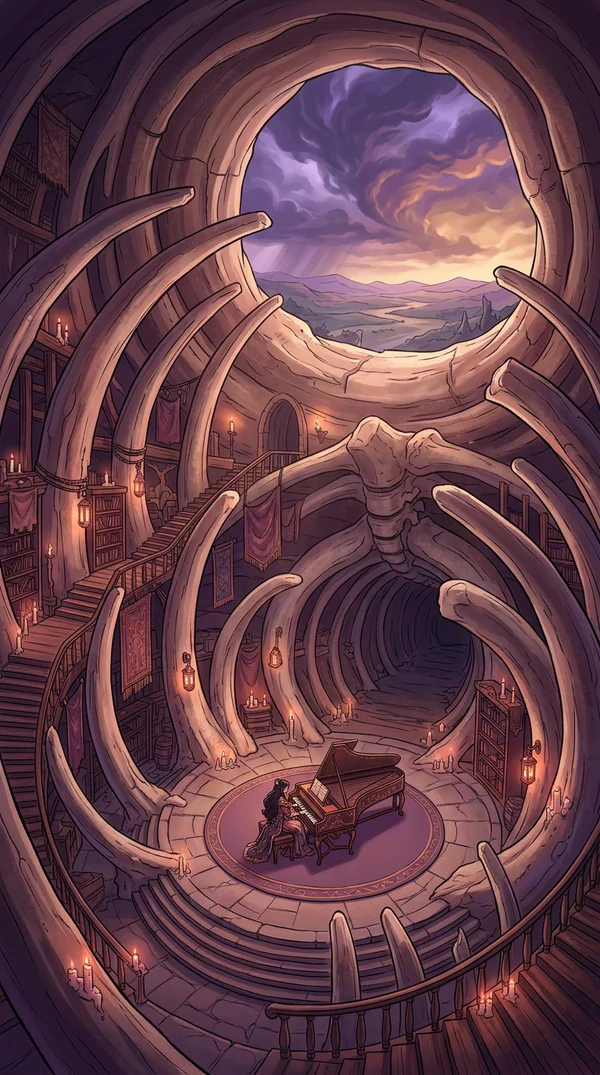
Kit was crossing the outer court with Ines Brannock, which was the kind of thing a betrothed lady did, and the Petitions Gate was where the Bones let its subjects in to stand behind a rope and hold up papers. A woman in a widow’s black cap stood at the front, small and square, with a paper in both hands. There was flour worked so deep into the creases of her knuckles that it would never wash out.
“Greywater,” she was saying to the clerk. “Greywater mill. My husband’s father built that wheel. We’ve paid our forty crowns every Lady Day for forty years, to the crown, and it’s in our lease in black ink that won’t come off.”
“The Treasury holds it in trust for the owner now, mistress, and the owner’s marriage settlement requires vacant possession,” said the clerk, in the voice of a man who had said it a great deal. “Your lease is with the trustee. The trustee may end it at the quarter day.”
“There’s never been an owner. It was the crown’s.” The widow’s voice cracked. “I remember it was always the crown’s. And I woke up yesterday and remembered it never was, and I’ve got the lease in my hand that says both, and I can’t make the two of them sit still.”
Ines made a small sound of distaste and walked on.
Kit stopped.
The woman’s name, according to the paper in her hands, was Marta Hesk. She had a face like a walnut, and when she saw a lady in grey silk looking at her she straightened her cap and said, with enormous dignity, “They took the marsh off us before, you know. When I was a new bride. The Morning of Deeds. Everyone in Greywater woke up and remembered they’d sold up to the crown. My mother cried for a year and couldn’t say why.” She swallowed. “I didn’t think it’d happen twice.”
Kit gave her a purse. It was Katrine’s purse. It was everything in it. The widow looked at it as though it were a dead fish.
“I’m sorry,” Kit said, and Marta Hesk said, “What for, my lady?” and Kit had no answer that she could say aloud, so she walked on after Ines with her face very still.
The clerk took the petition. Contests authenticity of deed, he wrote across the corner. Refer to Examiner.
On the tenth morning there was a paper under the connecting door.
It was not in capitals. It was not in the crabbed clerk’s hand.
It was in his own: fast, forward-leaning, left-handed, the final s’s cut off as if the pen were impatient. The hand from the wall. He had made no attempt to disguise it at all, and that was how she knew, before she had read a word, that something had changed.
The Chancery sends me its disputed deeds, he had written. Nobody knows it’s me. They call me the Reader, and they take my word on paper, since they can’t take it any other way.
Yesterday they sent me the Greywater deed.
The parchment is sixty years old. The ink is fast. The seal is genuine. The clerk’s hand matches the Saltmarsh rolls of the period, down to the long s. It is the most genuine document I have ever held.
Ten days ago there was no House Aubery for it to belong to.
It is genuine. That is what frightens me.
I know what you are now. I know what you could do with a sample of my hand and a drop of my blood. So I’m done hiding it from you. Here it is, my lady. Every letter. Learn it well.
And then look me in the eye and tell me who you’re writing for.
C.

What did you think?