They planned it in the music room, on the backs of minuets, because the walls there carried every whisper to the door and paper carried nothing.
Casimir drew the Chancellery basement from memory. He drew fast and well, a draughtsman’s hand: the street door where the paper bales came in, the great room of the Black Press itself, the clerks’ gallery above it, the iron door of the vault behind. He marked the shelf with no catalogue numbers with a small black square.
The vault clerks admit the Reader by token, he wrote. They have never seen my face. They think I’m an elderly scholar with a stammer. I’ve been careful.
“And me?”
You’ll need a writ in Sarrow’s hand. Can you?
Kit gave him a look. He laughed silently, and kissed her wrist where his ink was fading, and pushed the paper across.
She had seen Odile Sarrow’s signature exactly once, at the foot of her own contract, but once was enough when the hand was that plain. Small, upright, no flourish, every letter separate like soldiers who don’t trust each other. Kit wrote the writ in ordinary ink in a clerk’s hand, as any Chancellery writ would be, and signed it O. Sarrow with the Lord Chancellor’s own austerity, and held it up to the window slantwise and could not find a single flaw.
Oskar read it over her shoulder and signed something to Casimir.
“He says you frighten him,” said Casimir. Oskar’s grin vouched for it.
Oskar takes the gallery, Casimir wrote. He reads the guards’ mouths. If anyone says the wrong name, he drops a ream over the rail.
“And if it goes wrong?”
He looked at her for a moment. Then he wrote, The paper chute, and drew it: a long wooden slide from the street-side bale yard down into the press room, for the bales to come down. It goes both ways if you’re small and don’t mind splinters.
“I’m not small.”
You’re very small.
She threw a minuet at him.
On the twenty-eighth night the Chancellery basement smelled of hot iron, lamp oil and printer’s ink, a smell so like the back room on Gall Street that Kit’s eyes stung.
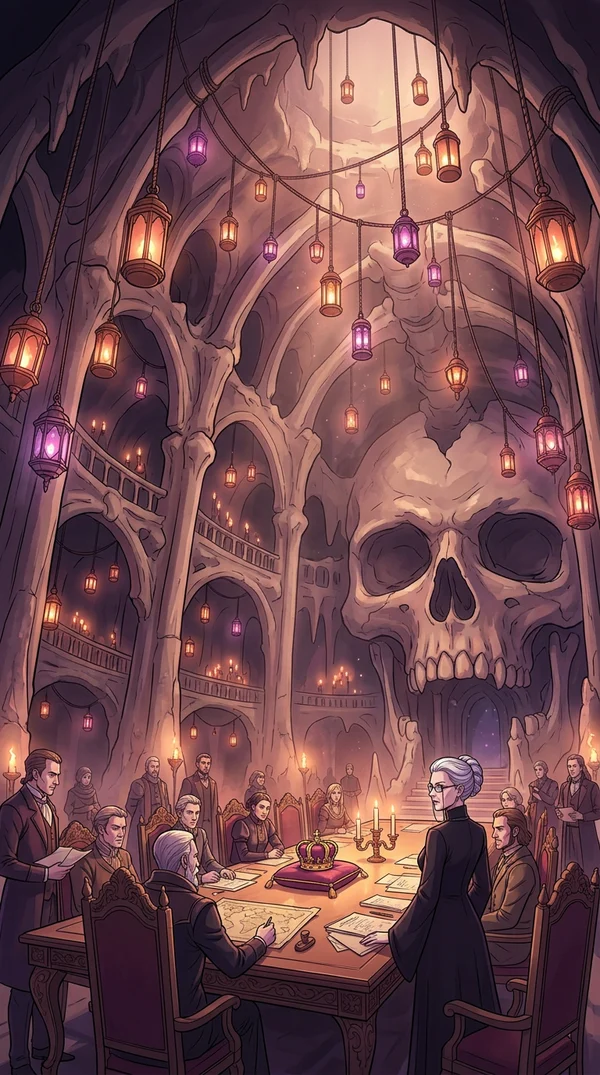
The Black Press stood in the middle of the great room like a gallows built by a clockmaker, black iron and oak, with a half-printed statute still in the bed. Bales of paper were stacked to the ceiling along one wall. Above, the clerks’ gallery ran round three sides; she did not look up at it, and knew Oskar was there.
Casimir walked beside her in a scholar’s long grey gown with the hood up and a pair of thick spectacles on his nose. He stooped. He shuffled. He was, she thought, enjoying himself far too much.
The vault clerk was a thin young man with a candle. He looked at the Reader’s brass token in Casimir’s palm and bowed. He read Kit’s writ, then read it again, then looked at her, in her plain grey with her hair under a cap.
“The Chancellor’s own hand,” he said. “She doesn’t usually send writs at night. I ought to send up and—”
“She said you’d say that.” Kit let her voice go flat and bored, the voice of every clerk who had ever been made to wait. “She wants the Greywater file brought up for the Vigil, tonight, and she said that if you sent up to check, she would remember your name.”
He went pale, and unlocked the iron door. Over his shoulder Kit saw him beckon a boy from the stair, and the boy go up it at a run.
So they had a quarter of an hour. Perhaps less.
The vault was long and low and very cold, and lined floor to ceiling with shelves, and on every shelf lay fast pages in flat boxes: oaths, deeds, treaties, debts. Paper that could not burn. Paper that would outlast the building. Kit walked between the shelves with her heart going so hard she could feel it in the healed leg.
She found the Greywater deed first, in a box marked Referred to Examiner: genuine. Sixty years old, the long s, her own forgery, perfect. She slid it inside her bodice.
Casimir stopped at the end of the last row. A shelf at the height of his chest, with no numbers on it. Six boxes. One of them was sealed with a plain disc of black wax that bore no device at all.
He looked at it. He didn’t touch it.
Kit broke the seal with her thumbnail.
There was one sheet inside. Rough cream Paper Quarter paper, bought by the quire on Gall Street. One line, written across the middle in black quickgall that had gone fast nine years ago.
No one who hears Casimir Corvane will believe a word he says.
There was no g anywhere in the line for a long tail to drop from, and Kit didn’t need one. The N had the little hook at its foot that her mother put on every capital N, the one Tansy used to call Maud’s fishhook. And under the line, small, where a dawnwriter signed her ledger, the mark Maud Haddow had put on every recipe and every grocer’s bill and every note she had ever left on the kitchen table: an M with a stroke through it, like a door with a bar across.
Kit stood in the cold and held her mother’s last lie in her two hands.
She had thought she would feel rage. She felt only a great tiredness, and under it a grief she had kept in a drawer for nine years and never once taken out to read. I did a terrible thing to a boy. I did it for you.

 100 to start reading with.
What did you think?