Left Wing, chapter 2 of Everything My Dragon Burned
Hask will not fly on Morrow’s left.
I find this out at four hundred feet over the Saddle, in a crosswind that smells of snow, while Captain Locke signals left wing, close up for the third time with a flat, chopping hand.
I signal back trying.
He signals something that is not in the regulation book.
The problem is simple. On the left, Hask has to look at Morrow with his right eye, and his right eye is the one he uses for things he respects. He drifts. He sideslips. He tucks himself under Morrow’s tail like a sulking child and flies there, in her wake, where the air is dirty and rough and he can glare up at her belly with his left eye instead.
The coal in my chest says Not beside. Not her. Big. Thinks she’s big.
“She is big,” I tell him. The wind rips the words away. “That’s not an insult, that’s a measurement.”
He drops another ten feet, purely to annoy me.
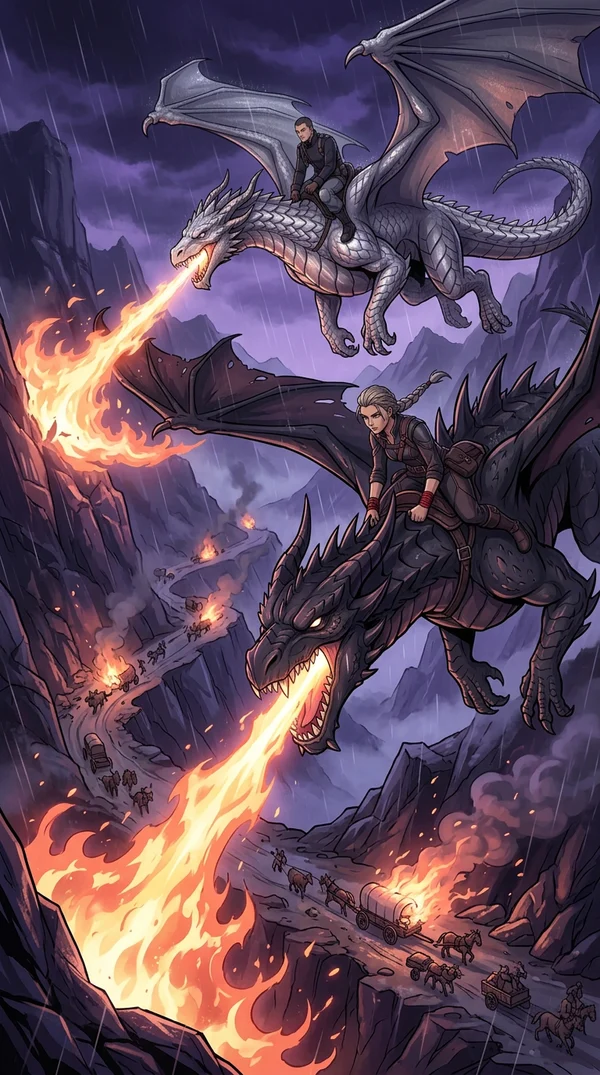
Below us the Saddle opens like a split seam in the mountains: a long, high valley of scree and frozen tarns between two shoulders of rock, five miles from our ridge to the far lip, where the land falls away toward the Ossine plains. It’s the only way through the Kettles for a hundred miles. In summer it’s a road. In a month it’ll be forty feet of snow. Until then it’s ours to hold, and theirs to take if we let them.
Ardan banks right, wide and smooth, Morrow’s huge gray wings tilting like a ship coming about. I swear, and Hask, who has been waiting all morning for an excuse, snaps out of her shadow and comes up on her right side so fast my teeth click.
Now we’re flying wing to wing. Right side. Wrong side. Ardan looks across the forty feet of air between us, and I spread my hands: you want him on the left, you fly on the right.
For a moment I think he’s going to signal me back to base.
Then he gives me one short nod and moves Morrow over, and we’re flying again, properly, with Hask on her left after all. He’s just put himself on the side where he has to look at me.
I decide not to think about that.
We see the Ossine at the far lip around midmorning.
They’re coming up the switchbacks on the far side in a long brown snake, foot soldiers and mule trains and, every few hundred yards, a spitter: a squat wheeled engine the size of a farm cart, with a bow-arm of laminated horn and steel and a crew of six. Spitters throw two things. Barbed glass bolts, which shatter in a dragon’s hide and keep cutting. And chain. Weighted nets of it, flung spinning, to foul a wing and drag a dragon down onto the rocks, where the crews finish it with axes.
I’ve seen it done. I’m not going to describe it.
Ardan signals count and turn. That’s the job today: count the engines, mark the column’s head, go home. We’re not a strike. We’re eyes.
We count. Fourteen spitters on the switchbacks, more behind. I’m marking the last of them on the slate strapped to my thigh when Hask goes rigid under me, and the coal in my chest flares white.
There.
I don’t see it. He does. A battery of three spitters dug into the scree on our side of the lip, under brown canvas painted to look like rock, waiting. They’ve been there since before dawn. They knew someone would come to count.
The first chain is already in the air.
It comes up spinning, a dark wheel of iron with lead weights at its rim, and it isn’t aimed at us. It’s aimed at the biggest thing in the sky.
Morrow sees it late. She’s old and she’s steady and she’s not fast, and the chain catches her left wing at the second joint and wraps it, and I hear her scream, a sound like a bell cracking. Her wing folds. She drops. The chain’s tail is anchored to a stake in the scree, and it holds, and Morrow swings on it like a hanged bell, toward the rocks.
Ardan is still in the saddle, hauling on her neck-straps, his whole body bent back. He can’t cut the chain from there. Nobody can.
The spitter crews are already winding to fire again.
I don’t decide. There isn’t time to decide. I just let go.
Going under is like stepping off a roof you’ve stepped off a hundred times, and finding the ground isn’t there. The cold, the wind, the reins in my fists all fall away, and I’m inside Hask: I have his long spine and the fire coiled under his ribs and his eyes, which see the world in heat. The spitter crews are bright as lamps. The chain is a cold black line across a white sky. The anchor-stake glows faintly where they hammered it into the rock that morning.
I don’t need to tell him. I just look at it. We look at it.
We fold our wings and drop.
It’s a shallow sinking, a quick one, ten heartbeats from stepping off to coming back. Quick in, quick out: that’s the first thing they teach you. The dragon keeps count, and every heartbeat you stay under, the bill gets bigger. I feel the fire come up through us like a swallowed sun. I feel us put it exactly where we want it, a narrow white blade, not the wide roar Hask uses when he’s showing off. It hits the anchor and the stake and the iron links around it, and they go soft and bright and part like wet bread.
The chain comes free. Morrow’s wing kicks open.
And I come up.
Back into my body, my cold hands and my bitten cheek and the reins cutting my palms. Hask is climbing hard, his wingbeats shaking me in the saddle. On my right, Morrow is climbing too, ragged, the loose chain trailing from her wing like a broken necklace, but climbing. Below us the spitter battery is burning; Hask, who never does only what he’s told, has put a second blast into the canvas on the way up out of sheer bad temper.
I sit there and breathe and wait for the toll.
You never feel it go. You just know it’s coming, the way you know a bill is coming after a good dinner.
By the time we land on Cinder Ridge, half the wing is out in the lines to watch.
Morrow comes in heavy and lopsided, and Old Bram and three keepers run to her with shears for the chain. Hask lands beside her, light as a cat, and immediately sticks his nose into the business, snorting at the keepers, shouldering them, until Morrow turns her great head and looks at him. He backs off. He doesn’t go far.
I slide down and my knees nearly give. Shallow sinkings don’t take much from the body, but they take something.
Ardan gets down slower. He stands by Morrow’s shoulder with one hand flat against her neck while Bram cuts the last links away. His face is streaked black, and so are his hands and the front of his leathers. Soot. Hask’s soot. Our fire passed close enough to blacken him and not close enough to hurt.
Everyone on the field can see whose soot it is.
He walks over to me. He does it in front of all of them, steadily, and stops close enough that I have to tip my head back to keep looking at his face.
“Don’t do that again,” he says.
I blink. “Save your life?”
“Go under for me.” His voice is very low. “I don’t want it. I don’t want to owe you anything.”
Something hot climbs my throat. “Then don’t. Consider it a loan. You can pay it back at the Reckoning. I’ll let you off a few inches of steel.”
His jaw goes tight. Then he does something I don’t expect: he looks at my left wrist, where my fingers are already working at the tally cord, tying the twenty-eighth knot. He watches me pull it tight with my teeth.
“What did it take?” he says.
“I don’t know yet. You never know straight away.”
“That’s not an answer.”
“It’s the only one there is.” I spit out the silk. “Don’t worry, Captain. If it’s anything important, I’ll write it on the list of things you’ve cost me.”
He turns and walks away. The crowd parts for him, and then closes behind him, and then turns, every face, to look at me.
Sol’s the one who comes over. She stands beside me with her arms folded and watches Ardan’s back go into the stores tent, where Pell is waiting with a jar of salve and an arm around his shoulders.
“Well,” she says. “He looks good in black.”
“Shut up.”
“I mean it. It’s a strong look.” She bumps my shoulder. “You all right?”
“Fine.” And then, because it’s Sol: “What was the name of that inn at Brannick Field? With the blue door? Where we got thrown out on your birthday?”
Sol looks at me for a long second.
“The Bell and Barrow,” she says quietly. “You loved that place.”
“Huh,” I say. “Well. Not anymore.”
That night, Morrow does something she hasn’t done in a year.
Bram tells me later that since Jory died she wouldn’t lie within fifty feet of another dragon. Ardan flew her alone on the southern front, a pair of one; she drove off every partner they gave him. She ate alone. She slept alone. Keepers left her feed at a distance and walked away backwards.
Tonight, while Ardan and I lie in our cots twelve feet apart in absolute and deliberate silence, I hear her get up.
The ground shudders. Canvas creaks. Something enormous moves round the tent, slow and careful, and lies down again on the south side, where Hask is.
I hear Hask’s breath stop. I feel him, through the bond: a startled stillness, like a cat that’s been picked up. Then a long, low rumble, deeper than I knew he could go, which I have never in eight years heard him make.
“What,” says Ardan, flatly, into the dark, “is your dragon doing.”
“I don’t know,” I say. “What’s yours doing?”
Neither of us moves. Through the canvas I can see the shapes of them, two great dark curves against the faint snow-light: Morrow lying along Hask’s flank, her tail wrapped around the foot of the tent, her neck laid across his. Hask is purring like a forge.
They’ve coiled. Round us. Both of them.
I lie very still. Every rider in the wing knows what happens to a pair whose dragons coil together. Most of us think it’s a story.
Then my heart kicks.
Not with my fear. With his. It comes from outside me, from twelve feet away, a hard double knock under my ribs that is not my rhythm and not my alarm. I feel his breath catch in my own throat. I feel the sudden, total attention of a man lying rigid in the dark, listening to me breathe.
And I know, the way you know your own hand, that he’s feeling me feel it.
What did you think?