The last thing I remember is Sol, at the forge, with a mouthful of bread.
“Ardan Locke’s transferring in,” she says. “Off the southern front. Into the Ninth. Tomorrow.”
I remember the feel of the tack-oil rag in my hand going still. I remember the smell of the forge. I remember lying awake that night in my tent alone, staring at the canvas, thinking: he’s coming to kill me. Good. At least somebody’s going to settle it.
Then nothing.
Then a ceiling of canvas, white with snow-light, and the smell of carbolic and burned wool, and a weight on my left hand.
I turn my head.
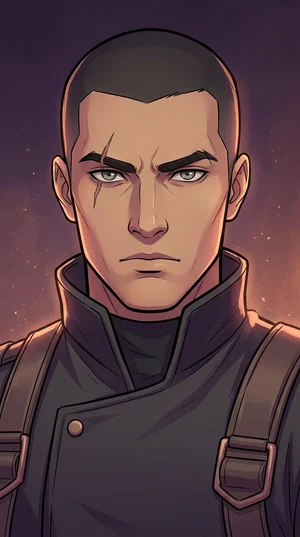
There’s a man asleep in a chair beside my cot. He’s slumped sideways with his head against the tent pole, and both his hands are bandaged to the wrist, white linen, and one of them is lying on top of mine on the blanket as if it got there by itself and decided to stay. Dark hair cropped to the skull. A scar through his left eyebrow.
I know that face. Everyone in the wing knows that face. I saw it once, across the smoke of a pyre, a year ago. You’ll answer for it.
I take my hand out from under his. Very carefully.
He wakes anyway. His eyes open, gray, and find mine, and something goes across his face so fast and so naked that I look away from it, the way you’d look away from someone undressing.
“Captain Locke,” I say. My voice is a rasp. “What are you doing here?”
He doesn’t answer straight away. He just looks at me. He looks at me as if I’m a ledge he’s about to step off, and he already knows exactly how far down it is.
“How much is gone?” he says quietly.
“What?”
“What’s the last thing you remember?”
“Sol. The forge. Being told you were coming.” I push myself up on my elbows, and everything hurts, and I look down at my left wrist. At my tally cord. Dark red silk, knotted so tight they’ve gone hard as beads.
I count them. I count them again.
Thirty-one.
I had twenty-seven. I know I had twenty-seven. I counted them that night in the tent, the way I do when I can’t sleep. The last of the new ones is tied in a different hand from mine, smaller and neater and very tight. Somebody tied it for me while I slept.
“How long?” I say.
“Sixteen days.” His voice is very even. “The Saddle campaign. The Ossine came up the pass two days ago, and we held it, and the snow closed it behind them. You went under in the battle, longer than anyone’s ever gone. You’ve been asleep since.”
Sixteen days. Gone. Clean as a tooth.
I stare at him. “And you’re here because—”
“Pair procedure.” He reaches into his coat with a bandaged hand, slowly, and brings out a piece of paper. Folded twice. My name on the outside in pencil, in my own handwriting, and a date I don’t remember living. “If either of us goes under deep, the other one carries the letter.”
“I don’t write waking letters,” I say.
“I know,” says Ardan Locke. “You wrote this one anyway.”
His sleeve has ridden up over the bandage. There’s a tally cord on his wrist, and I count that too, out of habit. Six knots.
“Everyone says you never go under,” I say.
“I went under,” he says. “Twice. Morrow took something, the second time.”
“What?”
“I don’t know yet.” Something warm moves under his voice, and I don’t understand it. “Nothing I’ve missed.”
I read it alone. He goes and stands outside the tent in the snow to let me. I can see his shadow on the canvas, not moving.
The letter is in pencil, on cheap paper, in my own hand. It’s crooked, like I wrote it on my knee.
Maren,
It’s you. You’re reading this because you went under too long and Hask has taken something big. Probably all of it. Don’t panic. Count the knots. Then keep reading.
You didn’t murder Jory Locke. He fired the red. Saffi had been fed feverwort and she was diving on the hospital, and he asked, and you made it quick. Hask showed us. It was Pell. If you’re reading this, I hope they’ve hanged him.
The man who gave you this letter is Ardan. You think he hates you. He did. He doesn’t.
You’re going to look at him and think that isn’t possible. So check. Your dragons coiled, and you’re crossed, and you can feel him. It’s real. It can’t lie. It’s the only thing in the world that can’t.
He’s stubborn and he never goes under and he folds his socks. He’s the best thing that’s ever happened to you, and you’re not going to remember why. That’s all right. You chose him once without being sure. You can do it again.
Don’t be an idiot about this. You’ve been an idiot about everything else.
M.
P.S. Hask is in love with Morrow. Let him.
P.P.S. Oranges don’t taste of anything anymore. Don’t ask.
I read it three times. Then I fold it back up and hold it against my chest.
Outside, the shadow on the canvas hasn’t moved.
Check, says my own handwriting.
I don’t know how. I don’t remember how. But I close my eyes, and I reach, the way I’d reach for Hask, out past my own breastbone into the cold.
And there’s someone there.
It’s like putting my hand against a wall in the dark and finding it warm. He’s ten feet away, standing in the snow, and I can feel him the way I can feel my own pulse. Fear, a great deal of it, held very still. Exhaustion, bone-deep. And under it all, holding everything else up, so big and so steady and so patient that it takes my breath away: something I’ve never had pointed at me in my life.
He’s not asking for anything. That’s the thing. He’s just standing there in the snow, feeling it, and letting me feel it, and waiting to see what I’ll do.

 100 to start reading with.
What did you think?