You're on My Ice, chapter 1 of Five Minutes for Falling
At 5:58 on a Tuesday morning in January, there was a man on Poppy Albright’s ice, and he was enormous.
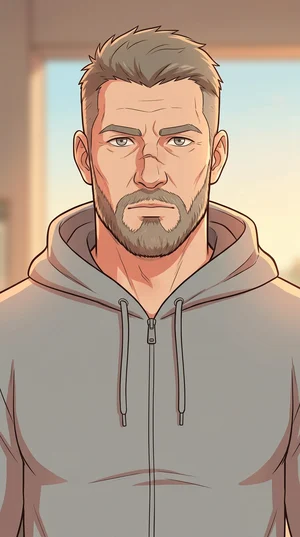
He was skating backward along the far boards in a gray hoodie and black sweatpants, no helmet, no music, no hurry, carving the corners so low and clean that the blade threw up a little fan of snow each time. A stick. A bucket of pucks at the bench door. A hood pulled up as if that would stop anybody from noticing six-foot-four of him under the Snowglobe’s one working bank of lights.
Poppy set down the tray of coffees on the lobby counter, checked the clock over the skate rental window, and pushed through the doors onto the mats.
“Hi!” she called. “Good morning! You’re on my ice.”
He did not stop. He slapped a puck off the boards, collected it on the rebound and sent it into the open net at the far end with a crack that echoed off the trusses.
“Excuse me,” she said, louder. “Sir. Large sir. Your booking ended at 5:45.”
He looked over, then. A beard trimmed close, a nose that had been broken at least twice, and eyes the pale, unimpressed gray of the Providence River in February. He glided to the bench door and stopped with his hip against it. Not even a spray. Show-off.
“Clock’s fast,” he said.
“The clock is a gift from the Fox Point Rotary Club and it is never wrong. My six o’clock is coming through that door in two minutes, and they are seventy-two, sixty-four and thirty-four years old, and two of them cannot stop yet.”
“They can’t stop.”
“That’s what the lesson is for.” She held the door wider. “Off. Please. I’m saying please, which is more than you did when you booked my ice under the name A. Smith.”
One side of his beard shifted about a quarter of an inch. On another man that would have been a grin. On this one it seemed to be the most he was prepared to concede without a lawyer present.
“Smith’s a common name,” he said, and stepped off the ice, and kept stepping up, and up. She had to tip her head back. He smelled like cold air and the cheap blue tape on his stick.
That was when she placed him.
Not because she followed hockey. She did not follow hockey. She ran a sixty-four-year-old community rink with a leaking compressor, and hockey was the thing that paid for the ice between two and nine every evening and left tape balls in the drain. But you could not live in Providence that winter and not know the face. It had been on the local news for six weeks. It had been on a billboard on I-95, in an Ironclads jersey, until somebody quietly painted over it. It had been on every phone in the city in a grainy video from a bar on Wickenden Street, swinging.
Vold the Brute, the Providence Courier had called him. Captain Anders Vold, who had punched a man in the back hallway of the Anchor Room on the eleventh of December and had never said one word about why.
“Oh,” said Poppy.
“Yeah,” said Anders Vold.
“Well.” She let the door bang shut behind him. “You’re still on my ice.”
The Tuesday Wobblers arrived at six exactly, because Rosalind Shah had been a family-court judge for thirty years and believed lateness was a form of contempt.
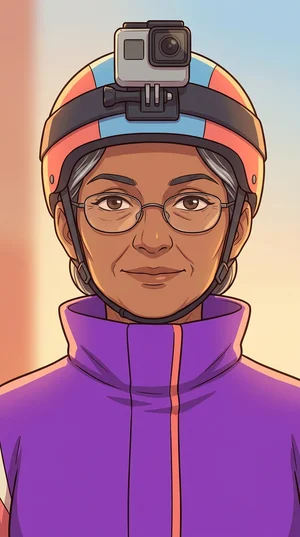
Rosalind came first, in a purple ski suit and a helmet with a GoPro mount she had never once used. Then Walt Pruitt, seventy-two, retired letter carrier, who walked with the slight roll of a man with one knee that had been replaced and another one that should have been. Then Cora Nguyen, thirty-four, who worked nights in the emergency department at Rhode Island Hospital and came straight from her shift in scrubs with skates slung over her shoulder, because she said falling on purpose at six in the morning was the only thing that let her sleep.
They saw him at the same moment. He was sitting on the far bench unlacing, and he was not quick about it.
“That,” said Walt, “is the hockey player.”
“That is A. Smith,” said Poppy. “He’s leaving. Helmets on. Let’s go.”
She took them onto the ice the way she took everyone, hand to the boards, short steps, knees soft. Rosalind had been coming for eleven weeks and could now glide the length of the rink on one foot if nobody spoke to her. Cora was fearless and bad at it. Walt was careful and worse.
“Lesson one,” Poppy said. “Again. Always.”
“How to fall,” the three of them said, like a congregation.
“How to fall. Little dip. Hands forward, like you’re reaching for the last doughnut. Chin tucked. Down sideways, onto your hip. Never back onto your wrists. Your wrists are not—”
“Landing gear,” said Cora.
“Landing gear.” She went down herself to show them, easy, the ice cold through her leggings, and popped back up. “Falling’s not the scary part. Falling’s just the floor arriving. You decide how you meet it. Okay? Walt, you first.”
Walt was looking at the far bench.
“Walt.”
“He’s watching,” Walt said. “I’m not falling down in front of the captain of the Ironclads.”
“Then you’ll fall down in front of him by accident, which is worse.” She skated backward in front of him, hands out. “Look at me. Not him. Me. Little dip.”
Walt did a little dip. Then his bad knee did something his good knee did not agree with, and his skates went two directions at once, and he went down backward, wrong, onto both wrists, and his helmet hit the ice with a hollow plastic knock that went straight through Poppy’s chest.
She was on her knees beside him before the echo stopped. “Walt. Don’t move. Talk to me.”
“Ow,” said Walt, with dignity.
“Wrists?”
“Both hate me.”
“Head?”
“Helmet hit. I didn’t.” He tried to roll and his face went gray around the mouth. “Knee’s not great.”
Cora was already sliding over on her knees, scrubs and all, saying Walt, look at my finger. Poppy got an arm under his shoulder and knew, the moment she took his weight, that she could not lift him. Not on ice, not with that knee. She was five foot three and a hundred and twenty pounds of ex-pairs skater, and pairs skaters were the ones who got lifted.
A shadow fell across them.
Anders Vold had come out onto the ice in his socks.
“Here,” he said.
He didn’t wait for permission, but he didn’t grab, either. He crouched, put one arm behind Walt’s back and the other under his good knee, and said, “Hold my neck, sir,” in the same flat voice he’d used for the clock, and stood. Just stood, with a grown man in his arms, like someone picking up a bag of groceries. He walked across the ice in his socks, careful and sure, to the bench, and set Walt down on it as if Walt were made of something that could chip.
“Ice,” he said to Poppy, over his shoulder. “For the knee. You got a bag?”
She stared at him.
“Boss,” he said. “Ice.”
“Behind the counter,” she said. “Yes. I have ice. It’s a rink.”
There it was again. The smile’s cousin.
She got the ice. Cora checked Walt’s wrists and his pupils and pronounced him bruised and lucky and banned from the ice for two weeks, which Walt received like a prison sentence. Rosalind found Walt’s reading glasses on the ice and gave Anders Vold a long, judicial look over the top of them.
“Young man,” she said. “That was decent.”
He was lacing his boots by then. He nodded without looking up. “He okay?”
“He’ll live,” said Cora. “He’ll complain.”
“Good.” He stood, shouldered his bag, and looked at Poppy. “Thursday. Five o’clock. I’ll be off by quarter of.”
“Under what name?”
“Smith,” he said, and left.
It was only after the lobby doors had swung shut behind him that Poppy noticed Cora was still holding her phone up.
“Were you filming?” Poppy said.
Cora looked at the phone as if it had done this on its own. “I was filming Walt. For the group chat. You know, encouragement.”
“Delete it.”
“Absolutely,” said Cora, who did not.
The bank letter lived under the skate sharpener.
Poppy did not believe in hiding problems. She believed in putting them somewhere she could see them every day and choose not to look at them until five o’clock, when the afternoon learn-to-skates were done and the hockey kids had not yet arrived and the building ticked and dripped around her like a big tired animal.
It was the second letter. The first one had been polite. This one used the phrase material default twice. Fourteen months ago her grandmother Noreen had died in her sleep in the apartment over the pro shop, where Poppy now lived, and Poppy had inherited the Snowglobe: the glass front that faced the river, the 1962 Zamboni named Gus, the compressor that coughed, forty years of photographs of skating clubs on the lobby wall, and a second mortgage Noreen had taken out to replace the roof. Fifty-eight thousand four hundred dollars still owing. Two payments behind. The Snowglobe made money in January and lost it in July, and Noreen had always found a way through the summer, and Poppy did not yet know what the way was.
She read the letter again. She put it back under the sharpener. She sharpened three pairs of rental skates very hard.
Her phone had been buzzing in her back pocket since noon. She had been ignoring it with real discipline. At 5:10, between the last learn-to-skate and the first hockey practice, she finally looked.
Forty-one messages. Three missed calls from her mother in Phoenix. A text from her cousin that just said POPPY????
Cora’s video was everywhere.
It was nineteen seconds long. Walt on the ice. Poppy on her knees. The big man in socks crossing the frame, lifting Walt like a sack of mail, setting him down gently. Then, clear as a bell in the hollow rink: Boss. Ice. And Poppy, red in the face, saying Yes. I have ice. It’s a rink.
Two point one million views. The top comment: the way he said BOSS i need to lie down. The second: Vold the Brute carrying grandpas now?? The third, with eleven thousand likes: wait who is SHE. is that his GIRLFRIEND
The Courier had written it up by three. The headline was THE BRUTE’S SOFT SIDE, and under it, smaller: Ironclads captain spotted at Fox Point rink with mystery woman.
“I’m not a mystery,” Poppy said to the empty lobby. “I’m on the website.”
She went to put the kettle on in the office. When she came back, there was a woman in the lobby.
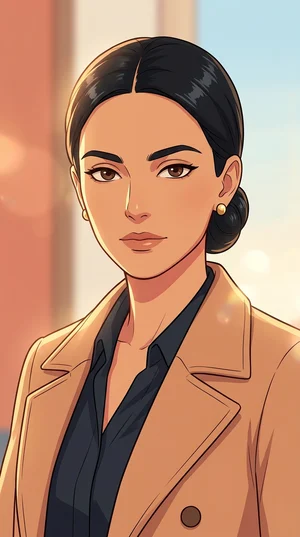
She was perhaps forty, in a camel coat that cost more than the Zamboni, with black hair in a perfect low knot and two coffees from the good place on Wickenden Street in a cardboard tray. She was studying the photographs on the lobby wall, the skating clubs of 1974 and 1988, Noreen in every one of them, as if she were pricing them.
“Hi,” said Poppy. “We open for public skate at seven. Rentals are eight dollars.”
The woman turned and smiled. It was a very good smile. It had been to law school.
“Poppy Albright,” she said. “Nadia Khoury. I represent Anders Vold.” She held out one of the coffees. “Oat milk, two sugars. Your friend Cora was very helpful on the phone.”
Poppy did not take the coffee. “If he’s suing me for the video, he can’t. I didn’t take it. Also I don’t have any money. You can ask the bank.”
“Oh, I know you don’t.” Nadia set the coffee on the counter between them, beside the bowl of free mints, and looked at the leaking corner of the ceiling, the cracked glass in the trophy case, the old banner that said RIVERSIDE SKATING CLUB, EST. 1962. Then she looked at Poppy, and her smile went from good to dangerous.
“I’m not here to sue you, Ms. Albright,” she said. “I’m here to ask if you’d like to be my client’s girlfriend. For six weeks. Paid.”

What did you think?