The Rules Over the Door, chapter 1 of He Would Rather Starve
The man who wanted forty-one gravestones cut had written that he would prefer the stonecutter to arrive after dark, and that the stonecutter should not, under any circumstances, cut himself.
Hester Vane had read the letter eleven times. It was addressed to her father, who had been dead since April, and it was written in a hand so old-fashioned it looked engraved: long s’s, a lowercase g with a tail like a hanging bell rope. Forty-one names, with dates and one line each. Blackfell gritstone, already dressed. The work to be completed before the thaw. Three hundred sovereigns.
Three hundred sovereigns. The bank wanted two hundred and eighty by Lady Day.
She had answered it as J. Vane, which was not a lie, because her name was Hester Josephine, and she had packed her father’s chisels in their roll and taken the Tuesday train up from Wyke to Cold Ashby, where the line gave out, and the carrier’s wagon from Cold Ashby to the packhorse bridge below Blackfell, where the carrier had put her down in the snow and turned round without a word, because nobody from Cold Ashby went further. She had carried her roll over the hump of the bridge on foot. On the far side a stranger had been waiting with a pony cart and a lantern. And now she was sitting beside him on Blackfell Moor, and he would not stop whistling.
“You’ll want to stop that,” she said, “or I’ll want to push you off.”
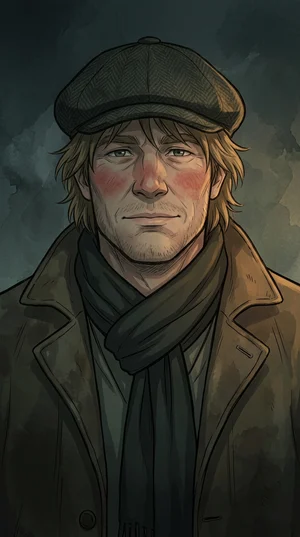
“It’s the Ashby Reel.” Toby Crane grinned at her sideways. He had a broad, weathered, likable face, the kind that got forgiven for things. Thirty-five, perhaps, with a groom’s shoulders and a cap pulled down. “Every soul in Cold Ashby knows it.”
“Every soul in Cold Ashby has heard it. That isn’t the same as knowing it.”
He laughed, which she had not expected, and stopped. For a while there was only the creak of the cart and the pony’s breath, and the dark moor going up and up on either side, white where the lantern touched it and nothing where it didn’t.
“You’re not what his lordship wrote for,” Toby said.
“His lordship wrote for a letter-cutter. I cut letters.”
“He wrote for Josiah Vane.”
“Josiah Vane’s under a stone I cut myself. Fourpence a letter, and I didn’t charge for the space.” She kept her eyes on the road. “If his lordship wants his money back, he can have it. I haven’t been paid any.”
Toby took the reins in his right hand and held up his left. In the lantern light she saw a scar across his palm, white and puckered, as though the hand had once tried to close on something it shouldn’t. “Got that on the ice,” he said, cheerfully, “years back. Point is, the house is old and the master’s older, and you’ll do well to mind the rules. That’s all I’m saying. Mind the rules and mind your hands.”
“I always mind my hands,” Hester said. “They’re the only part of me anybody pays for.”
Wintersend Hall came up out of the snow like a word half rubbed away. A long black front, three storeys, two towers, a great many windows and almost none of them lit. Below it, in the dark, she could hear nothing at all, which Toby said was the beck, the Wending Beck she had walked over at the bridge, frozen since November. “The bridge is the bounds,” he said. “From first snow to the thaw, the house’s people don’t go over it. We send our orders down with the carrier, and he leaves the goods on the bridge. When you hear the beck running, that’s the thaw. Not before.”
He handed her down at the great door and did not get down himself.
Above the door, cut into the lintel, were the rules.
Hester had expected something. A family motto, perhaps, the sort of Latin that rich men paid sixpence a letter to have put over their porches so they could forget what it meant. She had not expected seven lines of English cut by somebody who had never held a chisel before and had decided, with great courage, to begin.
I. SAY YOUR NAME AT THE THRESHOLD. II. ABED BY THE LAST BELL. III. BLEED NOT UPON THE STONE. IV. OPEN NO WARM DOOR. V. WHAT IS TRADED HERE IS WRITTEN; WHAT IS WRITTEN IS OWED. VI. THE MASTER KEEPS FROM THE CHAPEL STEP. VII. NONE LEAVES BEFORE THE THAW WHO HAS SIGNED.
The serifs wandered. The Ws had been cut as two Vs that had not been introduced. The S in THRESHOLD leaned like a drunk on a lamppost, and someone had gone at the semicolon in the fifth line as though it had personally offended them.
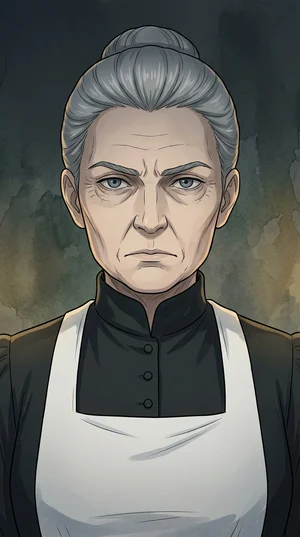
The door opened before she could knock. A woman stood in it with a candle: sixty, or close to it, in black wool, with a ring of keys at her belt and a face like a shut gate.
“Say your name,” the woman said.
“I beg your pardon?”
The woman tipped her candle, very slightly, toward the lintel. Toward the first line.
Hester looked at it. She looked at the woman. She had been in a great many houses of mourning and had learned that every one of them had its customs, and that it cost nothing to keep them and a great deal not to. “Hester Vane,” she said, clearly, to the dark hall beyond.
Something in the house settled. She would have said afterward that it was the draught, a door shutting somewhere, a shift of cold air. It felt like a crowd in the next room turning, all at once, to look at her.
“Mrs. Bell,” said the woman, and that was all the welcome there was.
The library was at the end of a corridor so long and so cold that Hester’s breath went ahead of her. Mrs. Bell opened the door and did not come in.
The room was lit by a single candelabrum at the near end of a table that must have seated thirty. The far end was in darkness. The shelves went up into darkness too, and everywhere there was the smell of old paper and cold ashes and, under it, something she could not place, like a church in winter, like stone that had never once been warm.
“Mr. Vane,” said a voice from the far end of the table.
It was a low voice, unhurried, with an accent she could not place either, as though it had been learned a long time ago in a place that no longer spoke that way.
“Miss Vane,” said Hester. “Mr. Vane died in April. I’m his daughter. I cut half his stones for ten years and all of them for the last two, and I’ll cut yours, if your lordship can bear to be lettered by a woman.”
There was a pause.
“Come into the light,” the voice said. “I would like to see who is going to spell my dead.”
She came into the light. She put her chisel roll on the table, because her hands wanted something to do. And then he leaned forward, just to the edge of the candlelight at the far end of the table, and she saw him.
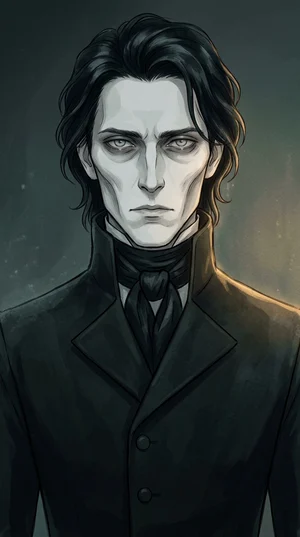
He was beautiful. That was the first thing, and it annoyed her. Beautiful the way a ruin is beautiful, with all the soft parts gone. Dark hair, too long, pushed back. A face with good bones and nothing on them; the skin of his cheeks lay close as wet linen over a carving. He might have been thirty-three. His eyes were grey, very pale, and they did not blink as often as eyes ought to. He wore a black coat buttoned to the throat and he held a glass of something dark that he did not drink.
He was starving. She had seen it once before, in a man brought up into Wyke from a fall-in at the Holme pit, a week without food. The same stillness. The same terrible patience.
“Lord Severn,” she said.
“Ambrose Severn.” He inclined his head. “You are looking at my rules.”
“I’m trying not to.”
“You disapprove of them.”
“I don’t disapprove of rules. I disapprove of whoever cut them. Your semicolon looks like it was done with a hoe.”
Something happened at the corner of his mouth. It was not quite a smile; it was the place a smile had been, a long time ago. “My mother cut them,” he said, “the winter I came home. She had never held a chisel. She did not wish to bring in a mason, for reasons that will become apparent.”
“I’m sorry,” Hester said. “I meant the semicolon. Not her.”
“She would have agreed with you about the semicolon.” He set his glass down. “You will have read my letter.”
“Eleven times.”
“Then you know I am asking you to cut forty-one names, and you have not asked whose.”
“You’re paying three hundred sovereigns. For that money I’d cut the names of the twelve apostles and spell Judas any way you liked.” She held his eyes. “Whose are they?”
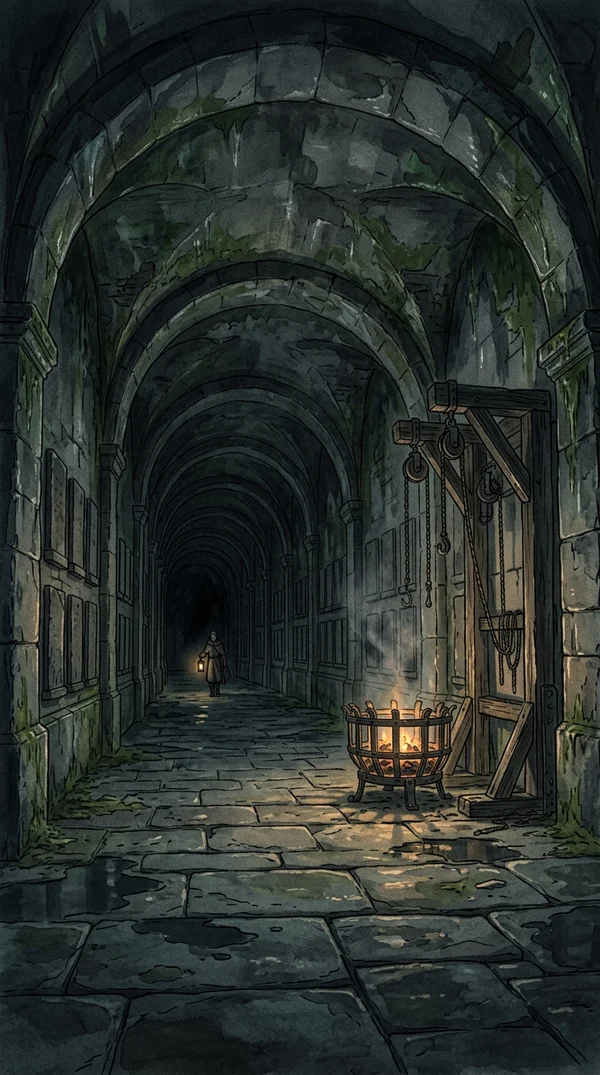
“People who died in this house, or because of it.” He said it very evenly. “Mostly because of me. I will give you the list tomorrow. The tablets are in the crypt, already dressed and set. You will be paid at the end, and you will be housed and fed, and you will keep the rules.”
“And I’ll arrive after dark, and not cut myself.” She tapped the letter. “You underlined that twice.”
“Yes,” said Lord Severn, “I did.”
The Ledger of the House lay on a reading stand at his end of the table, and he did not bring it to her. He told her to bring the candelabrum and come to it, and when she did, he stood and went back three paces, into the dark, as courteous as a man stepping aside on a stair.
It was a great book bound in leather gone grey at the edges, open about two thirds of the way through. The pages were covered in writing in a brown ink that had faded to the color of rust, many hands, many centuries. On the clean page at the end, someone had written out a contract in the same old engraved hand as the letter.
Hester Vane shall cut forty-one names upon forty-one stones in the crypt of Wintersend before the thaw, and keep the rules of the house. Paid three hundred sovereigns. Discharged by the work done or the thaw come.
Except it did not say Hester Vane. It said J. Vane, and as she read, the ink of the J moved like a hair in water and became an H, and the rest of her name spelled itself out after it, rust-brown, as though it had always been there.
She did not make a sound. She was rather proud of that.
“The house has heard your name,” Lord Severn said from the dark. “It writes what it hears.”
There was one more line. It was in the same hand, but it had been written later; the ink was darker.
The guest shall not offer the master her blood, nor shall the master take it. The breaker is written to the house.
“What does that mean,” she said, “written to the house?”
“It means kept. As the house keeps everything.” He did not come closer. “I wrote that line, Miss Vane. I would like you to read it again, and believe it.”
She read it again. She had read contracts for funerals where the family was at war over the plot, and she knew the difference between a clause put in by a lawyer and a clause put in by a man who was frightened. This was the second kind.
“There’s a pin in the gutter of the book,” he said. “The house signs in blood. One drop. I am sorry for it.”
“You’re sorry it signs in blood, or you’re sorry you’ll be in the room?”
He did not answer that.
Hester found the pin. It was silver, old and black at the head. She had cut herself a thousand times in the yard, on slate edges and chisel slips, and she pricked her thumb now as briskly as she would have pricked it to test a blade. A bead of red came up, very bright in the candlelight. She pressed it to the line beneath the contract.
The page drank it.
In the dark at the end of the table there was a sound like ice breaking on a pond. Hester looked up. Lord Severn was standing exactly where he had been, but the glass in his hand was gone to pieces, and the dark wine in it was running down his wrist and dripping onto the floorboards, and he was not looking at it. He was looking at her thumb.
His eyes were no longer grey. They had gone silver all the way across, like a pond with the moon in it, and he was not breathing at all.
“Mrs. Bell,” he said, very quietly, without turning his head, “take Miss Vane upstairs. Now.”
The door behind Hester opened at once. Mrs. Bell must have been standing just outside it.
Hester did not move yet. She put her thumb in her mouth, like a child, because it was the quickest way to stop it, and she saw him watch her do it and close his eyes.
“Miss Vane,” he said, still with his eyes closed, still in that quiet, courteous voice. “There is a key in the door of your room. When you are inside, turn it.”
“Against the house?”
“No,” said Lord Severn. “The house has heard your name. The house will let you be. Turn it against me.”
What did you think?