Twelfth Night, chapter 5 of He Would Rather Starve
He was very good at chess, and he was a liar about it.
“You let me take that bishop,” Hester said, on the fourth evening.
“I would never.”
“You looked at it. You looked at it and then you looked at the ceiling like a vicar who’s been offered a second sherry.”
“I was considering the ceiling. There is a damp patch.” He moved his queen, from the far end of the table, by telling her where, and she leaned down the polished wood and moved it for him with the end of a long brass candle-snuffer, because the board sat at the halfway mark, and neither of them crossed it. “Check,” he said.
She looked at the board. “That’s very rude.”
“It is chess.”
They played by the hour, at dusk, every day. Toby sat on the crypt stair in the mornings and whistled, and Mrs. Bell sat at the top of it in the afternoons and knitted something grey and endless, and neither of them spoke to the other, and Hester cut. Nine names by Christmas. Eleven by the New Year. Her ankle healed. Nobody filed anything.
And every evening she moved her chair one place closer.
He never remarked on it. He would be sitting at his end when she came in, in the dark, with the board set up at the middle, and she would sit down one place nearer than the night before, and he would say, “Good evening, Miss Vane,” and nothing else. But on the night she reached the twelfth chair, she saw him look at the distance between them, and then at his hands.
After the chess came the names.
She read him the list, and he told her who they were. It was the strangest hour of her day and she found she looked forward to it more than to her dinner. He told her about the drover lost on the moor whose dog had followed Ambrose home and lived in the stable for nine years and bitten everyone but him. About a man named Absalom Pryce who had come up Blackfell with a stake and a Bible and very nearly managed it, and had been, Ambrose said, the bravest fool he had ever met, and he had been sorry about that one for a hundred and fifty years.
“Why tell me?” she asked him once. “I only need the dates.”
“Because you will be the last person who ever knows them,” he said. “I would like someone to know them.”
She did not ask him what he meant by last. She did not want to know yet.
In return, because a bargain went both ways, he asked her things. Why she had not married. (“Nobody asked who could also do long division.”) Why she charged by the letter. (“Because a letter is a thing you can see. You can’t charge by the grief. People would argue.”) And on the night before Twelfth Night, out of nowhere, with his eyes on the chessboard: “Who cut your father’s stone?”
She was quiet.
“I did,” she said. “In April. In the yard. It took me a morning. I charged myself fourpence a letter and wrote it in the daybook, so that I’d have to pay it.” She moved a knight, badly. “I don’t know why I’m telling you that.”
“Because I asked,” he said, “and you are honest when you are asked a question, which is the most inconvenient quality I have encountered in a guest.”
“Did I pay it?”
“I would think you paid it before you had finished cutting.”
She looked at him. He was looking at the board. The candlelight came just to his cheekbone and stopped.
“I did,” she said. “It was the only bill I’ve ever sent that I didn’t want paid.”
He reached out, very slowly, and moved his own knight to a square where she could take it. He did not look at the ceiling this time. He looked at her.
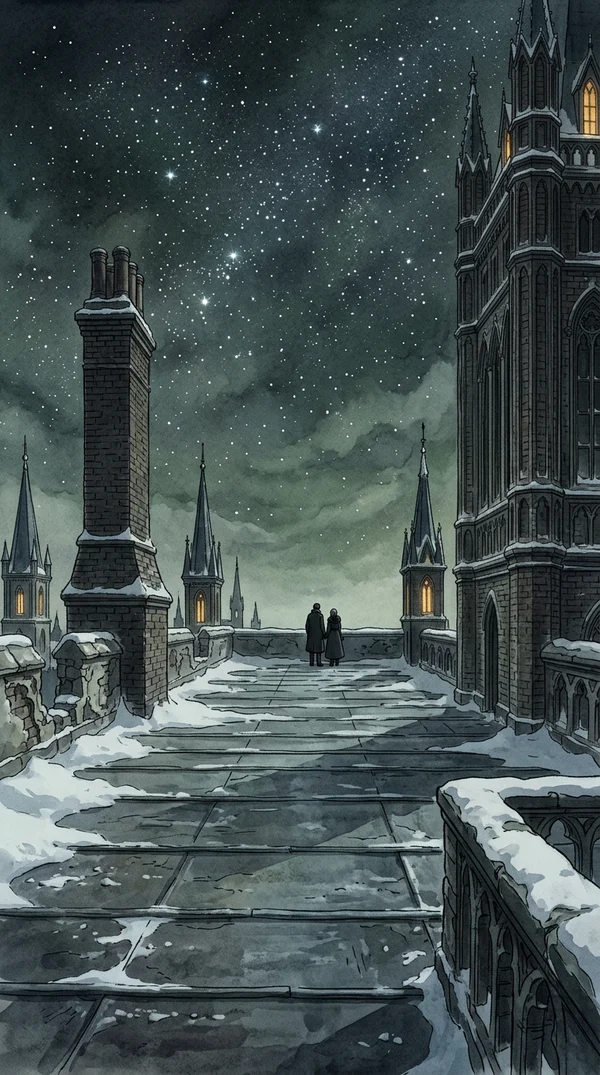
On the night after Christmas she woke a little before the last bell and went to the window, because she had heard a door. A lantern was crossing the yard below, slowly, through the new snow. It went to the north end of the house, where the chapel was, and stopped there at the step, and stood. Hester could see the shape that held it: black wool, a shawl, a ring of keys catching the light. Mrs. Bell stood at the chapel step for as long as it took Hester’s candle to burn down a finger’s width. Then the lantern came back across the yard and went in, and a moment later the bell began.
I saw her lamp in the yard last night, Toby had said. Late.
In the morning Mrs. Bell served her breakfast without a word, and Hester ate it, and watched her hands, and said nothing.
On Twelfth Night, Toby brought in holly and ivy from the moor in a sack and stuck it behind every picture frame in the library until the room smelled green and sharp, and Mrs. Bell, without a word to anyone, put six candles on the mantel instead of two.
“It’s the last night of Christmas,” Toby said, when Hester looked at him. “House likes it kept.”
“I thought the house didn’t like anything.”
“It likes being kept.” He winked at her. “Same as all of us.”
There was a piano in the corner of the library under a dust sheet. Hester had never seen it uncovered. Tonight the sheet was off and folded on the floor, and when she came in at dusk Lord Severn was sitting at it, at the very far end of the room, with his back to her.
He played something old. She did not know it. It was a dance, a slow one, the kind that people had stopped dancing before her grandmother was born, and the piano was out of tune in the damp and two of the keys did not sound at all, so that the tune kept stepping into holes and climbing out again. He played it anyway. He played it as though he had learned it in a lit room full of people a very long time ago.
She stood in the doorway and listened.
When he finished, he did not turn round. “My mother’s favorite,” he said. “I have not played it since she died.”
“When was that?”
“Before your father was born.”
Hester came into the room. She did not go to her chair at the table. She went to the other side of the piano and leaned on the lid, and they were twelve feet apart, closer than they had ever been with both of them awake to it.
“Play me something else,” she said.
“I don’t know anything else. Not from this century.”
“Then I’ll teach you one.” She hummed it for him: a yard song, the one her father’s men had sung when they were dressing a big stone and needed to keep time with the hammers, all about a girl from Ashby with a wooden leg. It was not a respectable song. By the third verse he had found it on the keys, and by the fifth he was playing it with a gravity that made it so much funnier that she had to stop singing and put her face in her hands.
When she looked up he was laughing. Properly. With his head down and his shoulders shaking, the sound of it rusty and helpless, and in the six candles of Twelfth Night he looked younger than she had ever seen him. He looked, for a moment, like the soldier in the doorway before he saw the man with the red beard.
She came round the end of the piano without deciding to.
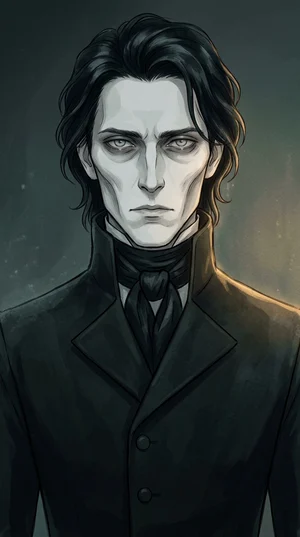
He stopped laughing. He stopped everything. He sat very still on the bench, with his hands on the keys, and she stood beside him, so close that her skirt brushed his knee, and the cold came off him like the breath of an open door in winter. She could see the shadows under his cheekbones, the faint blue at his temples, the pulse that was not there in his throat.
“Miss Vane,” he said.
“Hester.”
“Hester.” He said it as if he were reading it off a stone. “You should step back.”
“I know.”
She did not step back. Neither did he. He lifted his hand from the keys, slowly, the way he moved the chess pieces, and stopped it an inch from her face, and she could feel the cold of it on her cheek like frost on a window. He did not touch her. He looked at her as though he were asking.
She was a woman who charged by the letter. She had never in her life given anybody anything without first writing down what it cost.
She leaned into his hand.
His palm was so cold it burned. And then he stood, all at once, and his mouth was on hers, and it was cold too, cold as snow, cold as the crypt, and underneath the cold it was desperate, and careful, and so gentle that she did not understand for a moment that he was shaking. She put her hand on his chest and felt nothing beating there at all. Her own heart was so loud she was sure the house could hear it. His fingers moved into her hair. Her eyelashes were wet; she thought she was crying and then realized it was frost, melting, from his breath on her face.
He made a sound against her mouth. Low, hurt, almost a word.
Then he was not there.
He was across the room, his back against the bookshelves, his hand over his mouth, as far from her as the library allowed. His eyes had gone to silver, iris and white alike. She could see it even from there, two pale coins in the dark, fixed on her throat.
“Ambrose,” she said.
“Don’t.” It came through his fingers. “Don’t say my name. Don’t come any closer. Please.”
“I’m not afraid of you.”
“I know,” he said. “That’s why.”
He went past her to the door. He went the long way, round the far side of the table, keeping all thirty chairs between them, and at the door he stopped with his hand on the frame, the way he had stood at the top of the crypt stair.
“Lock your door tonight, Hester,” he said, without turning. “Please. For me, if not for you.”
She locked it. She lay awake listening to the house, and once, long after the last bell, she thought she heard footsteps stop outside, and stand, and go away again.
In the morning, when she came down to the kitchen, Mrs. Bell was standing at the range with her back to her and the stone wren on the sill beside her.
“The master’s gone up to the east tower,” Mrs. Bell said, without turning round. “He’s locked the door from inside. He says you’re to keep cutting, and Toby and I are to stay on the stair, and you’re to want for nothing.”
Hester put her cup down. “And the dusk hour?”
Mrs. Bell turned. For the first time since Hester had come to Wintersend, there was something in her face that was not locked against her. It looked almost like pity.
“He says there won’t be one,” she said. “Not anymore.”
What did you think?