“You lost your nerve,” Toby said, the morning after the lantern in the lane.
“I lost my nerve,” Hester agreed. She did not look up from the stone. “I’m sorry. You were kind to offer.”
He watched her a while from the stair. Then he laughed, easily, and said she’d come round to it, and went up whistling. After that he was as he had always been, tea in the mornings and hay prices and the barmaid at the Plough, and she drank his tea and laughed at his barmaid and cut, and never once let her eyes go to his left hand. She found she could do it. She had cut names for murderers’ widows with the murderer standing at her elbow paying the bill. It was only a matter of keeping your face like a stone you had not started on yet.
Mrs. Bell sat at the top of the stair in the afternoons, knitting, and now she sat at the top of it in the mornings too, and Toby on the bottom step with his tea, and neither of them said a word to the other, and Hester cut between them like a woman cutting in a churchyard between two families at war over the plot.
By the twentieth of February she had thirty names. By the twenty-fifth, thirty-three.
And Ambrose was dying.
She did not need Toby’s gran to tell her. She could see it. He no longer kept to the tower; it was as though he had not the strength to climb it, and he lay in the library instead, on the long sofa under the window at the far end, and the frost grew on the glass above him in great white ferns and did not melt even at noon. He slept through the dusks now. Twice she came in for the dusk hour and found him lying with his eyes open and silver and seeing nothing, and stood at the far end of the table until he came back, slowly, from wherever he had been, and said, “Good evening, Miss Vane,” as though nothing had happened.
On the twenty-fifth he did not come back at all. She waited an hour. She said his name. She said it louder.
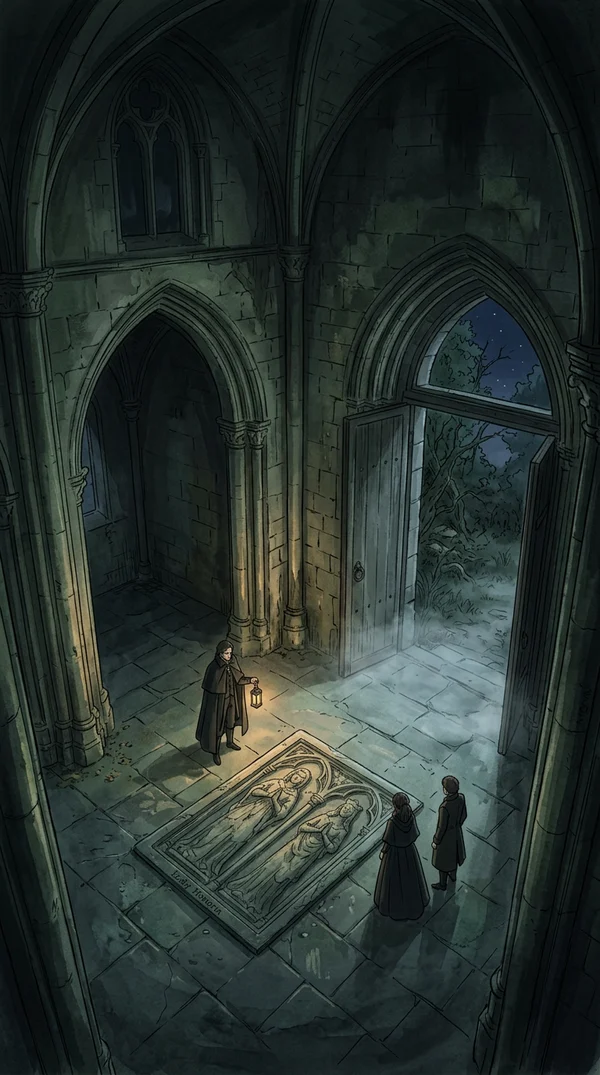
Then she walked down the library, past the thirtieth chair, past the chessboard with his queen still on her square, to the sofa, and knelt down beside him.
He was so cold. That was the first thing. The cold came off him like the breath off a glacier, and when she put her hand on his, his skin was harder than skin should be, smooth and chill as dressed stone. She thought, absurdly, that he felt like one of her tablets.
She took his hand in both of hers and held it.
Nothing happened. She held on. Then his fingers moved. Then, very slowly, as though the effort cost him, they closed around hers.
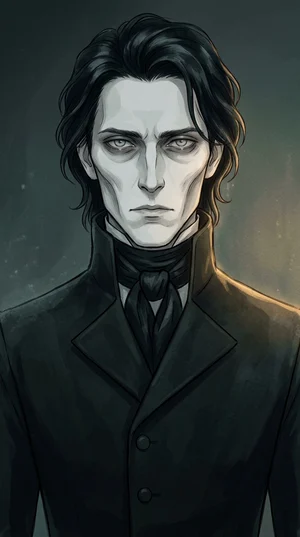
“Hester.” His eyes had grey in them again, at the centers. “You’ve crossed the table.”
“You didn’t come to the dusk hour. That’s a breach of contract.”
“I didn’t know you were counting it.”
“I count everything.” She chafed his hand between hers, hard, the way she would chafe her own in the yard on a January morning when they had gone white and stupid with cold. “Give me the other one.”
He gave her the other one. She held them both against her, and rubbed them, and breathed on them, and he lay and watched her do it with an expression she could not read.
“They won’t warm,” he said.
“Everything warms. It’s only a question of how long you’ve got.”
“I am not sure that is true.”
“Stone warms,” Hester said. “I’ve cut on gritstone in a frost so hard it rang. You put your hands on it long enough and it takes the heat from you, and then it holds it. It holds it longer than you do.” She looked at him. “You only have to be patient. I’m very patient. I’ve cut thirty-three of your dead and I’ve another eight in me.”
He said nothing. But his hands, in hers, did not pull away.
“Tell me how it happened,” she said. “Not the red beard. Before that.”
He told her.
He told her about a winter war in a country he did not name, and a burned church in the snow where his company had sheltered, and a wound in his thigh that went bad, so that by the fourth day the others had gone on and left him there with a canteen and a pistol and the understanding that he would use one or the other. He told her that on the fifth night a woman had come into the church out of the snow, a woman with a lantern and no name, who had sat down beside him and looked at him as if she were reading him.
“I thought she was a nun,” he said. “She was very kind. She asked me if I wanted to live, and I said yes, and she did not ask me anything else. She did not ask me what I would give.” His thumb moved, very slightly, over the back of Hester’s knuckles. “That was the first thing ever taken from me without a price agreed. The last, too. Ever since, I have paid for everything.”
“The Ledger,” Hester said.
“Two guineas a cup. Joseph Hebden of Cold Ashby, and his father before him, and a dozen others before that. Men who needed the money. Once a month, in the gatehouse, with a lamp and a basin and Mrs. Bell at the door. It is all written.” He was quiet. “A hundred and fifty years. Every drop I have had since my mother died, I bought. I made very sure of it. I could not have borne for anyone to give me anything.” His eyes were on her hands. “I don’t think I would know how to take it.”

 100 to start reading with.
What did you think?