Carried Warm, chapter 1 of Kill Me Before It Burns
The trick to robbing the Corona on Galewatch Night is that everyone up there is looking down.
The whole court lines the storm-terrace in wind-silks, nine Lords and their nine households and the old Empress in her chair, and they watch the Gale throw lightning at the bottom of the world. It’s the one night a year the sky-palace remembers it floats. They drink hot wine and tell each other the storm is beautiful, which is an easy thing to say from four miles up and a hard thing to say from the bottom.
I was on the Reliquary roof by the second bell, belly-down on a lead gutter, with my tension wire between my teeth and my pulse knocking at my collar.
Ninety-one steps from the cleaners’ door to the egg. My mother counted them every night for eleven years, pushing a mop. She used to tell me the Reliquary like a bedtime story: the long hall of saints’ knucklebones, the case of Vael’s shed claws, the cold room at the end where the last egg slept in iron. I could have walked it blind. I didn’t plan to walk it at all. I planned to come through the ceiling.
The dome over the cold room was made of Tallow glass in diamond panes, and I’d cut Tallow glass before. I scored a pane, pressed the suction cup, lifted it out, and let the cold room breathe up at me. Frost on my face. Somewhere below, a guard was snoring with real commitment.
I dropped a knotted line and went down it.
The guard sat by the cold room door with his chin on his chest and his purse on the bench beside him, fat and open. I stepped over his boots. A purse is a fine thing, but I have three rules, and the first is that you don’t take from anyone who’ll go hungry for it. He had the hands of a man who sends his pay home. I left it.
The second rule is no blood. I carry a knife for rope and wax seals and that’s all it’s ever cut.
The third rule is nothing stays. Whatever I take, I sell before sunrise. You can’t lose what you don’t keep, and nobody can take it off you either. I learned that one young.
The egg sat in its cradle on a plinth of black stone. I’d imagined it bigger. It was the size of a man’s head and the colour of hammered pewter, with a bloom of violet across the crown, like a bruise coming up under the skin. The cradle was cold iron, furred white with frost, and it was bolted to a cold-case chained to the plinth.
I looked at the chain. The lock on it was new. Nine wards, Tallow-made, the kind that takes me a quarter hour with good light and nobody snoring nearby.
The commission had said nothing about a new lock. The commission had said: four thousand marks, the egg, intact, delivered to Dace’s back room by dawn. Four thousand marks was Auntie Brask’s dock out of hock forever, with enough left over to buy Jory a sail that didn’t leak. I’d said yes before Dace finished the number.
The guard’s snore caught, choked, and resumed.
I didn’t have a quarter hour. I had my two hands and an egg.
I lifted it out of the iron. It was heavy as a paving stone and so cold it burned. The frost came off on my palms with a sound like sugar. I needed both hands for the line, both hands for the roof, both hands for the kitewing, and there was nowhere to put a pewter egg except the one place a thief always puts the thing she can’t drop.
I pulled up my shirt and slid it against my belly.
The cold went through me like a nail. I made a noise I’m not proud of, cinched my belt over the bulge, buttoned my jacket over the lot, and climbed.
Up through the dome. Along the lead gutter, slower now, the egg dragging at my middle like a stolen moon. The music from the storm-terrace came round the curve of the palace in pieces: a viol, laughter, someone calling a toast to the Covenant of the Wing. Nine isles kneel to whoever holds the dragon. There hadn’t been a dragon in twenty years, and they kept toasting it anyway.
The Reliquary sits on the eastern lip of the Corona. Past the last gutter there’s a parapet as high as my knee, and past the parapet there’s nothing at all. Four miles of black air, and then the Gale, lit from inside like a lamp somebody keeps kicking.
I unrolled the kitewing on the parapet. Silk on whalebone ribs, oiled, patched, older than Jory. I clipped the harness to my shoulders and my belt, checked each buckle twice, and then I did the thing I always do, which is stand on the edge and not breathe.
They make the family watch. That’s the law of the Drop. You stand at the rail of the Weeping Stair with the other thieves’ children and the murderers’ wives, and the Storm Guard walks your mother to the gap in the railing, and she doesn’t look back because she knows you’re there and she doesn’t want that to be the last thing you see. I was nine. She’d taken one shed scale off the floor of this same building to sell for my fever medicine. One scale. Vael was shedding them by the bucket in those days.
I don’t remember her falling. I remember the gap in the rail afterward, and how ordinary it looked.
My knees did what they always do. I let them. Then I stepped off.
The kitewing bit the wind and the Corona tore away above me, all its lit windows sliding up and out of reach. The cold hit my face and the egg hit my stomach and I swore at both. I found the first updraft off the palace’s keelstone and rode it out east, then down, banking toward the far glow of Tallow, where the glassworks run all night and the furnace chimneys throw heat into the dark like something you could stand on.
It’s an hour’s glide from the Corona to Tallow if you’re good. I’m good.
Halfway, the egg stopped burning cold.
I noticed it the way you notice your hands thaw. First the ache went. Then it was simply a weight, then a weight with a temperature, then something warm against my skin, warm as a cup of tea held too long. I thought, distantly, that this was a nice change. I was very busy steering.
A quarter mile out from Tallow, the egg ticked.
It was a small sound. A fingernail on a window. I felt it more than heard it, a little knock right under my ribs, and I said, “No,” out loud to nobody, and the egg knocked again.
Cold waits. Warm wakes. Every Lowmarrow child knows the nursery song about the dragon eggs, and not one of us ever thought about what it meant, because none of us were ever going to touch one.
I’d carried it warm. I’d carried it warm for an hour against my own skin, like an idiot, like a hen.
I came down hard on the flat roof of the Cendry glassworks, between two chimney stacks, skidded on soot, folded the wing badly and sat down in the warm dark with my hands on my belly like a woman in a bad play.
The knocking had become a scrabbling.
“Don’t,” I told it. “Please don’t. I can’t sell you if you’re awake.”
I unbuckled my belt with shaking fingers and the egg fell into my lap. The shell had a crack now, a long silver seam from the crown down the side, and the crack was moving. A piece the size of my thumbnail lifted, tilted, and fell away. Something wet and dark pushed against the hole.
I could have put it down. I want to be honest about that. I could have set it on the roof and walked away and let the Corona’s Storm Guard find it at dawn, and nobody would ever have known I’d held it. I thought about it. I thought about it the whole time my hands were picking the shell off in pieces, as gently as unwrapping glass.
One piece, no bigger than my thumbnail, pewter on the outside and pearl on the inside, went into my jacket pocket. I didn’t decide to do it. My hands just keep things that shine.
It came out all at once, the way a knot does.
It was the size of a loaf of bread and it was the ugliest beautiful thing I have ever seen. Wet violet-grey scales, a belly the colour of an old copper pan, a long whip of a tail that wrapped twice around my wrist before I could stop it. Wings folded flat and damp against its back like wet paper. Two nubs of horn. When it opened its eyes they were the exact colour of new brass coins, and they looked at me with total, outraged attention.
“Hello,” I said. “I’m so sorry. I’m the thief.”
It opened a mouth full of needles and bit my thumb to the bone.
I yelled. It held on. Blood ran into its mouth and down my wrist, and it swallowed, I watched its throat move, and then a second heartbeat came into my body.
That’s the only way I can say it. My own pulse was where it always is, too fast and too loud. And under it, in the hollow of my throat, a second beat arrived. Smaller. Quicker. A light bright drumming that wasn’t mine, like a moth had got in under my skin and decided to stay. Warmth went out of my chest and into the thing in my lap, and the thing in my lap let go of my thumb and made a sound like a kettle beginning to think about boiling.
It was content. Its contentment arrived in my mouth like a taste: hot pennies.
“Oh, storm take it,” I whispered. “Oh, no.”
“You carried it warm,” said a voice above me. “Of course you did.”
I knew the voice. Any thief on the lower isles would know that voice, because it’s the one that says stop across rooftops just before a bolt hits the tile beside your boot. I looked up.
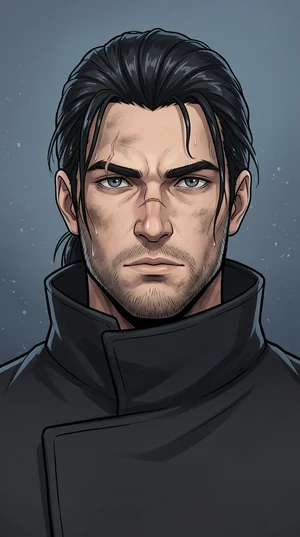
He was sitting on top of the chimney stack, one knee drawn up, a long straight blade across it. Black coat, black hair tied back, the Breaker’s iron bracer on his left forearm catching the furnace glow. Tall even sitting down. His nose had a bump in it. I’d put it there, three years ago, with a shutter on this same isle, while he was busy shouting stop.
Idris Ravelle. The Crown’s Bondbreaker. The only man in the Ninefold who’d chased the Wick across nine isles and never once caught her.
“Hello, Breaker,” I said. “You look tired.”
“I felt it wake an hour ago.” He dropped from the stack and landed lightly on the roof, three strides from me. “It’s like someone knocking on the inside of your ribs. I’ve been running across Tallow ever since, trying to think who’d be fool enough to carry a cold egg against their skin.” The blade came up, unhurried. “I should have guessed sooner.”
I put my hand over the hatchling. It hissed at him, a sound like fat on a pan, and climbed up my arm into the front of my jacket, where it was warm.
My kitewing was folded wrong and torn along one rib. Behind me was a chimney stack. Beside me was the roof’s edge, and below that, the long tiered drop of the glassworks and then the edge of the isle and then the Gale.
“It bit you,” he said.
“It bit me.”
“Then you’re bonded.” He looked at the small lump under my jacket for a long moment, and I’ll swear his face went somewhere else, somewhere a long way off. Then it came back. “And I’m sworn to end any bond not of the Castell blood. You know that.”
“Everybody knows that. It’s on the coins.” I eased my weight onto my back foot. “But you haven’t.”
“I can’t. Not for three days.” The point of the blade came to rest just under my jaw, light as a question. He was close enough now that I could smell rain on his coat and see the shadows under his eyes. “For three days, it dies if you die. After that it doesn’t. After that it’ll take the next heartbeat it’s offered, and the Crown will make very sure that’s the right one.”
The second pulse in my throat went faster, frightened, and the hatchling pressed itself flat against my ribs, and I felt its fear as a cold ache in my back teeth.
“So I’m safe,” I said, “for three days.”
“You’re alive for three days.” He took my bleeding wrist in his free hand. His grip was warm, which I hadn’t expected. “Then I kill you, Wick, and I’m sorry for it, and I’ll do it anyway.”

What did you think?