The Latch, chapter 2 of Kill Me Before It Burns
He had a cuff on me before I’d finished thinking about the edge.
It came off his belt, a heavy iron band hinged in two places with a short chain to a second band, and he closed it around my left wrist with a click I felt in my teeth. The other band went on his right.
“That’s very forward,” I said.
“You broke my nose.”
“You were standing in the way of my shutter.”
“It was the Archivist’s shutter.” He tested the chain once, like a man checking a knot on a boat he doesn’t trust. “And it was my face.”
The hatchling put its head out of my jacket, saw the cuff, and hissed at it. Then it reached out and licked the iron with a tongue like a wet violet ribbon.
“Don’t let it do that,” Idris said.
“I’m not letting it do anything. I’ve known it four minutes.”
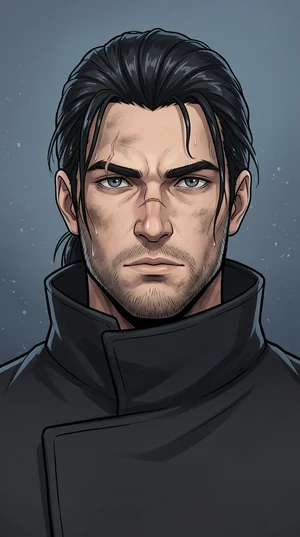
He looked at me then, properly, and I looked back, because three years is a long time to know someone only by the back of their coat. Up close he was younger than his reputation. The furnace light made the bones of his face look carved and tired. There was a white scar through the end of one eyebrow and a smear of soot along his jaw from the chimney stack, and he had grey eyes, the flat grey of a slate roof in rain. He was the sort of handsome that’s mostly a refusal to explain itself. I disliked it on principle.
“Three days,” I said. “Explain.”
“Now?”
“You’ve got a sword at my neck and a chain on my arm. I think I’m owed a sentence or two.”
He lowered the sword. He didn’t sheathe it.
“The first three days are the Latch,” he said. “Until the third moonrise, it can’t live without you. Kill you and it dies. After that comes the Kindling. If you die then, it takes the next heartbeat it’s offered within the hour. And then first fire, ten days, two weeks. After first fire, it’s yours until you’re dead, and when you’re dead, so is it.” He said it like a man reading from a page he’d read too often. “So. Three days.”
“And the Crown wants the next heartbeat to be a Castell.”
“The Crown wants what the law says.”
“The law says my mother goes off the Weeping Stair for one shed scale,” I said. “I’m not wild about the law.”
Something moved behind his face and was put away. He opened his mouth to answer.
Down at the far end of the roof, a lantern opened.
It was the strangest light I’d ever seen used on purpose. A grey lamp with a shutter, opened for a count of two and closed again, so the glow stuttered across the soot. Then another, from the roof of the next works over. Then a third, behind us, on the chimney he’d sat on.
Idris turned and put himself between me and the nearest one without seeming to decide to.
They came over the parapets in storm-grey coats with the hoods up, four of them, the lanterns hooked at their belts. They didn’t run. They walked like people who’d been told exactly where to walk.
“Breaker,” said the first. A woman’s voice, flat. “Marshal’s compliments. The thief comes with us.”
“The Marshal doesn’t give orders to the Breaker.”
“He’s giving this one.” She tilted her head at me. “Alive. Don’t fuss. She’s no use to anyone dead before the third moon.”
I felt the chain go tight between us as Idris’s arm tensed. I felt the hatchling flatten against my ribs. I felt, under the cuff, his wrist; and under his sleeve, where the iron pushed it back, I saw a thin silver line running beneath his skin like a vein made of wire. It had begun to glow. Very faint, the colour of a moon behind cloud.
“The Breaker serves the Crown,” he said quietly. “Not the Marshal’s grey dogs.”
“The Marshal is the Crown, near enough,” said the woman, “and the old lady won’t last the winter.” She lifted a hand. “Take her.”
I would like to say I fought magnificently. What I did was pick the cuff.
I had a pick in the seam of my sleeve and I had it in the keyhole before the first Lantern reached us. It’s a cheap Storm Guard lock, three levers, and I’d have had it in the time it takes to sneeze if the hatchling hadn’t watched the pick with those coin-bright eyes, leaned out of my jacket, plucked it out of my fingers, and swallowed it.
I stared at it. It swallowed again, with relish.
“They eat iron,” Idris said, and then the first Lantern was on him.
Being chained to a man in a fight is like dancing with someone who’s been told a different song. He went left and I went with him or lost an arm. He parried a cudgel, turned, and the chain swung me round behind him like a cape. I caught myself on a chimney and kicked the second Lantern in the knee hard enough to hear it, and she went down swearing. The hatchling put its whole head out and screamed at her, a noise like a whistle being stepped on.
“Don’t cut them,” I said.
“What?”
“No blood. It’s a rule.”
“Your rule.”
“I’m attached to you, so it’s practically ours.”
He made a sound that was nearly a laugh and turned his blade so the flat of it caught the third Lantern across the wrist. Her cudgel spun off the roof. The fourth, the woman who’d spoken, came for me directly, reaching past him for my collar, and he hit her with his iron bracer under the jaw, a short ugly blow, and she sat down in the soot.
The second one had got up. She swung the lantern at my head on its chain. I ducked, the chain went over us both, and Idris pulled me in against him by the cuff so hard I hit his chest with my face. The lantern smashed on the chimney behind us. Oil caught, and the sudden heat rolled across the roof, and I felt the hatchling turn toward it like a flower to a window.
“Skylight,” I said into his coat.
He didn’t ask. He took two steps and kicked the glass in, and the second Lantern, charging us, went through where we’d been standing and into the sand-pit of the Cendry works ten feet below, which is soft as a feather bed and twice as filthy. She’d live. She’d be finding sand in herself for a week.
The woman with the flat voice was still on her knees, holding her jaw. Idris put the point of his sword in front of her face.
“Who sent you,” he said, “an hour after it hatched?”
She spat soot. “Ask your Marshal.”
There were more lanterns now, stuttering on the roofs across the street. He looked at them, then at me, then at the hatchling looking at the burning oil with naked longing.
“Ladder,” he said.
We went down the works’ chimney ladder hand over hand, which is a thing I’d never recommend to anyone chained to a stranger. Twice his boot came down on my fingers. Once mine came down on his head. At the bottom we ran through a yard full of cooling glass and down a lane and into the black mouth of a culvert, and stopped there, breathing like bellows, in water to our ankles.
That was when I started to shake.
It came up from my middle and out to my hands. My teeth knocked. I couldn’t feel my feet. I’d been cold all my life, Lowmarrow cold, damp-in-the-bones cold, but this was a different thing. This was being emptied. I could feel the warmth going out of me in a thread, out of my chest and into the small heavy body against my ribs, where it purred and grew warmer, and I grew colder, and the second heartbeat in my throat beat stronger as mine went slow.
“It’s drinking you,” Idris said.
“I n-noticed.”
He looked at me in the dark. Then he unbuckled his coat one-handed, swore at the cuff, worked it off the arm that was free and down the chain, and dropped it over my shoulders. It was heavy and still warm from him and it smelled of rain and lamp oil and, faintly, of horse. The hatchling made a small greedy sound and pushed its head out into the warm air under the collar.
“You could have let them take me,” I said, when my jaw would work.
“They’d have taken it too.”
“Is that the only reason?”
“It’s the reason I’ve got.” He was looking at the culvert mouth, at the stutter of grey light on the walls outside. His wrist lay against mine on the chain, and I could feel the silver line under his skin. It was hot. “Grey Lanterns answer to Lord Marshal Severin. They were on Tallow inside the hour. Nobody on Tallow knew the egg had gone. Nobody but me.” He paused. “And whoever sent you.”
“Dace sent me.”
“And who sent Dace?”
I didn’t answer, because I didn’t know, and I’d never asked, and that was a thing I’d been proud of an hour ago.
He was quiet a while. The hatchling had found his hand where it rested on the chain and was sniffing his knuckles with great seriousness.
“We’re not going up,” he said at last. “Not to the Corona. Not until I know who in it is moving.”
My heart did something stupid. “Then where?”
“You tell me. Somewhere the Lanterns don’t know. Somewhere warm, or that thing will drain you dry by morning and save me the trouble.”
“Lowmarrow,” I said. “There’s a skiff waiting under the Cendry dock at third bell. It was meant to take your egg to Dace.”
“My egg.”
“The Crown’s egg. Your problem.” I pulled his coat tighter. “The fog’s so thick on Lowmarrow that the Lanterns get lost going to the privy. And there’s a stove. And there’s a woman who’ll feed you, though she’ll hate you while she does it.”
“Most people do both.”
“She’ll do it with a ladle.”
He looked down at the hatchling licking his knuckles, at the chain between us, at me drowning in his coat. I watched him do the sums. I watched him not like the answer.
“Third bell,” he said. “Show me.”
He stood, and the chain stood me up after him. The hatchling grumbled and resettled against my ribs, warm now, heavier than the egg had ever been, its small quick heartbeat knocking under mine.
“Keep the Crown’s egg out of the water,” he said.
“It’s not the Crown’s egg any more,” I said. “It’s my dragon.”
It was out before I could stop it. He didn’t answer. Neither did I. But all the way down the lane to the Cendry dock I heard the word the way you hear a dropped coin roll under furniture. My. I hadn’t called anything mine since I was nine years old. I had a rule against it.
I told myself it was a figure of speech. The thing in my jacket bit me, quite gently. It knew better.
What did you think?