What Dace Sold, chapter 4 of Kill Me Before It Burns
“No,” said Idris.
“I didn’t ask you.”
“You were about to.”
He was right, which was annoying. Jory had come back from the docks at dusk with fog in his hair and news in his mouth: Grey Lanterns on every bridge, asking after a small dark woman with a burn on her hand, and Dace Morrow’s shop at the end of the Hang lit up and open for business as though nothing in the world had happened.
“He’s got my four thousand marks,” I said. “Brask’s deed is pledged to Carrow the moneylender till the first of the month. And Dace knows who hired me, which is a thing you want to know as well, so don’t pretend you don’t.”
Idris looked at Grudge, who was sitting in the coal scuttle eating the coal scuttle. “And if it’s a trap?”
“Then it’s a trap I know the back door to.”
Brask, from the stove, said, “Take the boy’s hood. And take that dragon in a bag. If anyone sees her, you’re done.”
So I went to see Dace with a dragon in a satchel on my back and a Breaker on a chain, and the Breaker wore Jory’s second-best hood pulled down over his face, and walked a little behind me with his chained hand in my coat pocket as though we were sweethearts. I’d suggested it. He’d looked at me for a long time and then put his hand in my pocket without a word, and I’d been aware of his knuckles against my hip the entire length of the Hang.
The Hang is Lowmarrow’s market, and it’s slung under the isle like washing under a bridge. Rope walkways run out from the lip of the rock, with stalls lashed to them in baskets and cages and nets, all lit by fish-oil lamps, all swaying. Below the walkways there’s only fog. Below the fog, every so often, the Gale lights up and the whole underside of the isle glows violet, and everybody keeps haggling as if it hadn’t.
“People live like this,” Idris said quietly.
“People live like this because you lot live up there.”
He didn’t answer. A woman selling eels on a string pushed past us and he turned his shoulder to give her room without thinking, and I disliked that too, a little less than before.
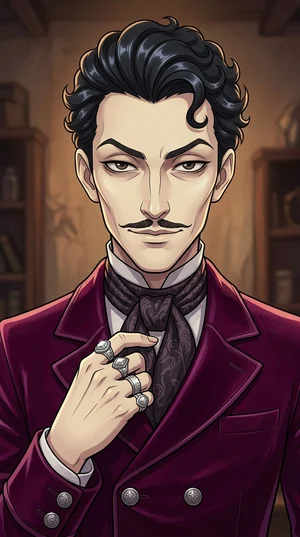
Dace’s shop is at the very end of the Hang, where the walkways meet the keel rock, a lamp-and-pawn shop cut into the stone with a round window full of other people’s rings. He was behind the counter when we came in, thin and bright in a velvet coat, with silver rings on every finger.
“My Wick,” he said, and held out his arms. “My little candle. I was beginning to worry.”
“You never worry.”
“I worry constantly. It’s why I’m still alive.” His eyes went to Idris. “And who’s this?”
“My fella,” I said. “He doesn’t talk.”
“How restful.” He came round the counter. He looked at my satchel. “And the item?”
“There’s been a complication.”
The satchel moved. Dace’s eyes went to it and stayed there, and I watched the colour go out of his face, all at once, like a lamp being turned down.
“Oh, Sorrel,” he said. “You didn’t.”
“I carried it warm.”
“Of course you did.” He laughed, short and high, and went back behind his counter and poured himself something from a green bottle with his back to us. “Well. Well, well. That changes the price.”
“It changes nothing. I did the job. I want my four thousand.”
“Half,” said Dace. “Client’s honour. Half on delivery, and you haven’t exactly delivered.” He brought out a paper chit and laid it on the counter between us. Banker’s paper, good for two thousand at any counting-house on the middle isles, sealed in red wax. “There. I’m not a monster.”
I picked it up. The seal was a heart, split cleanly down the middle. I didn’t know it. Beside me, Idris went very still inside his hood.
“Who’s the client, Dace?”
“Oh, love. You know I never ask.”
“You always ask. You just never tell.”
He smiled and reached for the lamp on his counter, an ordinary brass shop lamp with a shutter on it, and adjusted the wick. The shutter opened. Closed. Opened.
Not a stutter, exactly. A count of two.
I’d learned the trade at this counter. I’d learned to watch a man’s hands and not his face, and to notice what’s different. There were three cups out on his back shelf, washed. Dace never washes a cup unless someone’s going to see it. His shop boy, who has never in four years left the stool by the door, wasn’t on it.
“You sold me,” I said.
Dace sighed. “You were always going to be sold, my candle. The client wanted the egg gone and a thief to hang it on. A very different client wants the egg and the thief both, and pays considerably better.” He spread his hands, all those rings. “I just got paid twice. It’s what I taught you.”
“You taught me nothing stays.”
“And look how well you learned.” He glanced past me at the door. “Don’t run, love. It’s very undignified.”
The door came in.
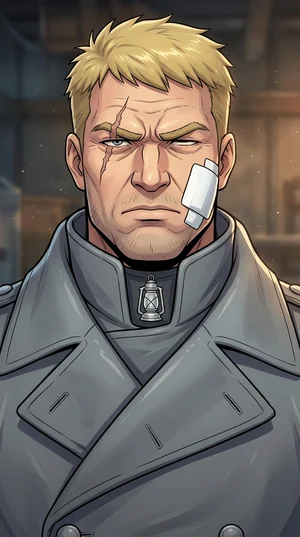
The man who came first was a Grey Lantern captain, I knew it by the silver lamp-badge at his collar. Big, fair, with a scar through one eyebrow that pulled his whole face into a permanent question. Two more Lanterns came behind him, and I could hear boots on the walkway outside, a lot of boots.
“Sorrel Vantry,” he said. “I’m Captain Coyle. Let’s not make this tiresome.”
Idris put back his hood.
Coyle stopped. “Breaker.”
“Captain.”
“The Marshal wondered where you’d got to.”
“I’m sure he did.” Idris’s hand came out of my pocket. The chain drew tight. “Back door, Vantry.”
I was already moving. Coyle was faster than he looked. He came over the counter in one long stride and got his fist in the strap of my satchel, and yanked, and I went backward into him.
The satchel flap burst open. Grudge came out of it like a cork out of a bottle and bit him in the face.
She got him across the cheek, needles and all, and hung there, and Coyle screamed and let go of me to get both hands to her. She dropped off him on her own, smug as a cat, and scrambled back into the bag, and I ran with her bumping against my spine and the taste of hot pennies in my mouth.
Dace’s back door opens onto the underslung walkways, the ones the rope-men use to get at the Hang’s anchor chains. They’re not paths so much as rumours: planks hung on chains beneath the rock, a hand-line if you’re lucky, and nothing under them but the fog. I went through the door at a run and onto the first plank and every part of me that was nine years old screamed and I kept going because the chain on my wrist was pulling and the man on the other end of it wasn’t stopping.
Behind us Coyle shouted. The walkway bucked as he came onto it. Grudge, in the satchel on my back, began to shriek, high and thin, like a gull with its foot caught.
We ran along the underside of the world. Water dripped on us from the rock. The fog came up between the planks in breaths. Somewhere below, the Gale lit, and for one violet second I could see all the way down, through the fog and the dark, into the endless white churn of it.
I stopped.
I didn’t mean to. My feet just quit. The walkway ahead ended in a gap, eight feet of nothing where three planks had rotted out of their chains, and on the far side it carried on round the curve of the rock as if it had no idea it was broken.
“Sorrel,” Idris said.
It was the first time he’d used my name. I didn’t look at him. I was looking down.
“Not down.” He was in front of me, suddenly, with his back to the gap, his chained hand catching mine. “At me. Look at me.”
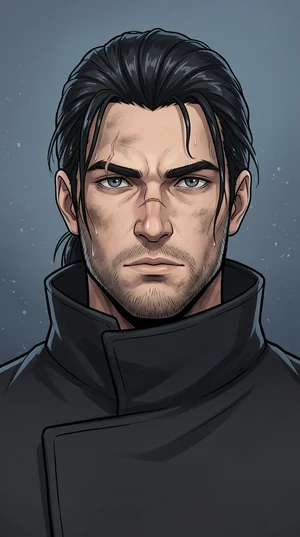
I looked at him. Grey eyes. Soot still on his jaw from yesterday. Rain in his hair.
“We jump together or we fall together,” he said. “Those are the choices. I’d like to jump.”
“I can’t.”
“You came off the Corona on a silk kite.”
“That was different. Nobody was watching.”
His mouth tried something out and put it away again. Then Coyle came round the last bend behind us and Idris said, “On three,” and went on one.
The chain yanked me off my feet. I jumped because the alternative was being dragged. There was a long nothing, and fog in my mouth, and then my boots hit wood and slipped and I went down on one knee on the far planks with the whole walkway swinging under us like a hammock. Idris had me by the back of the coat. He hauled me up by it.
“That was two,” I said.
“I lied.”
Coyle had come to the gap. He looked at it. He didn’t jump. He shouted for a rope.
We went on round the curve, fast, the walkway climbing toward the anchor chains, and I’d almost begun to breathe again when the plank under Idris’s foot simply wasn’t there any more.
He went straight down through it. The chain caught. It caught on my wrist, and the jolt of his full weight hit me so hard I went flat on my belly on the planks and slid, and my shoulder screamed, and the edge of the walkway came at my face. I got my free hand round a chain stanchion. I stopped. He was hanging below me in the fog by his cuffed wrist and nothing else, and the cuff was crushing the bones of mine together, and I could feel them grinding, and I couldn’t pull him up. He weighed twice what I did. I couldn’t even hold on much longer.
“Let go,” he said, from below.
“I can’t let go, you’re chained to me, you halfwit.”
“Pick it.”
I understood him. Pick the cuff, drop him, keep the dragon, run. He’d worked it out before I had, and I minded that more than the cuff.
Grudge had gone silent on my back. The cold in my teeth was hers, and it was terror.
I got a pick out of my sleeve with my teeth.
I didn’t pick his side. I picked mine. The cuff sprang off my wrist and the chain whipped, and I caught the free band on its way past and slammed it shut round the iron stanchion beside my hand. The stanchion took him. The walkway lurched and held. He hung there by his own cuffed wrist from a chain locked to the bones of the Hang, and I knelt on the planks above him with my wrist on fire and my hands empty and no chain on me at all for the first time in a day.
Coyle was shouting for that rope. The far end of the walkway curved up to the anchor chains and from there to the lip of the rock and from there to every street in Lowmarrow I knew how to vanish into.
I lay down on my stomach, reached down, got both hands in his collar, and pulled.
He came up the chain like a man climbing out of a well. When he got an elbow over the planks I got his belt and dragged, and we rolled together onto the walkway and lay there in a heap, and he looked at me from about four inches away with an expression I had never seen on his face before. Pure astonishment.
“You were free,” he said.
“Shut up.”
“You were free and you—”
“I said shut up. Get your cuff off that post, I’m not leaving a good lock for Coyle.”
He sat up and opened it with a key from his belt and stared at the empty band, and then at my wrist, which was swelling, and didn’t put it back on me.
Jory was waiting under the anchor chains with the Gossip’s sail furled, the way I’d told him to, and we dropped into the skiff and slid off into the fog with Coyle still shouting for a rope above us.
Idris didn’t say a word until Lowmarrow was a smudge behind us. He sat with my wrist in his hands, wrapping it in a strip of his shirt, and his face was closed.
When he’d finished, he said, “Show me the chit.”
I’d kept it. Of course I had. I took it out of my coat. The red wax caught the skiff lamp: the heart split clean in two.
“You know it,” I said.
“Every Breaker knows it.” He touched the wax with one fingertip. “It’s the Widow’s seal. Her private seal. Only her steward carries it.” He looked up at me. “The Empress paid you to steal her own egg, Sorrel. And her nephew’s Lanterns just bought you from the man she paid.”
What did you think?