The first laugh came from the back of the dining room at twenty to nine, while Garrett Ware was reading my handwriting aloud.
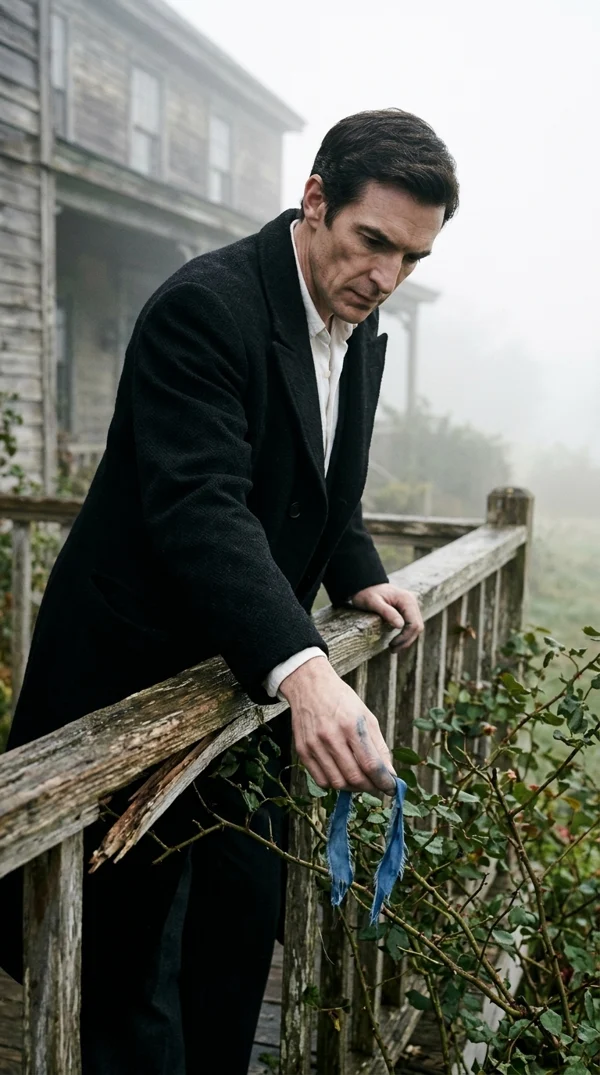
I remember the fog. The rail. Miss Quimby? Hands on my back. I remember being pushed.
He’d read the rest already, beautifully; he’d been reading to rooms for forty years. My notebook at nine: Dreamed about the fog again. A lady falls off a roof and nobody catches her. My notebook at my wedding: Shutter, third floor, left. Open approx. one inch. Cause unknown. I remember the shop. The inkhorn on the sign. I remember a lantern at a rail. All of it, the exhibits to his motion, under item four of the trust’s summer meeting, on the first Monday in August, in front of every member who’d come for supper in the garden.
“The Attorney General’s chosen expert,” said Garrett gently, “believes that she is the reincarnation of this museum’s first curator. She believes that she has been murdered, in this house, in a previous life. And she is the person the state proposes to put in front of a judge in September to tell him what this collection is worth, and whose it is.”
That was when someone at the back laughed.
Not unkindly, I think: the laugh people give in church when somebody’s phone goes off. Then someone else did. A man in the second row said, “Jesus,” under his breath. Two of the docents along the wall looked at their shoes. In the front row a woman who’d chaired the gala committee three times put her hand over her mouth.
They were all there. Teddie in her realtor’s blazer, with Bettina. Mrs. Gove in a straw hat, with her daughter-in-law, who’d looked me in the eye on the lawn for the first time since July and nodded. Detective Mattock by the door. Anjali from the Ledger with her notebook out. Sabine Hatch alone at the back in a navy suit and running shoes. Celestine Ware in her wheelchair in the doorway to the hall, with a tartan rug over her knees in August and Delphine’s hands on the handles behind her. And at the foot of the table, in the chair nobody had sat in from 1931 until Twelfth Night, the man from the parlor portrait, who hadn’t moved since the sun went down.
I’d sat at my table all weekend and imagined exactly this, the laugh. Knowing doesn’t help as much as you’d think.
I could feel him not moving.
I stood up.
“Mr. Ware has read you some of my notebooks,” I said. “I’d like to tell you what I do with them.”
My voice came out level. I’d practiced the level, not the words.
“I’m an archivist. I’ve been one for twenty years. I write things down. I always have, since I was nine; you’ve just heard me at nine. I write down what I see and what I think and what I remember, and then I do the other half of the job, which is the half Mr. Ware didn’t read you. I check it against the record.”
I opened the box.
“Mr. Ware read thirty-one lines where I wrote I remember. Here they are.” I held up the yellow pad. “Beside twenty-nine of them, I’ve written where the record is. I’ll take you through three.”
The room was quiet now: not respectful yet, but waiting.
“In June 2013 I wrote that a shutter on the third floor of this house was open about an inch during my wedding, at about twenty past eight.” I took out the photograph. Teddie had driven to Dover on Saturday and sat in her friend’s kitchen until she found it: a frame from the photographer’s original files, enlarged, with the camera’s own timestamp printed underneath. 29 June 2013, 8:21 p.m. The garden, the folding chairs, the string trio, the magnolia, the back of my own head and my mother’s pearls. And above it, the back of the house in the last of the light, and on the third floor, the last window on the left: a dark vertical line, an inch wide, where the shutter stood open. “That’s not a memory. That’s a camera. I passed it round.”
They passed it round.
“In April I wrote that I remembered a lantern at a rail, and a woman with a camera case, and the river.” I took out three more pieces of paper and held each one up before I passed it. “The Portsmouth Ledger for Monday, the thirtieth of September 1889: the steam launch Nereid, owned by the Ware Bank of Portsmouth, struck the ledge below the South End wharves at half past ten; all were rescued except a photographer from Congress Street, Mrs. A. Thurlow, who was lost overboard with her case. The bank’s president, Mr. Lemuel Ware, had remained ashore.” I handed it to the first row. “The state bank commissioners’ report for 1890: the mortgage of the launch’s pilot, fourteen hundred dollars, discharged three weeks later, no payment recorded, charged off by order of the president. And the discharge itself, from the Registry in Brentwood, signed by Lemuel Ware.”
Somebody in the middle of the room said, quietly, “Ware.”
“And in April,” I said, “I wrote that I remembered fog, and a rail, and a voice saying Miss Quimby?, and two hands on my back.” I took out the last sheet. “This is the report of the Rockingham County medical referee on the death of Miss Cordelia Quimby, the first curator of this house, on the twenty-eighth of September 1944. She fell from the roof walk in fog at about twenty to eleven at night. There was one witness.”
I read it out.
“Miss Celestine Ware, nineteen, of New Castle, volunteer at the said house, who heard the deceased go up to the roof to observe the fog, and later found her in the garden.”
I didn’t look at the doorway where they’d wheeled her chair. I didn’t need to. Every other head in the room turned and looked for me.
Nobody was laughing now.
“That’s what I do with my notebooks,” I said. “I write down what I remember, and then I go and find out whether it’s true. Twenty-nine of the thirty-one lines have paper beside them. Anyone may have the list. Two don’t, and I’ve left them blank, because I don’t know, and an archivist who only shows you what she can prove isn’t being honest either.” I put the yellow pad on the table in front of Judge Leclair. “Mr. Ware says that makes me unreliable. I’d say it makes me careful. You can decide.”
I sat down.
Judge Leclair didn’t let the room breathe.
“Mr. Chairman,” she said, “before we go further, I have a motion.”
Garrett smiled at her. It didn’t reach anything.
“On the fourteenth of October last year,” said Judge Leclair, in her quiet-house voice, “the director of this museum signed an agreement to sell this house to Ware Harbor Partners, of which the chairman is managing partner. The agreement was never disclosed to this board. I have a copy from the Registry of Deeds. Since February 2012 the Ware Family Foundation, of which the chairman is a trustee, has paid the director of this museum a monthly fee for ‘advisory services’. That was never disclosed to this board either. I have the bank statements.” She laid both on the table. “I move that the chairman be removed from the chair, and from this board, for an undisclosed conflict of interest.”
“Second,” said the Unitarian minister.
Garrett looked round the table. He was very good at counting a room. I watched him do it: twelve faces, the two who’d always voted with him looking at their hands, the trustee from Rye who’d voted against Philip’s suspension now very carefully writing nothing on his pad.

 100 to start reading with.
What did you think?