“They took the volumes,” said the archivist at Cocheco College. “They didn’t take the film.”
She was a tall, stooped woman of about sixty with a gray braid down her back and a cardigan with holes in both elbows, and she’d been the college’s archivist for twenty-eight years, and she was, I could tell within a minute, furious. Not at me. At the Wares, and at the deed of deposit, and at a world in which a family could walk into her reading room on a Tuesday afternoon with a lawyer and carry out a box she’d kept safe for half a century.
“In 1976,” she said, leading me down a flight of concrete stairs into the basement on Monday morning, “the state gave every college library in New Hampshire a little money to microfilm whatever it was most afraid of losing. It was the Bicentennial. Everybody was feeling historical. My predecessor filmed the Ware papers first, because they were the oldest thing we had and the boxes were already falling apart.” She unlocked a gray steel cabinet. “Archivists microfilm what they’re afraid to lose, Ms. Tibbetts. And families never think to ask for the film back, because they don’t know it exists.”
She took out a small square box, and then another.
WARE FAM. PAPERS. BOX 1. REELS 1–2. FILMED 6/76.
The microfilm reader at Cocheco is older than Bettina, a great gray hulking thing with a crank on the side and a screen like a television from my childhood, and it hums. I threaded the first reel as I’d been taught in library school, under and over and onto the take-up spool, and switched on the lamp, and wound.
Letters, at first. Ware & Co. business correspondence from the 1790s, ships and rum and molasses, the same trade I’d been reading for nine months in Reuben’s presses, from the other side. A bill of sale for a schooner. A pew rent receipt.
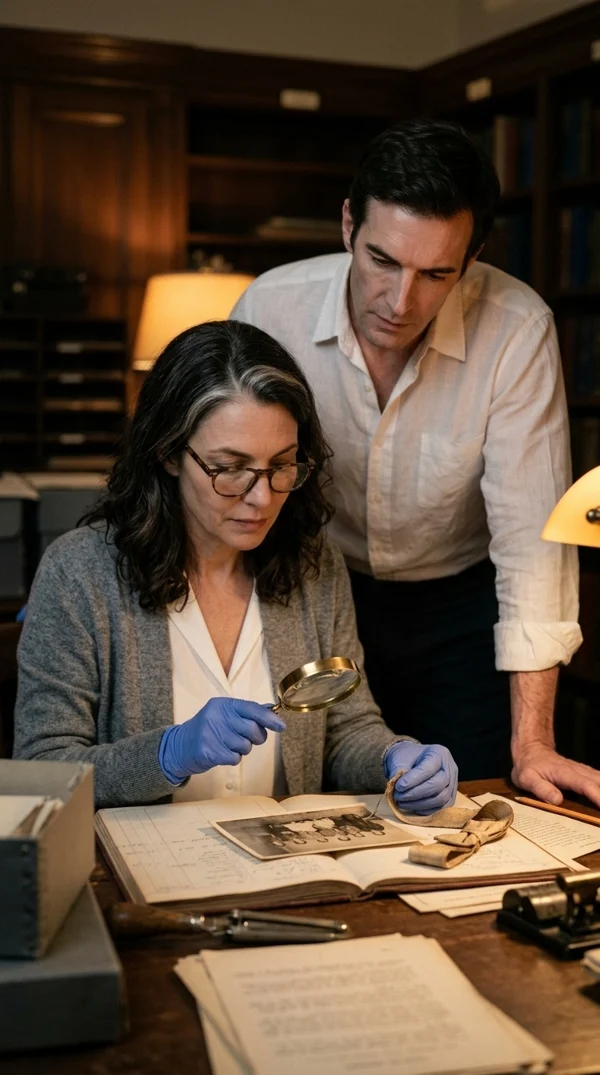
And then, a third of the way into the first reel, the camera had photographed a bound book. Open, a page at a time, two pages to a frame, with a little ruler laid across the bottom for scale.
THE WARE FAMILY BOOK, said the title page, in a big, careful, black eighteenth-century hand. Begun by Jotham Ware, of Portsmouth, Merchant, this first Day of January 1797. Births, Marriages, Deaths, & Matters of the Family.
I sat back from the screen.
Every old New England family had one. I’d catalogued a dozen. You open them expecting births and deaths, and that’s what you get, page after page, the dates and names of a family going about its business for a hundred years.
That’s what this was, too. Births. Marriages. A child dead of the throat distemper in 1801. A daughter married to a sea captain in 1805.
And in among them, in the same hands, things that were not births or marriages or deaths.
I wound slowly. I read every line. I wrote in pencil on my yellow pad: frame number, date, hand, text. I made myself do it in order, without skipping ahead, as I’d do it for anyone’s family, because if I let myself skip I would never stop, and I wanted to be able to swear to every word.
March 1797. Jotham’s hand, black and careful. R.T. has made his will. The firm to E. on his marriage, & I to be bought out at the valuation. This will not do.
June 1797. E. to marry Mrs. Tolman of Market St. at Michaelmas next. Portraits sent for from Newburyport.
July 1797. Mrs. T. shall not see Michaelmas.
I stopped. I read it again. I wrote it down, frame and line, and my pencil didn’t shake. That surprised me.
He hadn’t meant 1797’s Michaelmas. They hadn’t married in 1797. He’d written it more than a year ahead, as soon as there was a date to aim at. And then he’d waited.
29 September 1798. The matter of Mrs. T. concluded. The fever serves. J.W.
October 1798. E. dead of the fever. R.T. much broken.
And then, three months later, in a hand that had gone smaller and harder:
3 February 1799. E.T. seen in Cordwainer Lane at night by myself. He lives. God help this house. Watch it always.
1803. R.T. dead. The firm is ours.
The second reel was the rest of the book, and the second volume, and I didn’t stop for lunch.
The hands changed. Jotham’s son’s. His grandson’s. The entries thinned out through the middle of the century, births and deaths, a Ware lost at Gettysburg, a Ware made a judge. Once in a while, a line about the house. E.T. seen on the roof, 1841. A light on the third floor, 1866. A new “nephew” in probate. They’d watched it the whole time. Every generation, someone had been told: watch the house.
Then a big, confident, gray-whiskered hand I could have picked out of a crowd, because I’d seen its signature on a mortgage discharge in Brentwood.
January 1889. E.T. keeps company with a Mrs. Thurlow, photographer, of Congress St. She has the face. Born Michaelmas, 1845, Concord, it is said.
March 1889. A list, under a heading. To be seen to this year. Repairs to the bank’s roof. A new launch boiler. And, near the bottom, as if it were a boiler:
Mrs. Thurlow. 28 Sept.
And under it, smaller, the reason, written out plainly as a man writes out the case for a loan: If she goes he may go after her into the sun. Then the house comes to market, and the cove with it.
I sat back.
It had never been the women. The women were the means. It was the house: the house on the best water in the South End, which would come free the morning he stood on the roof and let the sun have him. Every one of us had been killed to make him do it.
October 1889. Corliss paid.
I got up and walked round the basement twice, between the steel shelves, and came back and sat down and went on.
The middle of the book, between the two of them, I read more slowly, because I’d begun to understand what I was looking for. Not every Ware had written in it. The great-uncles who sold insurance, the cousins who went west, the daughter who married a minister in Vermont: their births and deaths were there in other hands, and nothing else. The other entries came from one line only, eldest to eldest, as if the book were handed down with the house on the Point and the seat on the bank’s board. It wasn’t a family that had done this. It was a family’s inheritance. Each heir had been given the book and told what it was for, and had picked up the pen.

 100 to start reading with.

What did you think?