The House Book, chapter 4 of My Father Lost Me in a Card Game
“He’ll send it to your father,” Lev said at breakfast.
He’d seen the Escalade too. Of course he had. He’d walked me back along the sand afterwards without a word, a foot of air between us the whole way, and at the deck he’d said good night as if we’d been discussing invoices.
“Let him,” I said. “I’m twenty-nine.”
“Do you want me to talk to him?”
“No.”
He nodded once and buttered my toast. Black bread, salted butter. I hadn’t asked for toast. It was perfect, which was annoying.
“My father wants to meet you,” he said. “Lunch.”
The Zolotoy at noon on a Saturday is a different animal. The chairs were up on the tables and a woman was mopping the dance floor in slow figure eights, and all those mirrors that made a hundred people look like four hundred at night now showed only one old man in a red banquette at the back, eating herring.
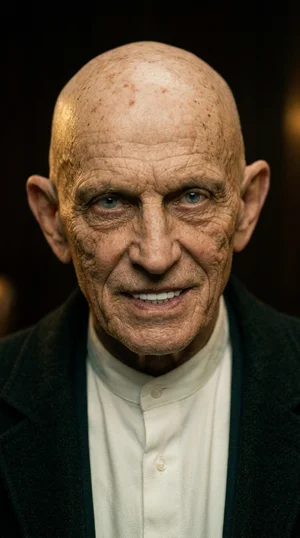
Anatoly Sokolov was seventy-four. He was small and bald, with ears as wide as cabbage leaves and a gold watch that slid around his wrist, and he coughed like a truck turning over on Neptune Avenue on a cold morning. There was a cigarette going in the ashtray next to a tank of oxygen. Nobody seemed to find this strange but me.
“So,” he said, when Lev had put me in a chair. “The bookkeeper.”
He said a Russian word that I took to mean that. Lev didn’t translate.
“My son,” the old man said, “never brings home anything he did not win. Then he wins you and does not keep you. Then he brings you home.” He ate a piece of potato. “You understand why I am curious.”
“I’m curious too,” I said.
He laughed. It turned into the cough and went on for a while. Lev poured him water and he waved it away.
“You know what is the Settling?”
“Last Thursday of August. Every marker paid at the table.”
“Every marker of the year. At my table, in front of the house, in front of whoever comes. Three families come, sometimes four.” He held up one finger. “And at the Settling, only at the Settling, a man may say another man cheated at my table. He says it to the man’s face, with the proof on the felt, and he puts up something of his own, so he means it. If he is right, every marker won by cheating is nothing. Paper.” He blew on his fingers, a magician’s puff. “The cheat pays the house double and never walks on my avenue again.”
“And if he’s wrong?”
“Then he loses what he put up.” He shrugged. “And if he says cheat anywhere else, in the street, in the newspaper, to his wife in bed, it is gossip about my house, and gossip about my house costs a tongue.”
He smiled at me. He had beautiful teeth for a man that age. Too beautiful. They had the bright, even look of very expensive work.
“After the Settling,” he went on, “the markers that are not paid, we collect. The old way.” He tapped two fingers on the tablecloth. “Fingers. You know this? This is my rule. Forty years.”
“I heard.”
“You heard. But my son, my son has a soft heart. He buys up markers. Every year, some poor man cannot pay, my son buys his paper and never collects, like a woman who feeds stray cats on the fire escape.” He shook his head at Lev, almost fond. “Eleven years, nobody loses a finger at my table. I am a laughingstock.”
Lev drank his tea and said nothing.
“Your father,” the old man said to me, “is a stray cat.”
“I know,” I said. “I’m his bookkeeper.”
He studied me over the herring, and then he laughed again, and this time he didn’t cough.
Lev brought the books home in a canvas bag from the Zolotoy’s safe.
The results book was a leather ledger, the kind nobody’s sold since my grandfather’s day. Every Thursday since January of last year in one man’s tidy hand: date, players, buy-ins, markers, what each man won or lost. I asked for more. Lev didn’t ask why. He just made a phone call in Russian, and an hour later Grisha came to the door with two more under his arm and an expression like a man handing over his diary.
The door book, from the music stand at the top of the stairs: every name that came up, every night, and whose guest they were.
And the cage book, from Zoya, the cashier, a little gray woman in a cardigan who sits behind a grille in the back of the card room. Every cash-out, every night, who took the money and how much, and a signature. Zoya wrote in green ink. Nobody, Grisha said, had ever seen her use another color.
I took them to the long table. I took out my highlighters.
I have four. Yellow for revenue, pink for costs, green for anything I need to ask about, blue for anything that’s wrong. I’ve used the same four colors since Brooklyn College. Lev stood in the kitchen doorway with his arms folded and watched me lay them out in a row, and the side of his mouth did the thing I’d spent four years failing to name.
“Don’t,” I said.
“I didn’t say anything.”
“You were going to.”
I worked through Saturday night. He brought me tea every hour and didn’t speak. At some point he sat down at the other end of the table with a chess book and a board and played against himself, and the click of the pieces became the only clock.
Here’s what was there.
Since February my father had played twenty-four Thursdays. On fourteen of them he’d lost three hundred and ninety-three thousand dollars. On the other ten he’d come out twelve thousand dollars ahead. Net, three hundred and eighty-one thousand: the three-forty in markers and the forty-one he’d taken out of payroll on Thursday morning. To the dollar. I checked it twice. That’s not a bad player. A bad player loses a little every night, like water out of a cracked jug. My father lost in floods, and between the floods he played fine.
I went to the door book.
On all fourteen of the flood nights, Grisha had written the same line. R. Falco, guest of N. Abruzzo.
On none of the ten others.
I went back to the results book. There was one other name at the table on all fourteen flood nights. Dr. D. Fusco. On those nights Dr. Fusco won three hundred and eighteen thousand five hundred dollars. On every other night he’d ever played at that table, nine of them, with my father or without, he’d lost. Forty-six thousand, all told. A losing player. Except when Ritchie Falco was standing behind my father’s chair.
I went to the cage book last, to see where the doctor’s money went. And there was something there I couldn’t read. On the flood nights the doctor never seemed to sign for his own winnings. Each time, next to Dr. F. and the amount in Zoya’s green ink, there was a different scrawl, a quick ugly loop like a dropped spring, and I couldn’t make out a single letter of it.
I marked it green. I marked everything else blue.
It was four in the morning. The chess pieces had stopped.
“It’s like flipping a coin,” I said, “and getting heads fourteen times in a row. It happens. About once in sixteen thousand tries.” I looked up. “You knew.”
He’d been waiting for it. He didn’t make me drag it out of him.
“I suspected in May,” he said. “Your father loses like a man being robbed, I told you. I started sitting in to watch. I watched the dealer. I watched the deck. I watched the doctor’s hands for three months. I couldn’t see it.” He set down the black king he was holding. “I watch the table. I never once read the door.”
“It’s not at the table,” I said. “It’s behind it.”
“Yes.”
“You could have stopped it.”
“How? Throw the doctor down the stairs?” He said it without heat. “Dr. Fusco brings eight men to my father’s game who lose a great deal of money. And he did my father’s teeth.”
I thought of that beautiful smile over the herring.
“Without proof on the felt,” Lev said, “at the Settling, it’s gossip. And you heard what gossip costs.” He held my eyes. “Now there’s paper. Now there’s you.”
On Sunday night I asked him to teach me to read a table.
I told myself it was for the case. It was partly for the case. We sat at his kitchen counter with a deck and two piles of kitchen matches, and he dealt, and I lost eleven hands in a row.
“You touch your earring when you bluff,” he said.
“I do not.”
“Left one. Every time.”
I put my hands flat on the counter. I lost the next hand anyway.
“What else?”
“When you have something good you look at it, then away, then back. Like someone checking the oven.” He dealt again. “When you want something, you do the same thing.”
I looked at my cards. Then away. Then back.
Then up, at him. I made myself watch him the way I’d watched those three ledgers, line by line, until the wrong thing showed itself. It took twenty minutes. He had no tells. He didn’t blink on a bad hand or settle on a good one. He bet the same way every time, at the same speed.
Except once, before he raised, he looked at my mouth.
Not my cards. Not my face. My mouth.
“You have one,” I said.
“No.”
“You just did it.”
He was quiet. Then he pushed the matches into the middle, all of his, a little avalanche. “Then let’s not play for matches,” he said. “One question. Winner asks. Loser answers.”
I should have folded. I’d never folded anything in my life; I’d never been in. I put all my matches in.
He turned over a pair of jacks. I had a seven and a two.
“Ask,” I said.
He didn’t take his time. “Do you want me?”
I could have lied. It was in the terms that I couldn’t, and anyway it would have been the worst lie I ever told.
“Yes.”
He came around the counter. He didn’t touch me until he was close enough that I could feel the heat of him through my blouse, and then he lifted one hand and stopped, an inch from the top button, and waited.
“Yes,” I said again.
He undid it. And the next. He asked before each one, not in words, just by stopping, his knuckles against my skin, waiting until I nodded, and every time I nodded something in me went loose that had been knotted since I was sixteen. His mouth found my throat. I put my hands in his hair. He made a low sound in his throat, and my blouse was open to the waist and I could feel the cool from the window on my skin and his breath and his hands at my waist, holding, not taking, and I wanted him so much my knees had stopped being reliable.
And under all of it, a voice that sounded like my mother’s said: Count it twice.
“Cash out,” I said.
He stopped.
Not slowed. Stopped. Mid-breath. His hands went still on my waist, then lifted away, and he stepped back half a pace and looked at me, breathing hard, and waited.
“It’s not that I don’t…” I couldn’t get my voice level. “I’ve been somebody’s stake for three days. Your father calls me a stray cat. My father wrote my name on a napkin. When I say yes to you, I want it to be the only thing on the table. Not the markers. Not the books. Not you rescuing me. Just yes.”
He was quiet so long I heard his refrigerator start up. Then he reached out, very carefully, and did up the bottom button of my blouse. And the next. All the way to the top, his fingers as steady as they’d been when he slid four fours into the dead cards.
“Then call it when it is,” he said. “I’ll be right here.”
What did you think?