Sibyl was up at six. She had the kitchen fire in, the table cleared, and the option set square in the middle of it with a pen beside it and a paperweight on one corner. There was a pot of coffee, and nobody drank any.
At seven-thirty her eyes went to the clock over the range. Were we waiting for Wear? His man was coming at ten, according to Perrin, who was already in his coat, early as ever. Sibyl moved the pen a quarter turn with the tips of her fingers.
Mrs. Cray had me from eight till half past nine in the front room of her office in Brackenby, on a Saturday, as a favor to Gorham. Gwyn drove me in and back, mostly in silence. Mrs. Cray was sixty, with a cardigan and a wedding ring and a way of tapping a page that made you look at it. She took the paragraph apart with her eyes over her glasses, like a woman boning a fish.
There were three faults, by her count, and one of them was real.
“Shall be operated so as not to prejudice the reserved access works. That’s a duty on the trust from the closing. No mechanism in it, and no limit.” Her fingernail came down on the line. In a year, when they wanted the road, they’d say the trust was under a duty not to prejudice it, and the answer was to let the road in. “You’ve lost on the papers before you’ve lost at the planning board.”
The second fault was unreasonably. Reasonable is a court’s word, and a court’s word in a deed means about ten thousand dollars of argument before anybody finds out what it means. The third was that the schedule of conditions wasn’t attached. What was reserved was a cross-reference to a document I hadn’t got.
Could it be dealt with? Not by ten o’clock. By a side letter, if Wear’s attorney would have one, and he probably would, because a side letter cost him nothing today. She tapped the page twice and gave me her advice straight. Sign this morning and get the side letter in the file. Then make my first act under this trust a written objection to the schedule of conditions when it came — on paper, with the word prejudice in it, a copy to Gorham and a copy to the planning board. Then the file showed what the trust was for. A file that showed what a thing was for was worth more than a paragraph.
And if they refused the side letter?
“Then sign anyway, and object in writing after.” She took her glasses off and let them hang on their chain at her throat. “A clause you don’t like in a deed you’ve got is worth more than a clause you’d like in a deed you haven’t.”
Was that wisdom, or just the price of a Saturday morning? I couldn’t tell. I suspected both.
Wear’s men had come at nine with a flatbed and a crane truck. There were four of them. The ground survey was at nine, and the frames were coming out at eleven.
The amended option was on the kitchen table, and mine was the only signature missing.
Sibyl was in the back hall. Culver stood in the yard door with his hands in his pockets. My mother was by the hutch with her hand over her mouth, and she didn’t manage to keep it there.
I signed at twenty past ten.
Nobody spoke. I put the pen down. Sibyl let out a breath she’d been holding since November. “Thank you.” She meant it entirely. My mother came across the kitchen with her eyes wet and hugged me, hard. “Oh, honey! Thank God!” — straight into my hair. Culver, from the door, nodded once at the floor and went out.
“There’s one thing.” I spoke into the table. “It’s in the agreement, in writing, and it’s the only thing I’ve wanted in it.”
Every pair of eyes in the kitchen came to me.
The garden wasn’t to be touched till the first of September, except the survey and the path line. The frames were on the path line and they were coming out; I knew they were coming out. The asparagus bed was under the stakes, and it went with them. My throat closed, and I made it open. “Nothing else lifted. Nothing grubbed, nothing felled. The other beds, the wall and the trees on it, the glass, the bothy — none of it touched till the first of September.”
“It’s in the agreement.” Sibyl’s voice was gentle, for her. “Wear’s signed it. It’s a term.”
“And the frames come out at eleven.”
“The frames come out at eleven, and the rest of the beds stay.” The frames were two hundred dollars of glass and a load of old pots, by her figures. They’d go to the yard. There was a buyer in the file, and it was the twenty-third of January. She reached out and just touched my elbow. “Twyla. You’ve done a year’s work in four months. You’ve got twenty-one years of it on paper, and the south wall standing up behind this house. It’s done.”
“Yes,” I said.
Done. As if it were a fucking pie.
They started at eleven, and the first pane went before the first frame was off its bearers.
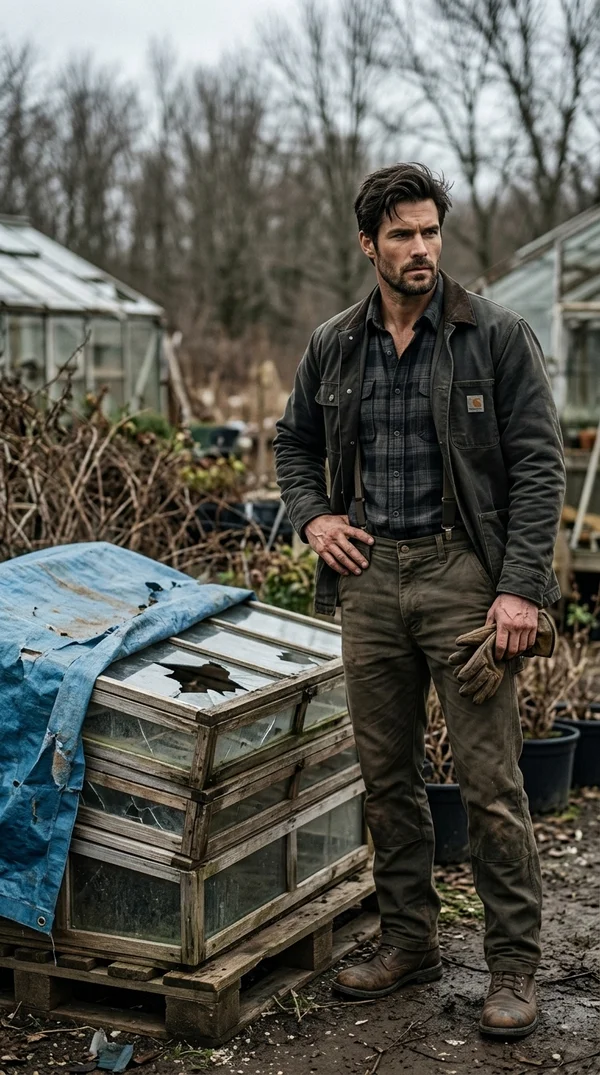
There are nine frames. They’re 1970s, in pairs on the flags along the east side of the garden. The crates were built into a run of brick, so they had to come up brick and all. The crane took the first in its slings and lifted it out of its crate. It was only old wood — wood with my empty pots in it, the bulbs carried into the greenhouse the night before. It swung sideways on the sling, and the corner caught the path. One whole light went in a wash of glass. A man said “sorry, miss” and got on with it. Sorry, miss. Like he’d just stepped on my foot.
Four hours. Nine frames. Most of the glass. Just gone.
I stood on the wall with my eyes on the crane and my spine against the warm brick and my palms flat behind me on it. What else was I going to do? Lie down in front of the crane?
At one o’clock the asparagus crowns came up out of the bed. Forty-eight of them, fifty-two years in the ground. They went on the heap at the corner by the barrowload, gray and pale and knuckled, smelling of the earth they’d been in. There were eleven stakes standing in the middle of where they’d been. At two the flatbed went down the lane.
Perrin was at Whinfield. He’d signed at ten past ten the day before and gone out at half past. This morning he’d seen Sibyl about Wear’s man at half past seven and gone straight back up the lane. He wasn’t there when I signed, or when the frames came out. At three o’clock I found Cissie. Where the hell was he?
He’d be back for five, by her account. She put a mug of tea into my cold hands. “Eat something.”
I drank the tea and didn’t eat anything.
He came at five. I was at the corner of the wall with the wheelbarrow, the broken glass and the last of the crates. He came down the path with his coat open and stopped. His eyes went to the run of brick where the frames had been, to the heap and the forty-eight crowns on it, and then to me.
His mouth worked. “You signed.”
“You asked me to.”
He stood with his arms slack, hardly breathing. “Nine frames.”
“Nine.” Nine fucking frames, and he’d counted them from the path like stock.
“Twyla — “
My hands were raw from the crates. “I’ve been on this wall since eleven o’clock this morning. Just standing there. It’s ten past five. You’ve been at Whinfield six hours, on the day of it.” I set the wheelbarrow down carefully. “You didn’t have to be at Whinfield.”
“There was the yard’s — “
“There’s always the yard’s.”
“There’s always the — “ He stopped. The facility went on the twenty-eighth of February. There was the lease on the second tunnel. There was the stock order.
“And the frames came out at eleven, and you were four hundred yards up the lane.”
He turned his head to the heap. “Say what you want to say.”

 100 to start reading with.
What did you think?