Show Rain, chapter 1 of Ninety Percent Chance of You
On the morning the sky went wrong, I gave it a ninety percent chance of a perfect drizzle.
Ninety is a careful number. I keep ninety-five for sunrise and Tully being late.
“Ninety,” said Tully, floating upside down beside me. “For forty weddings. You’re going soft.”
“I’m going accurate.”
“You’re going soft, and you’re going to be wrong in front of eighty people in white.”
“Seventy-nine. One of the grooms is wearing green.”
We were on the Loom at dawn, the best place in the Ring. The Loom hangs on the Axle, the still line down the middle of the world where weight runs out. It is a long cage of brass gantries and old glass housings strung along the core: mist spinners, chill coils, and the charge lines nobody had touched in a hundred and fifty years, because by charter there is no lightning on Meadowlark Habitat. Ever. You hook a toe under a rail and hang there like a seal in kelp, and all round you is garden.
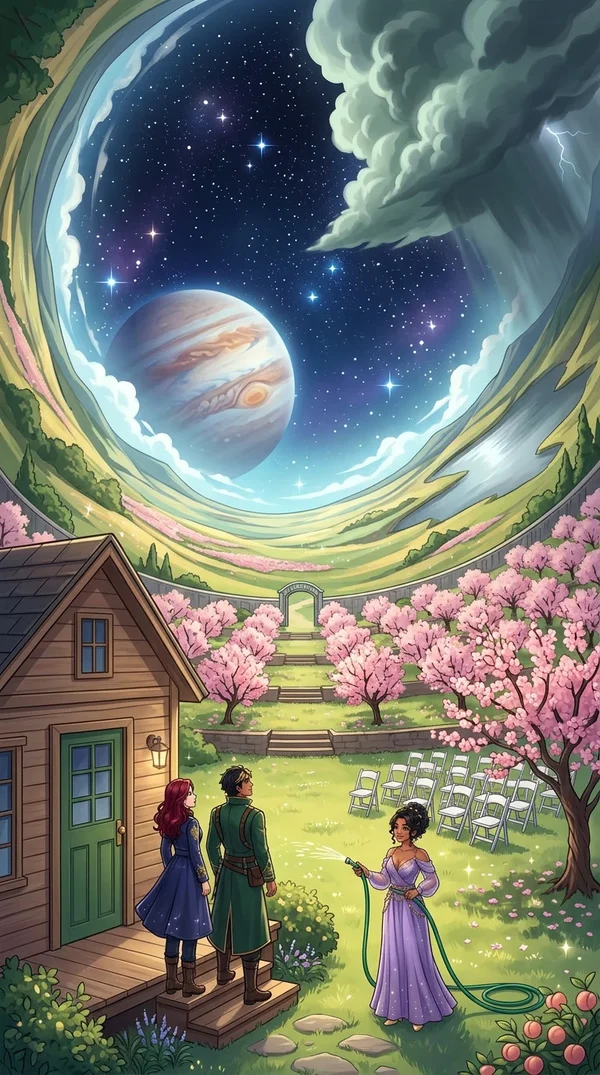
Not below you. Around you. The Ring is a drum four kilometers in radius, turning, and the garden is its inside, a green band twenty-five kilometers round. From the Axle the land wraps you on every side, fields and lakes and forest painted on the inside of a wave that never breaks. Past my feet, four kilometers down, the Overmere lay like a long silver fish. Past my head, four kilometers up, the Long Meadow. Off to my left the Wildwood climbed the curve, giant trees like the masts of ships that had sunk in green. Everything was the right way up for somebody.
Behind us the Lamp was warming, the sunline that runs the length of the Axle like the filament of a bulb the size of a valley. Night on the Ring is violet. At dawn the Lamp comes up through rose to whatever gold the season asks for, and in Bloom that is the gold of the inside of a peach. When it brightened, the whole garden blushed at once.
“Coil four,” I said. “Quarter turn.”
Tully turned coil four a quarter turn and typed the setting into the couplet board, the little brass keyboard where we send the Almanac our numbers. The mist spinner purred. Ahead of us a cloud began to make itself, a soft white thing the size of a barn and then of a village, fattening on the chill.
The Almanac had written today’s sky last night, as it does every night, and printed it on every Gate Board in the Ring as a couplet, because the founders built a weather mind with the soul of a fussy aunt. This morning’s read:
Show Rain at ten for those who wed; the rest of you, an umbrella instead.
It scans badly. The Almanac does not care. It proposes, the rainwrights approve or adjust, and between us, for a hundred and fifty years, nobody on Meadowlark has been rained on by surprise. That’s the deal. If the Almanac ever went truly mad, the Steward and the Senior Rainwright would walk to a Stem Gate and turn two keys together in front of witnesses and put it to sleep for good. Mine hung on a cord round my neck, brass, warm from my skin. I had never taken it out in public.
It had been a little odd lately, the Almanac. Eleven hiccups in a year: a shower nobody wrote over the Terraces, ten minutes of drizzle on the Long Meadow. We logged them as age. A hundred and fifty years old; you’d hiccup too.
“Release,” I said, and Tully let the cloud go, and I opened the reserve coils a crack with my key to breathe a little cold over Sweetwater ahead of it. The reserve is a season’s worth of chill, kept for Show Rain and emergencies. Clouds fall toward cold the way water runs downhill.
Mine slid off the Loom like a boat off a slip and drifted away down the long slope of the air toward Sweetwater, toward forty couples and one wedding planner who had told me, in writing, that if her brides got wet above the knee she would have me killed.
I rode the Stem Three lift down while the cloud went on ahead.
Weight comes back on the way down like a tide over the flats: so slowly you don’t notice, and then you’re wet to the knees. At the top of the Stem you weigh nothing. Two kilometers down you’re half yourself. At twelve hundred meters, seven tenths; at four hundred, nine. By the bottom you have all your kilos back and your knees have filed their usual complaint.
I took the Loop Line round to Sweetwater, fifteen minutes on the tram with my face against the window, watching my cloud hang over the wedding district exactly where I’d put it. I gave myself ninety-one.
Sweetwater is all chapels and climbing roses, and on the chapel lawn under the Vow Cedar, Del Asante had laid out forty couples in two long curving rows with an aisle down the middle, like a seating chart that had come to life and was very pleased about it. Del stood at the head of the aisle in pale blue with a clipboard, smiling like a lighthouse.
Above her, in the Vow Cedar, the Canopy crew was hanging ribbons.
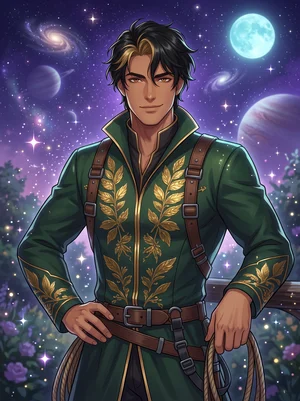
I knew which one he was before I looked. You always do. He was the biggest one, sixty meters up, astride a limb, tying off a white silk ribbon with the care other men give to defusing things. Rook Adair. Chief of the Canopy crew. Author, at the last count, of seventeen formal complaints about my rain.
He looked down at me, up at my cloud, and down at me again, and his face frowned with its whole architecture.
I waved. He did not.
At ten exactly, the Show Rain came down.
It was perfect. I’m sorry, but it was. A silver drizzle, fine as mist, slanting in the light the way rain does on a spinning world. Forty brides tipped their faces up. The officiant had to start the vows twice because people were laughing.
I gave myself ninety-four, and then I made the mistake of looking up.
There was a second cloud.
It was not mine. It was coming down off the Axle fast, grey-green, the color of an old bruise, building as it fell, swallowing my little Show Rain the way a whale swallows krill. Its underside sagged. I’d seen skies like that exactly once before in my life, at fifteen, from a harbor wall on Gullhaven, and I had spent thirteen years arranging never to see one again.
“Del,” I said. Then I shouted it. “Del!”
The cloudburst hit.
Not rain. A wall. It came down on the chapel lawn in one grey slab, flattening ribbons, roses, forty bouquets and the officiant’s hat, and the forty couples ran in eighty directions, and somebody’s grandmother sat down in the aisle and laughed.
Then the sky cracked white.
I knew exactly what lightning was and why it could not happen here. None of that helped. The bolt came out of the bruise and hit the crown of the Vow Cedar, and the sound was a door slamming in the middle of my chest. A limb as thick as a tram car tore off the trunk, burning, and came down through the branches where the Canopy crew had been working and smashed across the Loop Line rail beyond the chapel wall in a shower of sparks.
The second bolt went the other way. Everyone saw it. It came out of the cloud’s top and ran across the sky, up the curve, eight kilometers to the far side of the Ring, and climbed Stem Four, where the skyvines grow two kilometers high. The vines lit like a fuse. You could watch the fire run up them, overhead, upside down, a thin orange line on a green tower hanging from the ceiling of the world.
Somebody screamed. Several people. I was one of them.
By the time I got across the lawn, Del had already saved it.
In the time it took me to slip twice in the mud and lose a shoe, she had found every umbrella in every chapel in Sweetwater and handed them down the rows, and she was standing on a bench in her ruined blue dress, shouting through her hands.
“The founders were married in a rainstorm!” she called. “Did you know that? First wedding on the Ring. Pouring. They said it was luck.” She pointed at a couple in the front row. “You. Kiss. Go on, you’re getting wet anyway.”
They kissed. People cheered. Somebody started clapping in rhythm.
“Is that true?” I said, when I reached her. “The founders?”
“No idea,” Del said, without moving her smile. “Who did this?”
“Not me.”
“It came out of your sky.”
“It came out of a sky,” I said. “Not mine.”
She looked at me for one second with her smile switched off. Under it her face was a wedding planner’s face, which is to say a general’s. Then the smile came back on and she told the crowd the cake, at least, was in the dry.
The Canopy crew came down out of the Vow Cedar on their ropes. Rook came last. He landed in the mud beside me, straightened, and kept straightening, because there’s a lot of him. His sleeve was scorched to the elbow, there was soot down one side of his face, and he was so angry it had come out the other side as something cold and very polite.
“Is anyone hurt?” I said. “Your crew…”
“Ilse’s got a burn on her hand. Danny’s got a cut. Everyone’s down.” He looked at my one shoe. “Complaint Number Eighteen.”
“Oh, come on.”
“You set my tree on fire.”
“I did not set your tree on fire. Something set your tree on fire. Something that isn’t me.”
“Complaint Number Eighteen,” he went on, in the same even voice, as if he were reading it off the inside of his own skull, “in which the Senior Rainwright, having been warned in Complaints One through Seventeen that her weather is a danger to people who work at height, wrote a sky with lightning in it over forty weddings and my crew.”
“I didn’t write lightning. Nobody writes lightning. There’s no lightning button.”
“There is now,” said Rook, and walked off to see to Ilse’s hand.
I hopped after him for three steps and gave up, because you cannot have the last word with a man while wearing one shoe.
The Gate Board at the foot of the Sweetwater chapel steps chimed, which it does when the Almanac prints. Everybody turned. It’s a brass panel the size of a door with letters on little flipping tiles, and it had printed the forecast last night and had no reason to print anything now.
The tiles clattered. People read it out loud.
Rain where none was writ; ask the lake what’s under it.
“What does that mean?” said a groom.
“It means it’s broken,” said the man behind him.
Then the crowd parted for Steward Corin Vasko, and I understood that I was about to be blamed for the weather in front of everyone I knew.
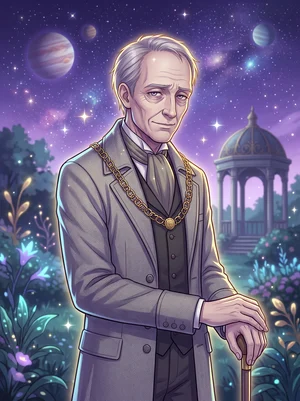
He came down the chapel path under a black umbrella held by a warden: sixty-four, silver-haired, soft-spoken, the kind of man who remembers your parents’ names. He asked after Del’s mother. He told the couples the Ring would pay for every dress. Then he turned to me with his face full of real sorrow, and that was the worst part. He looked as if it hurt him.
“Ms. Marlowe,” he said, gently, in a voice that carried right to the back. “I’m suspending you as of this morning, pending a hearing. I’m sorry. I know you’ve worked hard.”
“Steward, I didn’t write that cloud. Check the schedule. Check the…”
“I have checked. The Weatherworks records show your Show Rain and nothing else. Whatever this was, it went out from the Loom while you were on it.” He raised his voice for everyone. “The Almanac is a hundred and fifty years old. It has served us beautifully. But today it wrote lightning, and today we were lucky. On Founders’ Day, at the sunset ceremony at Stem Six, before the Lamp comes up for First Light, the Senior Rainwright and I will turn our keys together and retire it, and the Weatherworks will write our sky by hand from now on. Ms. Marlowe will, I’m sure, do her duty.”
People clapped. Not many, but some. The key on its cord had gone cold against my breastbone.
He meant my key. I was suspended, but I was still the Senior Rainwright. He couldn’t turn it for me. By charter the keeper turns it, at a Gate, with witnesses. He wanted my hand on it at sunset on Founders’ Day, three days away, in front of the whole Ring.
I pulled up the Weatherworks feed on my handset, and there it was, as he’d said. My Show Rain. Clear skies everywhere else. No second cloud. No lightning.
The numbers came to my screens through the Steward’s office. All of them did. I had never once thought about that.
What I had thought about, fondly, were the Bellhouses. Six of them, one forty meters up each Stem, founder-era weather stations with a brass bell and a drum of paper turning under an ink pen. They record the sky the old way. Nobody can edit a drum from an office. You’d have to climb up and cut it.
Six drums. Six Stems. All the way round.
The Loop Line rail was smoking under a burning cedar limb. Nobody would be riding anywhere for days.
Then I went and found the man with the burned sleeve, who was kneeling in the mud wrapping Ilse’s hand.
“The Bellhouse ladders,” I said. “Your crew keeps the keys.”
He didn’t look up. “We do.”
“I need them. All six. I’m going to walk the Ring and read the drums myself before he turns that key.”
Ilse looked at me. Then at him. Then at her bandage, with great interest.
Rook tied off the bandage. He stood up, all of him, and looked down at me with soot on his face and rain dripping off his eyebrows.
“No,” he said. “You need me. The keys don’t leave the crew.” He picked up a coil of rope from the mud and slung it over his shoulder. “I’m coming. Somebody should be there when you find out it was you.”


What did you think?