The Overmere, chapter 3 of Ninety Percent Chance of You
The north shore path runs four kilometers along the Overmere, and on a still day it is the most beautiful walk in the Ring, which is why people propose on it, which is why there are benches every forty meters with little brass plaques saying things like She said yes here, Year 131.
It wasn’t a still day. But it was close.
The lake lay flat and pale gold under the Lamp, and because the Ring curves up all round, the water held the whole far side of the world in it. You looked down and saw orchards and roofs and the Long Meadow hanging upside down under your feet, and you looked up and saw them again the right way up for the people who lived there, eight kilometers over your head. The sky was in the water and the water was in the sky, and somewhere in the middle of it you stood on a gravel path with a drum tube on your back, trying not to walk into a bench.
Out in the middle of the lake sat Bride’s Island, a hump of willows and white chapels, with the Ribbon Bridge slung out to it from the shore like a thread somebody had left on a sleeve. Six hundred meters of footbridge, so light it swayed in a breeze. I’d never crossed it. I didn’t like things that swayed.
The storm had moved. It wasn’t over the lake any more. It had lifted up toward the Axle and slid spinward ahead of us, and now it hung high up the curve over the Wildwood, grey-green, fat, with its skirt of rain trailing below it like a jellyfish. Waiting. Every so often a flicker went through its belly. Every time, I looked at Rook, and every time, he was already looking at it.
“It’s not moving,” I said.
“It’s moving at our speed.”
“Clouds don’t have speeds. They have drift.”
“That one,” said Rook, “has a speed.”
I didn’t argue. I gave it sixty percent that he was right and felt sick about the other forty.
The Weatherworks sits at the foot of Stem Three where the lakeshore bends, a long white building with a copper roof gone green and a weathervane in the shape of a heron. I had walked in through its front door every working day for two years. That morning there was a warden standing in front of it with a printed notice on a clipboard.
“Ms. Marlowe. I’m sorry. Steward’s orders. Suspended staff aren’t to enter.”
“I have a cup in there,” I said. “It has my name on it.”
“I’ll make sure it’s safe,” the warden said, kindly, and didn’t move.
We went round the side, along the lake wall, past the overflow sluice and the boathouse, and the back door to the instrument room opened before I’d raised my hand to knock. Tully stood in it in her rainwright’s coat with her hair in a disastrous bun, holding my cup.
“I brought your cup,” she said.
“I love you.”
“I know. I put a week’s pay on you. Get in before Hanna sees.”
The instrument room is a long dim gallery of screens and brass, with a big round window onto the lake and a ladder up to the lift platform. The screens showed what they always showed: the Ring as a flattened band, every Stem and lake and field, temperature, wind, rain, the Lamp’s color, the water in every tank and channel. A perfect, quiet, ordinary morning.
“Show me the feed,” I said. “Not the picture. The feed.”
Tully pulled it up. I sat at my own desk for the first time as a criminal and scrolled back through the raw numbers coming down from the gauges round the Ring, and then the numbers going out again to our screens and up to the Almanac, and compared them, the way you compare a ship’s log with the tide tables.
They didn’t match.
Not by much. You’d never see it on a screen. But the humidity coming in from the Ring’s gauges was high, high all season, as high as the ink on the Stem Two drum, and by the time it went out again to us and up to the Almanac it had been smoothed flat. Gently. Expertly. Every reading pressed down to normal, the way you’d iron a crease out of a shirt. Each corrected line carried a tiny flag in the margin.
CORR. STEWARD’S OFFICE.
“Oh,” said Tully, very quietly.
Rook had come to stand behind my chair. He leaned down with one hand on the back of it and read the screen over my shoulder, and I waited for him to say something about my coil work or my handwriting or the general unreliability of off-world people, and he didn’t. He read it. He read the next page. He reached past me and scrolled back another week, his arm so close to my ear I could hear his sleeve, and read that too.
He didn’t argue for a full minute. I counted. It was the longest he’d gone without disagreeing with me in two years, and I marked it in my head the way you mark a high-water line.
“That’s not the Almanac,” he said at last.
“No.”
“Somebody’s been flattening it.”
“Somebody’s been flattening it,” I agreed, “from the Steward’s office, for four years.” I scrolled back to where the little flags began. “Since Year 146.”
He straightened. He looked out of the round window at the lake, and when he spoke again it was in a different voice. Lower. Not to me, exactly.
“The Grandmother’s leaning.”
I swiveled round. “What?”
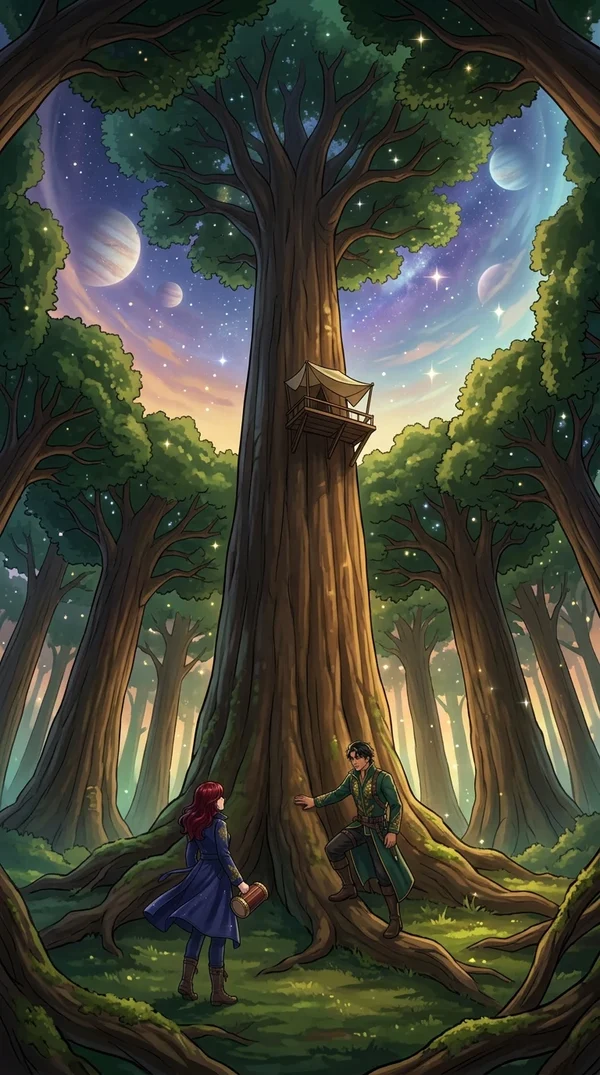
“The Grandmother. Oldest tree in the Ring. A hundred and forty meters.” He didn’t look at me. “She’s been leaning more every season. Three seasons, four. Not much. I’ve measured it. I’ve told the Steward’s office twice. They sent a man to look at her and he said trees lean.”
“Trees lean toward light,” I said, because it’s true and because it’s what you say.
“Not this one,” said Rook. “The light’s straight up. It’s always been straight up. She grew straight for a hundred and forty years and now she’s going over like a drunk at a wedding, and nobody believes me.”
I looked at him. I thought about saying something kind and didn’t know how to, with him. So I said the truest thing I had.
“I believe you.”
He looked round at me then, properly, as if I’d said something in a language he hadn’t known I spoke.
The instrument room door banged open.
“Where’s the coupling?” said the woman who came through it. “The big one. Brass. Hanna said it was on a bench. Which bench? You’ve got forty benches.”
She was a few years older than me and built like someone who carries engines for fun. She wore a grease-black work suit with the sleeves tied round her waist and a sleeveless shirt under it, and her arms were corded and scarred with old burns, and she smelled, when she came past me, of steam and hot metal and the inside of a kettle. Her hair was cropped close. She had a wrench through her belt like a sword.
“Dess,” said Rook.
“Rook.” She found the coupling under a pile of charts, hefted it onto her shoulder like a lamb, and turned. Her eyes went to me, and the tube on my back, and the screen, and back to me. “You’re the rainwright. The one who did the lightning.”
“I didn’t do the lightning.”
“Course not.” She didn’t sound as if she cared either way.
“I’m Isla Marlowe. Senior Rainwright.”
“Odessa Kerrigan. Chief Spin Engineer. Coldharbor.” She said it like a door shutting. “Pleasure.”
“Can I ask you something?” I said, because she was standing next to the one screen I’d always wondered about. “The Deep Cistern. Under the lake. Why aren’t its gauges on our screens? We get every tank in the Ring except that one.”
Something moved behind her face. Not much. A flicker, like the storm’s belly.
“Not your department, Rainwright,” said Dess Kerrigan, and went out with the coupling on her shoulder, and the door banged behind her hard enough to rattle the glass.
Rook was looking at the door. His face was doing something I couldn’t read at all, something old, as if he’d seen a ghost walk past and knew its name.
“You know her,” I said.
“Everyone knows Dess.”
“That’s not what I asked.”
He didn’t answer. Tully leaned over to me and whispered, in the voice she uses to sell things to Mina.
“Kerrigan and Thrale. The longest open bet on the Ledger. Six years. He was the one who left.” She mimed a door closing. “On the morning. Mina’s never closed it.”
I wanted to ask who Thrale was and what morning, and Rook said, “We should go,” in the voice of a man ending a conversation for everyone in a room, and Tully pressed my cup into my hands, full of hot tea, and pushed us both out of the back door into the wind.
The Stem Three Bellhouse is the oldest of the six, and it isn’t round like the others. It’s long, a brass cabin bolted along the side of the Stem like a barnacle on a mast, because it holds two drums. One is the ordinary drum: rain, wind, pressure, wet. The other, longer and slower, turns once a whole year, and it carries one pen. The founders hung a float on a cable down a pipe into the Overmere, and the float rides the water, and the pen draws the lake.
Ondine Ferrow wanted to know, every day, how much water her crew had. She didn’t trust anyone to tell her. She wanted to see it in ink.
Rook stamped our cards at the Stem Three Gate with the heron, without a word, and went up the ladder ahead of me; I clipped onto his line, and this time I didn’t argue, which he noticed, which I could tell because he didn’t say anything about it. At the top I opened the long case with my key, took the old rolls out of the locker beneath it, and unrolled four years of the lake across the boards, holding it flat with my knees and the flat of my hands. It was like unrolling a chart of a coast you’d lived on all your life and finding there was a reef in the middle of the harbor.
The line went down.
Not much. Not every day. A few centimeters a season, small enough that you’d never see it on the stones of the shore unless you’d marked them, small enough that someone smoothing the numbers could make it disappear without breaking a sweat. But it went down, and down, and down, four years of it, stepping down like stairs. And every step happened at night.
I knelt on the boards and put my finger on one of the little night drops, and then on the rain line on the ordinary drum beside it, and checked the date.
The morning after: a hiccup. A shower nobody wrote.
I checked another. The morning after: a hiccup.
I checked eleven. I checked them all. Then I checked yesterday.
The night of Bloom 107 the lake had dropped further than it had on any night in four years, a cliff in the ink, and the morning after, on Bloom 108, the Almanac had wrung a storm out of a clear sky over forty weddings and thrown lightning at the Wildwood.
“Isla,” said Rook, from the door. In two years he had never once called me anything but Rainwright. “What is it?”
I sat back on my heels with four years of falling water across my knees.
“Somebody’s emptying the lake,” I said. “And every time they do, the Almanac goes mad the next morning.”


What did you think?