We went down the vines in silence, and down the winch in silence, and Ilse took one look at our faces when the sling bumped onto the Stem Four platform and became very busy with the brake.
Then we walked.
I would like to tell you that I walked with dignity. I walked like a woman being followed by a large dog she has decided not to acknowledge. I walked fast, which on a spinning world with a drum tube on your back is not easy, because the land is always rising ahead of you and you’re always at the bottom of it, and you can never, ever get to the top of anything and stand on it and feel you’ve won.
He walked three paces behind me. Exactly three. I could hear his boots.
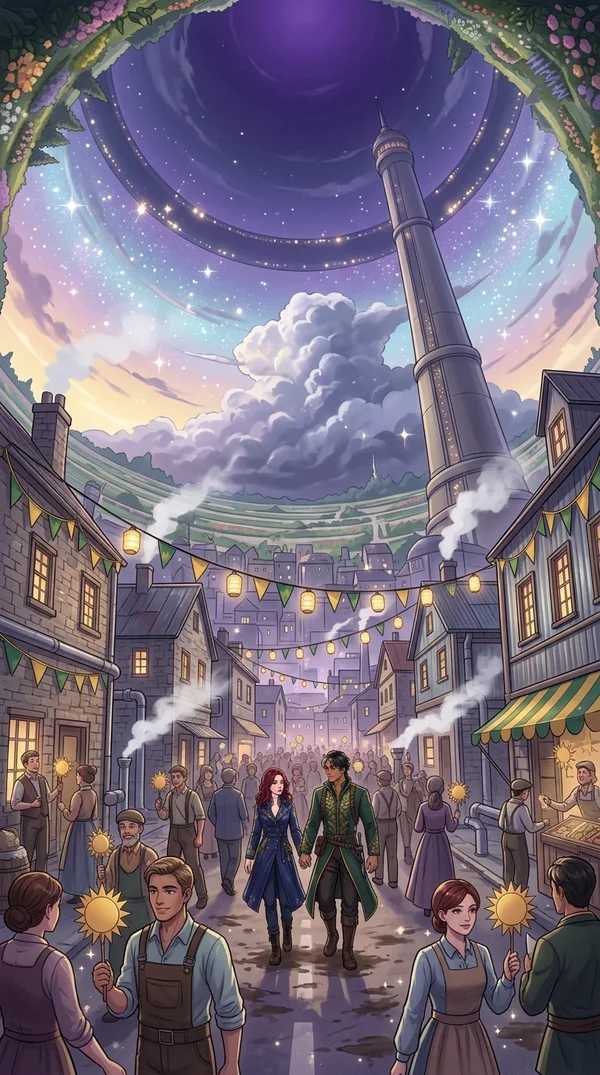
The Wildwood thinned. The trees dropped to fifty meters, then thirty, then to orchards of shade-tea under them, and the land began to climb in earnest, because we’d come to the edge of the floor where the Aft Wall begins. The Terraces go up the Wall in steps, hundreds of them, tea and rice and tea again, each a long green shelf held up by a dry-stone wall, climbing toward the bare rock and the old ice-glass higher up, so that the whole end of the world looks like a staircase built for someone very large and very patient.
The storm was over them. Of course it was. It sat on the Wall like a hen on a nest, grey-green and heavy, and rain sheeted down the steps and ran off the edges of the terraces in a thousand little waterfalls, all of them bending the same way as they fell.
I narrated it to myself. It helped. Here we see the Senior Rainwright, recently kissed and recently suspended, walking up a tea terrace in a storm she did not write, with a man who wrote to the Weatherworks to have her removed from the habitat on grounds of danger to life, and kissed her twelve hundred meters up a vine anyway, knowing. Note the dignity. Note the posture. Note that she is going to be sick.
“Isla,” said Rook, behind me.
“Don’t.”
“There’s…”
“Don’t talk to me.”
“There’s someone on the ledge,” said Rook.
There were six of them, and a goat.
A pickers’ crew, out at dawn to save the young leaf before the storm flattened it, caught on the wrong side of a flood. Three terraces above us the runoff from the whole upper Wall had come down into one long tea shelf and filled it like a bath, and its retaining wall, two meters of old dry-stone, was bulging outward under the water like a sail. Below it, on the next terrace down, the path had already gone. The pickers were standing on what was left, a strip of ledge a meter wide between the bulging wall above them and a five-meter drop below, with their baskets and their goat, and the water was pouring over the wall’s top in a sheet onto their heads.
“Hold on,” Rook shouted up. “Stay still.”
He was already shrugging a rope coil off his shoulder. He looked up at the wall, and along the ledge, and back down the terrace to the stone stair we’d just come up, and I could see him working out an anchor and a line and a way across, and I could see the wall too.
I’ve watched water break things my whole life. I grew up on a harbor wall. You learn to see where it’s going to go before it goes.
“Not there,” I said.
He looked at me.
“Not that end. You’re going to anchor at the stair end and come along the ledge to them. Don’t. It’s going to break at the stair end.” I pointed, and my hand was steady, which surprised me. “Look at the stones. Third post from the stair. They’re dark right through. It’s already coming through behind them; that’s not rain on the face, that’s seep. The far end’s still dry. The wall will go at the third post and take the stair with it, and anyone on the ledge between.”
He looked at the third post for one second. Then he turned without a word and ran the other way, up the terrace edge to the far end, where a lone old shade tree stood on the step above the pickers, and he went up its trunk like a squirrel and threw a loop round a branch and dropped the end down to the ledge.
“Clip on,” he shouted to the first picker. “One at a time. Walk to me. Away from the stair.”
I went up after him. Somebody had to work the line. He took them up the tree one by one onto the terrace above, and I sat at the foot of the trunk with my boots braced against a root and the rope round my back the way my father taught me to hold a boat off a quay, paying it out and taking it in, and every time a picker swung off the ledge onto the rope my heels skidded in the mud and every time they held.
Four. Five. The water over the wall’s top thickened. The stones at the third post began to weep in a steady stream.
“The goat,” the last picker shouted, a woman with grey braids, holding it in her arms. “I’m not leaving the goat.”
“Then bring the goat,” Rook said, and she did, the goat bleating its opinion of all of us, and she was halfway up the rope with it when the wall went.
It went at the third post. It went exactly where I said. A whole section of dry-stone folded outward with a sound like a cart overturning, and the tea shelf behind it emptied itself in one brown roar across the ledge and the stair and over the edge, five meters down onto the terrace below, and the stair was gone, and the ledge was gone, and the picker with the goat was hanging on the rope two meters above where it had been, both of them spinning gently, both of them screaming.
I held. Rook hauled. The goat came over the edge first, by its scruff, and then the woman.
There was a long minute afterward when nobody said anything. Six pickers sat in the mud in a row with their baskets, steaming in the rain. The goat ate a basket. I lay on my back in the tea and stared up the long slope of the sky at the far side of the Ring hanging over me, and my hands were shaking now, and I couldn’t make them stop.

 100 to start reading with.

What did you think?