Coldharbor is the part of the Ring the brochures leave out.
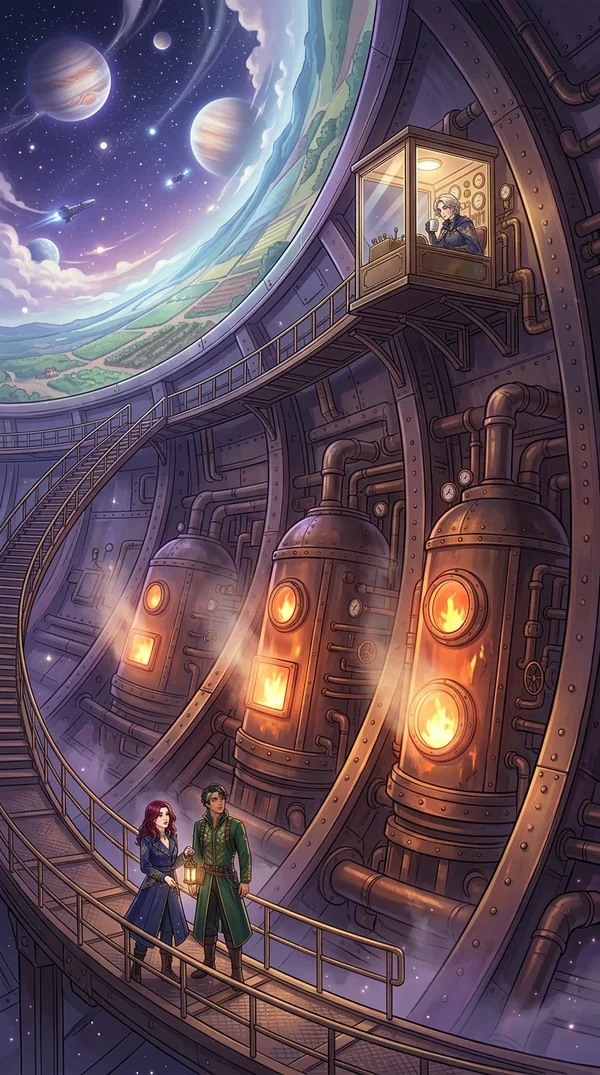
It sits at the foot of Stem Five where the Terraces run out against the Aft Wall, and it’s where the people who keep the Ring alive go home at night: pump fitters and pipe crews, the Spinner gangs, the Icehouse loaders. The houses are stone and tin with steam pipes running along their gutters. The streets smell of hot metal, wet wool and fried dough. Lanterns hang on wires between the roofs, and every so often a vent in the road breathes out a long white plume that drifts sideways as it rises, so the whole town looks as if it’s quietly smoking.
We came in at dusk, mud to the knees, with the storm sitting behind us on the Terraces like a dog that had followed us home. The Lamp was going down to violet. Founders’ Day bunting hung across every street, gold and green, and the town was full: workers’ families in from the Long Meadow side for tomorrow, Founders’ Week visitors off the Hub Dock, children running everywhere with paper suns on sticks for First Light, the hour after sunset on Founders’ Day when the Lamp comes back up to full, the way it came up the first time in Year 1.
I climbed the Stem Five ladder on Rook’s line in the last of the light and read the drum. It said what the others had said, only louder. High wet. And the ring main dropping between two and four every night, harder here than anywhere, as if Coldharbor were closest to whatever was drinking.
Rook stamped our cards at the Gate with a kettle. Five boxes out of six.
“The Drop,” I said, when he’d done it. “It goes down to the Underneath. Right?”
He looked at me. “Yes.”
“Then that’s where it is.”
The Drop is a shaft at the edge of town, a round hole in the world twenty meters across with an iron fence round it and a lift cage hung over it on chains, and the steam that comes up out of it is warm and smells of rust and river. A gate in the fence. A sign on the gate in founders’ lettering: UNDERNEATH. AUTHORIZED CREW ONLY. And leaning on the gate with her arms folded, as if she’d been waiting there for us all day, Dess Kerrigan.
“No,” she said, before I’d opened my mouth.
“I haven’t asked anything.”
“You’re going to ask to go down. Answer’s no.”
“Ms. Kerrigan…”
“Dess.” She didn’t unfold her arms. Her face in the lantern light was tired, drawn tight, with a smear of grease along one cheekbone. “You can’t go down there, Rainwright. I’m not being funny. It’s not safe for people who don’t know it. And it’s not your department.”
“You keep saying that. What is my department? Because I think something under this floor is draining the Overmere every night, and I think your gauges know about it, and I think…”
“Isla,” said Rook, quietly.
Dess looked at him. Something passed between them again, something I couldn’t read, an old long tired thing like a rope that’s been holding too much for too long.
“Go and get a bed, Rook,” she said. “There’s a lot of people in town.” Then, to me, not unkindly, she said, “Some people are alive tonight because of what’s down there. Leave it alone. Please.”
She turned and walked back into the steam. The gate clanged behind her. We stood in front of it, and the ground under our feet hummed, faintly, very faintly, like a held note.
The Kettle and Drop had one room left.
“One,” said the landlady, Mrs. Lund, a small brisk woman with forearms like hams and an apron printed with teapots. She looked at Rook. She looked at me. She looked at the slate behind the bar where somebody had chalked the latest from the Gate Boards: MARLOWE & ADAIR. 8 TO 1. “Lucky it’s a double.”
“It’s a what?” I said.
“One bed. Double. Clean sheets. Bath down the hall.” Mrs. Lund pushed a key across the bar. “You’ll not get another in Coldharbor tonight. Half the Reach is here for Founders’ Day.”
“We’ll take it,” said Rook.
“We’ll discuss it,” I said.
We discussed it on the stairs, and in the corridor, and in the room, which was small and warm and had a sloping ceiling, a stove, a washstand, a window onto the steaming street, and a bed that took up most of the floor and was very definitely, very cheerfully, a double.
“I’ll take the floor,” said Rook.
“You took the floor last night.”
“I’m good at floors.”
“There’s no floor. The bed is the floor. You’d have to sleep standing up in the corner like a broom.”
In the end I took every towel in the room, and the two from the bath down the hall, and Mrs. Lund’s spare tablecloth, and I built a wall. Down the middle of the bed, rolled and stacked, a long lumpy dyke of towels, with the tablecloth over the top like a flag. I stood back and looked at it with my hands on my hips.
“There,” I said. “Border.”
Rook studied it with his arms folded.
“That’s a very good wall,” he said, at last. He sounded as if he meant it.
“I’m a rainwright. I know about dams.”
We washed, in turns, with our backs to each other. We ate bread and soup Mrs. Lund sent up on a tray. We lay down on either side of the towel wall in our clothes, in the dark, with the stove ticking and the lanterns outside throwing slow yellow light across the ceiling, and the Ring humming very faintly under the floor.
I’d thought I’d be angry. I’d been angry all day. But I lay there and listened to him breathing on the other side of the towels, and I thought about the goat, and the rope in my hands, and the way he’d turned and run the other way the moment I said not there, without asking why. Nobody had ever done that. My whole life, people had asked why.

 100 to start reading with.

What did you think?