Lammas Morning, chapter 1 of Offered to the Viking
My husband’s brother sold me on Lammas morning, on the beach below our village, with the whole of Eskwick watching.
Three longships had come round the headland at first light. By the time their keels ground up onto the shingle, Godric the reeve had his rings on and his speech ready, and Cenred had my wrist.
“Smile, sister,” he said. “It’s for all of us.”
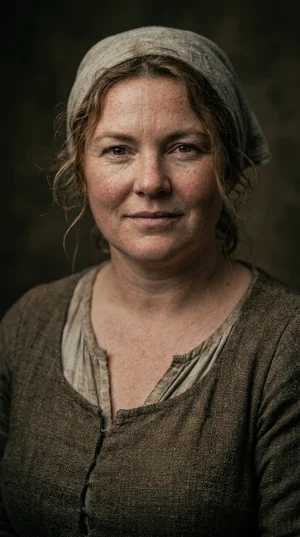
He had told me to wear my good blue dress. He had told me it was for the Lammas blessing. I was thirty-eight years old and two winters a widow. I had brewed the ale for every wedding and every wake in that village for eighteen years. And I let him walk me down to the waterline like a heifer to the fair, because I did not understand until Godric opened his arms to the Northmen and said it.
“We are a poor place, lord. We have little silver. But we give you the best we have.” His soft hand settled on my back. “A widow. Healthy, skilled. She brews, she heals. She will warm your hall.”
Nobody said a word. Not the priest. Not Mildryth, who had been my friend since we were girls. Not one of the men I had stitched up after the herring season.
Then the Northmen’s leader walked up out of the surf.
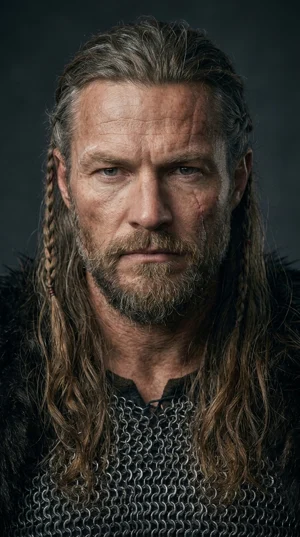
He was taller than any man in Eskwick and broad through the chest under his mail. His hair was long, dark gold going grey, braided back at the temples and loose down his back. A white scar ran from his eyebrow to his jaw. He looked at Godric. He looked at Cenred’s hand on my wrist.
Then he looked at me, and he asked me. Not them.
“Did you agree to this?”
The sea ran in around his boots and slid out again. Behind him a hundred men in leather and iron stood along the gunwales of the three ships, and not one of them was laughing. I remember thinking that was strange. I had always heard the Northmen laughed while they did it.
Godric found his voice first. Godric always found his voice first.
“She is modest, lord. A widow’s modesty. You’ll find her—”
“I did not ask you.”
He said it quietly. His English was slow and careful, every word set down like a stone on a wall, with a burr under it that made our own words sound older. He hadn’t taken his eyes off me.
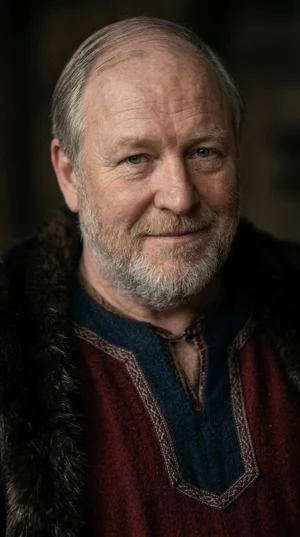
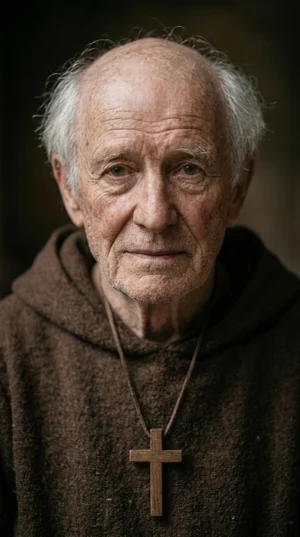
I had a hundred answers ready. I’d been answering for other people my whole life. Yes, lord. Of course, lord. We only want peace. That was what Godric wanted, and Cenred, and the fishermen twisting their caps, and probably Father Wigmund too, God forgive him, in his old brown habit with his lips moving.
My wrist throbbed in Cenred’s fist. I could smell the new bread in the Lammas baskets on the stones, and the tar of the ships, and my own fear, sour as a mash left standing overnight.
“No,” I said.
It came out hoarse. So I said it again, loud enough for the back of the crowd.
“No. I didn’t agree to anything. They told me it was a blessing.”
Something moved in the scarred face. Not a smile. The opposite of one.
“Then he has given me something,” the Northman said, “that was never his.”
He looked down at Cenred’s hand.
“Let go of her.”
Cenred didn’t. He was a stupid man, but a stubborn one, and he had decided at dawn that I was his to spend. His fingers dug in.
The Northman didn’t reach for his sword. He didn’t reach for anything. He stood in the wash of the tide with the water dragging at his boots and simply waited, and the waiting spread across the beach like cold, until a gull screamed overhead and a child up by the boats began to wail and was hushed.
Cenred let go.
I held my wrist against my stomach. Four red marks already. By evening they’d be plum-coloured, in the shape of my husband’s brother’s fingers.
“Your name,” the Northman said.
“Aldith.”
“Aldith.” He got it right the first time, which nobody from outside the village ever did. “I am Thorvald Ketilsson.”
Then he turned to the rest of them and raised his voice, and I understood that the quiet had been a choice.
“Hear me. The king at York has shared out this land among those who came with him, and this coast is mine. I have not come to burn it. I have come to farm it.” A ripple through the crowd. Nobody had expected that. “Those who plough their fields keep their fields. The dues you paid your old lord, you pay to my hall, and not a measure more. No one will be harmed who does not lift a weapon against me or mine.”
Godric was nodding along, rings flashing, already a reeve again in his own head. I watched the Northman notice.
“And hear this.” He didn’t point at me. He didn’t need to. “This woman is under my hand. Not as a gift. I do not take women as gifts. Any man who sells her again, or touches her against her will, answers to me.”
Then he walked past us up the beach, and his men began to drop down off the ships.
I don’t remember the walk home well. I remember a basket somebody had kicked over, and the Lammas loaves rolling in the wet sand with nobody picking them up. I remember people stepping out of my way. Not the way you step aside for someone you respect. The way you step around something spilled.
Mildryth caught me at the beck, blotched red from crying and pretending she hadn’t been.
“Aldi.” She grabbed my sleeve. “Cuthbert’s teeth, I swear I didn’t know. Not till Godric said it. And then I just stood there like a stunned cod and I couldn’t…”
“I know.”
“I should have screamed. I should have taken a rock to Cenred’s head.”
“You’d have missed. You always miss.”
It came out of me like a hiccup, the kind of thing we said to each other on ordinary days, gutting fish, bickering about salt. She laughed, wetly, and hugged me there on the path, and I stood stiff as a post inside her arms because if I bent at all I’d break.
“Go home,” she said into my headrail. “Bar the door.”
Cenred was sitting on my bench.
My house is the last one before the cliff path, with the brewhouse beside it and the herb garden behind, and the beck running past close enough to hear from my bed. Leofric gave it to me the morning after our wedding: the house, the brewhouse and the acre of barley up the slope. My morning-gift. Sixteen years we lived in it, then the February storm took his boat and him with it. It smelled of malt and woodsmoke and drying yarrow, and it was mine.
Cenred sat by my hearth as if he’d been born there. And at his belt, on the thong where I’d worn them every day of my married life, hung my keys.
He must have lifted them that morning while he fussed with my brooch and told me to stand up straight.
“You shamed us,” he said. “You were meant to smile and go quietly. Godric had it settled. Instead you stand there saying no like a child, and now he’s angry, and if he burns us, sister, that’s on your head.” He stood and smoothed his tunic. He was a heavy man, thick through the neck, with Leofric’s nose on a face that had never once looked kind. “Anyway. You were given, and he refused you, so now you’re nobody’s. A woman alone can’t hold a house. I’ll see to it. As kin.”
There it was. I’d been waiting two winters to hear it said aloud.
After Leofric drowned, Cenred had come to my door with a ring and his best face on. Father Wigmund said no before I could: the Church forbids a man his brother’s widow. I said no after him, more plainly. Cenred went away with his ring. He never went away from the house. He walked past it every day after, looking at it the way a dog looks at a shut door.
“Give me my keys,” I said.
“Sister—”
“I’m not your sister. I was your brother’s wife, and he’s dead, and you just tried to sell me on a beach to save your neck. Give me my keys and get out of my house.”
He laughed at me.
My mash paddle leaned by the door. Oak, as long as I am, heavy as a man’s leg; I’ve stirred two hundred brews with it. I took it in both hands and walked at him with the flat held level at his chest, the way you move a pig, and he backed up, and backed up, and at the door I reached out and took my keys off his belt.
“This isn’t finished,” he said from my step.
“No,” I said, and shut the door on him.
Then I sat down on the floor with the keys in my lap and shook.
It rained at dusk. Thin, cold rain off the sea at the end of summer, more mist than rain, so the cliff went grey and the gulls went quiet.
I barred my door, which I had never done once in eighteen years, and sat by the fire listening to the beck and to the strange voices drifting down from the reeve’s hall, singing something low and rolling in their own tongue.
When the knock came, I picked up my knife.
“Who is it?”
“Thorvald.” Then, through the wood: “I won’t come in unless you ask me.”
I didn’t ask him. I lifted the bar, though, and opened the door a hand’s width with the knife where he could see it.
He stood in the rain with nothing over his head. He’d taken off his mail; under it he wore dark wool, and the wet had turned his hair the colour of sand at low tide, the braids at his temples standing out like rope. Without the iron he was even bigger. I had to tip my head back to see his face.
He looked at the knife. Then at my wrist, where the bruises were coming up.
“The man with the thick neck. Who is he to you?”
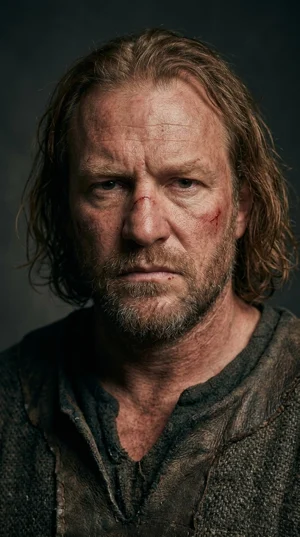
“My husband’s brother.”
“He wanted you.”
It wasn’t a question. The rain dripped off the thatch between us.
“My men need ale,” he said. “They say you brew the best on this coast. I’ll pay in silver, by weight, at the hall, in front of everyone. Trade. Not a gift.”
“You could just take it.”
“Yes,” he said, as if I’d told him the tide was in. “I could.”
“Then why are you standing in the rain?”
“Because you didn’t ask me in.”
He turned to go. Then he looked back, water running off the end of his nose, and almost smiled.
“Tomorrow night you’ll eat at my table. Beside me, not below me. That’s the only order I’ll ever give you.”
He went off into the wet dark. I barred the door behind him and leaned on it, and my heart was going in a way it had no business going for a man who’d come off a longship that morning.
I was nearly asleep when the bar jumped in its brackets.
Not a knock. A shoulder. Then another, and the old wood groaned, and a voice I knew said, low, “Open up, sister. Godric says we do this properly.”
Cenred. And not alone; I could hear boots in the mud, two men at least, and the creak of a rope being paid out.
“Go home, Cenred.”
“You’re coming to my house tonight. Where kin belongs. Tomorrow you’ll be sensible.”
The bracket on the left side had been loose since Leofric died. I’d been meaning to have it seen to. On the third shove it tore out of the doorpost, the bar dropped, and the door swung in, and the rain came in with my husband’s brother behind it, red-faced, with two of Godric’s cousins at his back and a coil of rope over one of their shoulders.
I had the knife up. I’d have used it. Cenred caught my wrist, the bruised one, in exactly the place he’d held it that morning, and squeezed until my fingers opened, and the knife went into the rushes.
“She’s my brother’s widow,” he said, over his shoulder, to the cousins, as though they’d asked. “She’s mine.”
A hand closed on Cenred’s wrist.
I hadn’t heard him come. Nobody had. He’d never gone back up the hill, I learned later; he’d sat on the stones by the beck in the rain, in the dark, watching my door, because he’d seen the way Cenred looked at it.
Thorvald didn’t squeeze. He just held on, and Cenred’s fingers opened off my arm one by one as though they belonged to somebody else. The cousins took a look at him in the firelight from my door and remembered urgent business elsewhere. The rope landed in the mud.
“She’s my kin,” Cenred said. His voice cracked. “Mine.”
Thorvald looked at him. Then past him, at me: barefoot in my own doorway, wrist cradled, hair coming out of its plait, rain blowing in on my shift.
He said it the way you’d draw a line in the sand between me and every man in Eskwick.
“Mine.”
What did you think?