His Table, chapter 2 of Offered to the Viking
Cenred went. He went backwards out of my door and slipped in the mud and got up and kept going, and the rain swallowed him.
Thorvald picked my knife out of the rushes, wiped it on his sleeve and held it out to me hilt first. Then he picked up the rope from the mud, looked at it a while, and coiled it over his arm as though he meant to keep it.
“I’m not yours,” I said. My teeth were chattering. “I said no on the beach. I’m saying it again.”
“I know.” He didn’t come over the threshold. The rain ran off him in sheets. “In my tongue it’s one word. Mín. It means what’s under my hand. What I’d stand in front of.” He looked at my wrist. “I said it to him so he would understand it. He did.”
“And to me?”
“To you I’ll say it when you give it to me,” Thorvald said. “Not before. Bar your door.”
I couldn’t. The bracket was hanging off the post by one nail. He saw that, and said nothing, and went and sat down on the wet stones by the beck where I could see him from my door, and stayed there until I gave up watching and slept.
In the morning there were two new iron brackets on my door, on the inside, set deep into fresh oak, and an iron hasp besides. I found a smith’s punch-marks in them. Nobody in Eskwick owned iron like that.
I took three casks up to the hall that evening on a handcart, and made Mildryth’s son pull it, all twenty years and six feet of him, because if I was going to walk into a hall full of Northmen I was not going to arrive sweating.
I’d thought about not going, all day, through a brew I ruined by forgetting the barm, which I hadn’t done since I was fifteen. In the end it was simple. If I stayed home, the village would say I was hiding. If I went, they’d say worse, but at least to my face.
So I wore the blue dress again, with the salt brushed out of the hem. I pinned my headrail with my mother’s bronze pin, hung my keys on my belt where everyone could see them, and walked up the hill with my chin up and my stomach in my shoes.
The reeve’s hall had stood at the top of Eskwick since before I was born: long and low, timber and thatch, with a carved post either side of the door that Godric’s grandfather had paid a man from York to make. Tonight two Northmen stood at those posts with spears, and the air coming out of the door was roast pork and woodsmoke and too many men.
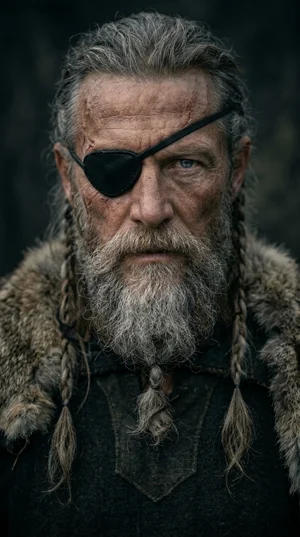
A one-eyed man met me on the threshold. Older than the jarl, grey-bearded, a face like a weathered gatepost and a leather patch where the left eye should be.
“Ale-wife,” he said. “Orm. I keep his silver.”
He had a little folding scale at his belt, bronze, with pans no bigger than cockle shells. He hefted each cask and grunted, then weighed out silver right there under the torch where the whole village could see: cut bracelet, bent coin, the snipped-off arm of somebody’s brooch. More than Godric had paid me in a season.
He tipped it into my palm and folded my fingers over it with his own.
“Trade,” Orm said. “He told me to say it. Trade.”
The hall went quiet when I walked in.
Not all at once. It went quiet from the door inward, like a pond after a stone, bench by bench, until all I could hear was the fire spitting on the long hearth and a dog somewhere cracking a bone.
Northmen along both walls, big men with their hair long or braided or shaved at the sides, silver at their arms and throats. In a nervous huddle near the door, the men of Eskwick who’d been asked to eat with their new lord and hadn’t dared refuse. Godric. Beside him Cenred, a fresh scrape on his cheek from the mud, his thick neck red above his collar.
At the far end, on the high seat where Godric used to sit, Thorvald stood up.
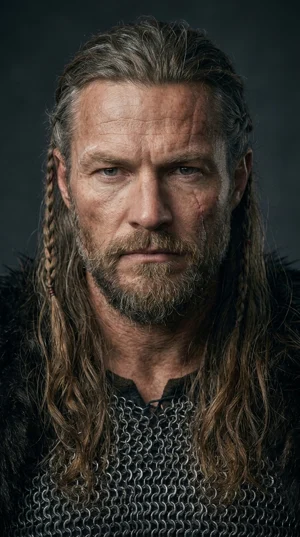
He’d braided his hair fresh. I noticed that before anything. The two thin braids at his temples were tied back with a strip of red cloth, the rest loose down his back, clean and gold-grey in the firelight. A dark blue tunic edged with woven braid. No mail. He didn’t need it. Every man in that hall knew where he was without looking.
He held out his hand toward the bench at his right.
I walked the length of the hall to get there. It was a longer walk than the one down to the beach, because this time I knew what they were thinking. I felt it on my back like heat off an oven door. There she goes. The Northman’s gift.
I sat at his right hand. He sat down beside me.
“Godric,” he said, not loudly. “Come and pour for her.”
The reeve’s face went white, then red, then a sort of mottled grey, like a cheese kept too long. He got up. He came the whole length of the hall with my own ale in a jug and poured it into my cup, and his rings chattered on the rim.
“Thank you, Godric,” I said.
I had never in my life said anything so sweetly.
Thorvald drank from his own cup. My ale. He held it in his mouth the way a man tastes wine, and swallowed.
“Good,” he said.
That was all. I’d been praised for my ale by a bishop’s steward and by a thegn’s wife from Ripon who swore it was the best north of the Humber, and none of it had ever put heat in my face like that one flat word.
He asked me questions all through the meal. Not the ones men ask women at feasts, about weaving and children. How many households. How many ploughs, and whose oxen. Which strips flooded when the beck rose. How the herring had run. How much food-rent the village paid the old lord each Martinmas.
I knew all of it. You can’t brew for a village eighteen years without knowing who’s sick, who’s drinking, and who’s been short of barley since the wet spring.
“Twelve measures of barley a household,” I said. “A pig from every third house. Cheese. Honey from the two that keep bees.”
“Twelve,” Thorvald said.
“Twelve.”
He turned his head and looked down the hall at Godric.
“Your reeve told my man eight.”
I hadn’t known Godric had been asked. Down the hall, Godric was studying his meat as if it had written something on his plate.
“It was always twelve,” I said slowly. “Godric collected it.”
Thorvald only nodded, once, and put it away somewhere behind those grey eyes, and asked me about the honey.
When the meat was gone and the benches loud with drink, he stood.
The hall went quiet faster this time. He spoke first in his own tongue, a long low run of words; I heard my name in it twice. Some of the Northmen looked at me. Orm, by the hearth, nodded slowly.
Then he said it in English.
“Yesterday I was offered a woman as tribute. I refuse the gift. A gift can’t say no, and I have no use for a woman who can’t say no to me.” He let that sit. “I will have her only if she gives herself. Not before. And any man who calls her a gift again answers to me.”
I sat with both hands round my cup and my face on fire and every eye in the hall on me.
Down by the door, Cenred said something into his ale. I didn’t catch it, but I caught the snigger, and the word whore inside it.
So did Thorvald.
“Say it again,” he said. “Say it to me.”
He hadn’t moved from the high seat. But the men on the benches nearest Cenred had all gone still, the particular stillness of men who’ve fought side by side, and Cenred looked at them, and at Thorvald, and into his cup.
He didn’t say it again.
Thorvald walked me home.
The rain had blown out to sea and the sky was high and clear and crowded with stars, the moon coming up out of the water like a slice of pear. The path down from the hall is steep and rutted. In the dark I put my foot wrong and pitched sideways, and his hand caught my elbow, steadied me, and let go at once, as if he’d touched a hot pan.
“Why?” I said, when I had my breath.
He knew what I meant. He walked a while before he answered.
“My mother was given to my father to end a feud. Her brothers had killed his cousin and blood was owed, so they paid him cattle and silver and her.” The words came out flat. I think they had to. “She was nineteen. She kept his house thirty years and gave him four sons, and I never once saw her smile in it.”
The beck ran loud beside us in the dark.
“I’m forty-four,” Thorvald said. “I’ve never married. I swore as a boy I would never take a woman someone handed me. Then yesterday a fat man in rings tried to hand me one on a beach.” He stopped and looked down at me. “So. No.”
“I won’t belong to anyone again.” It came out harder than I meant. “I belonged to my father, then to Leofric. He was a good man and I loved him, but I belonged to him, and when he drowned I found out his brother thought I came with the boat.”
“Then belong to yourself,” he said, and started walking again. “And let me stand near it.”
I had no answer. My heart was going like a wren in a box.
At my door he put his palm flat on the new oak and pushed, gently, to show me it held. Then he sat down on my step, drew his sword, and laid it across his knees, his back against my doorpost as if he meant to be there a long while.
“What are you doing?”
“Sitting.”
“All night? You’re a jarl. You have a hall.”
“I have a hall,” he agreed, and looked up at me with the starlight on his scar. “You have a door. Bar it, Aldith. Not against me. I’m the one outside it.”
What did you think?