Barley and Bog Myrtle, chapter 3 of Offered to the Viking
He slept on my step three nights running.
The first morning I found him there at dawn, awake, his sword across his knees and dew in his hair. I handed him a cup of small ale through the door without a word; he drank it, handed back the cup and walked up the hill to his hall. The second morning I gave him bread with it. The third morning I came out and found he’d mended the latch on my brewhouse door, which had hung by one nail since Leofric died. I stood there holding the bread and didn’t know what to do with my face. The man was mending my whole house one hinge at a time.
“Three nights,” Mildryth said that afternoon, gutting mackerel on a board across her knees outside my door. “On a step. A man that size. His back must be a ruin.”
“Nobody asked him to.”
“No,” she agreed, and slit another fish neatly from gills to tail. “That’s the part I can’t get over.”
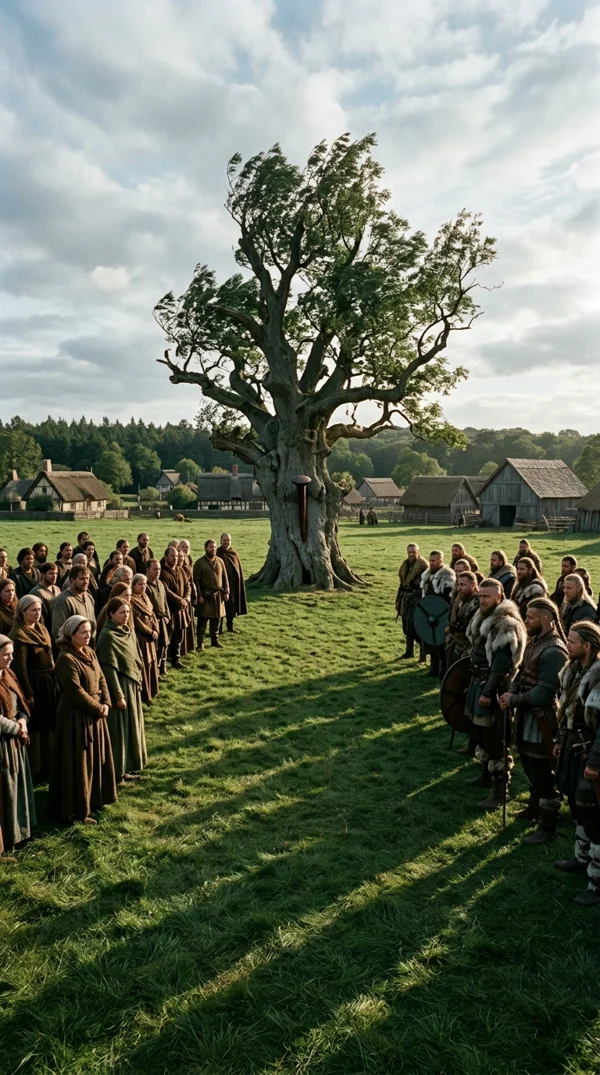
By then the village had decided the Northmen weren’t going to burn us in our beds. Not this week. They were too busy. They’d hauled the ships above the tide line and were building: a long new hall on the flat above the beach, a smithy, pens for cattle coming overland from York. They felled trees in Cenred’s wood without asking and paid him afterwards in silver, which made him angrier than theft would have. They paid for fish and eggs and cheese. The younger village girls had started finding reasons to walk past the building site with water jugs.
Nobody looked at me the way they had on the beach. They looked at me a new way, which was worse, because I couldn’t name it. Half of them thought I’d been lucky. The other half thought I’d been clever. Not one of them thought I’d simply said no and been heard, because that didn’t happen to women in Eskwick, so it couldn’t have happened to me.
The boy came to me on the fourth day.
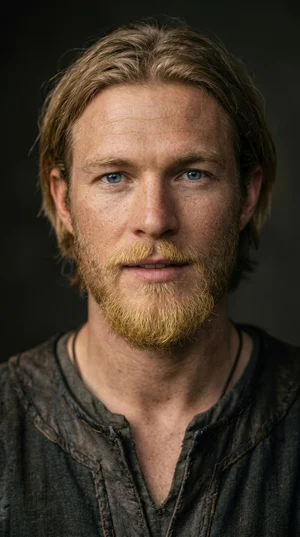
Not a boy. A man, twenty-two, he told me, with a soft yellow beard he was plainly proud of and a name I couldn’t say until he’d said it three times: Kolbein. He held out his right hand in my doorway, palm up, as if he were offering me something. A rope had burned a line across it hauling the ships, and the line had gone angry: swollen, hot, yellow at the edges.
“Orm says you heal,” he said, in very bad English.
I sat him on my bench and cleaned it. He didn’t make a sound, though he went the colour of whey under his beard. When I’d washed it with boiled water and vinegar I packed it with honey and bound it in clean linen.
“Honey?” He sniffed at it, suspicious.
“Honey. It keeps the rot out. Leave it on three days, then come back.”
He was looking past me, out the back door, at my herb garden. It’s not much: a few raised beds of yarrow and comfrey and mint and sage, and lavender against the wall, and in the far corner a small bed fenced with hazel hurdles and tied shut with twine. He pointed at the fenced bed.
“Why?”
“Henbane. Belene, my mother’s leech-lore calls it.” I stood beside him so he could see the plants: grey-green, sticky-leaved, ugly, the dull yellow flowers veined purple like old bruises. Even from the door you could smell them, rank and heavy, like something dead under a hedge. “It’s medicine. The root boiled for a bad tooth. A few seeds steeped for a man who can’t sleep for pain.” I held up a fist. “A handful, and he never wakes up.”
Kolbein looked at the bed with new respect and backed away from the door.
“I keep the seed in a pot on a high shelf and the bed tied shut, and I’m the only one in this village who knows how much is too much. So don’t touch it.”
“I don’t touch it,” he said fervently, and went off clutching his honeyed hand to his chest, and I didn’t think about it again for a week.
The mash was too hot. I knew it before I put my elbow in, the way you know a man is lying before he’s finished his sentence, and I said a word my mother would have slapped me for and reached for the cold-water pail.
“Let me.”
I hadn’t heard him come in. That was the trouble with him. A man that size should creak like a ship.
He took the pail out of my hands and, because I pointed, poured, slowly, while I stirred and swore and watched the steam thin. His sleeves were pushed to the elbow. A long white seam ran down one forearm, and the muscle under it moved as he tipped the pail, and I made myself look at the barley.
“There,” I said. “Stop.”
He stopped. Exactly then. Not a drop after.
“You are very bossy,” he said, “about water.”
“Water is the whole of it. Too hot and you kill what makes it sweet. Too cold and it sits there sulking like Cenred at a wake.” I tapped the paddle on the rim. “Most things are like that. You only get one chance to get the heat right.”
He didn’t answer. He had a way of letting a thing I’d said stand in the room until I heard it myself. I went red. He looked at me as if I’d done something clever.
I made him lift the tun when it was time to run off the wort, a job I do in three stages with a great deal of swearing. He did it in one, without swearing. Then I showed him how it went: the sweet brown liquor running off the grain into the cooling trough, the bag of bog myrtle and yarrow I hang in it, the barm from the last brew waiting in its crock, frothing and sour-smelling and alive.
“That’s what makes it ale,” I said. “Without the barm it’s only sweet water. You keep a little back from every brew to start the next one. My mother’s barm came from her mother’s. This is the same barm, more or less, that’s been in my family since before the abbey burned.”
“So it is very old.”
“It’s very old and very bad-tempered. Like Orm.”
He laughed. I’d never heard him laugh. It came out short and startled, as though it had escaped without asking, and it changed his whole face. The scar pulled. His eyes creased. He looked like the man he must have been at twenty, before all of it.
I dipped a finger in the wort when it had cooled enough and tasted it. Sweet, a little grassy, the first ghost of the bog myrtle. Good. It would be good.
When I looked up he was watching my mouth.
I had been married sixteen years. I knew that look. What I didn’t know was what to do about wanting it, about having wanted it since he walked out of the surf with the sea running off his mail and asked me a question nobody in my life had ever asked. I was thirty-eight, I smelled of wet barley and smoke, and the last man who had looked at my mouth like that had been dead two winters.
I put the paddle down.
“You’ll want the casks,” I said. “For the hall.”
“Yes.”
“They’re there.”
“Yes.”
He didn’t move toward them.
So I did it. I crossed the floor of my own brewhouse, put my hands flat on his chest, which was like putting them on a warm wall, came up on my toes and kissed him.
For a moment he did nothing at all, and I thought, well, Aldith, that’s the most foolish thing you’ve done since you married a fisherman who couldn’t swim. Then his hand came up under my headrail and into my hair, and he kissed me back.
Slowly at first, as though he were reading me. Then not slowly. He tasted of salt and my own ale. He made a sound low in his chest that I felt in the backs of my knees, and I had his shirt in both fists and my headrail had slid off altogether, and I wasn’t thinking about the mash or the village or anything. His other hand spread across the small of my back and pulled me in against him, all that size and heat, the steam from the vat curling round us both, and I went up on my toes to get closer and wanted, plainly and completely, the way I hadn’t let myself want anything in two years.
He stopped. He didn’t let go; he stopped. His forehead came down against mine and he breathed like a man who had rowed a long way against the tide.
“Aldith.” My name, careful, the way he said everything. “Is this you wanting? Or is this you paying?”
I stepped back so fast I hit the vat.
Because it was half true. That was what made me want to throw the paddle at him. Half of me had been thinking it since the beach: he’d stood in the rain, he’d sat on my step three nights, he’d taken Cenred’s hand off me twice, and a woman with any sense settles her debts before the man names his price.
“Get out of my brewhouse,” I said.
He went. He took the casks, one under each arm, and at the door he turned.
“You owe me nothing,” he said. “Not today. Not ever. When you kiss me again, I want to know it is because you want to.”
When, he said. Not if.
I stood there with my back against the vat and my mouth still burning, and the mash went on cooling behind me exactly as it should, which was more than I could say for myself.
At dusk I went up the cliff path to cut yarrow, because I couldn’t stand to be inside my own walls a moment longer.
The path climbs steeply behind my house through the gorse to the clifftop, where the land flattens into rough pasture and then moor. In August the moor is purple to the edge of the sky and smells of honey, and the bees are so thick in the heather they sound like a far-off crowd. I cut yarrow along the field edge and tried not to think about his mouth, and failed, and cut more yarrow than I could use in a year.
I was on my way back down when I saw them.
Below me, where the moor road comes down off the high ground and bends toward the village, three men were standing in the shadow of the old stone cross. Two of them I’d have known in the dark: Godric, by the way he stood with his belly out and his hands folded over it, and Cenred, by the thick neck. The third man was on a horse.
He wore a wolf-pelt cloak, even in August, and it was pinned at the shoulder with a brooch that caught the last of the sun and flashed gold. A big round brooch, the kind a thegn’s man wears. English work.
I crouched in the gorse with my arms full of yarrow and watched Godric hand something up to the rider. A sack. Small, and heavy, by the way the horse shifted when it took the weight. The rider wheeled and cantered back up the moor road toward the dale. Godric and Cenred stood a while longer with their heads together, then walked down into the village separately, a little way apart, like men who don’t want to be seen in each other’s company.
I didn’t go home. I went to Mildryth’s.
She was mending a net by her fire. When I described the cloak she only nodded, but when I described the brooch, big and round and gilded, with a ring of interlace round the edge, she put the net down.
“That’s Ordric’s man,” Mildryth said. “Ordric up the dale. He stood up at the altar in his own burh at Easter and swore on the bones of his saint he’d drive every Northman on this coast into the sea.”
What did you think?