At Martinmas there was frost on the shingle, and the whole of Eskwick came down to the beach.
A hard blue November morning, the wind dropped, the cold come down out of a clear sky to settle on everything. The sea lay flat as pewter. Every rope on every boat was furred white with rime. Gulls stood about on the frozen sand with their feathers puffed, looking offended. Two of Cenred’s old cows had been led down for the occasion, Mildryth’s now and Eadburh’s, with ribbons on their horns. And everyone I knew lined the top of the beach in their thickest cloaks, stamping and breathing smoke, just as they’d stood on Lammas morning.
Only this time I didn’t stand at the waterline.
I stood where Godric had stood, at the top of the shingle in front of all of them, in my blue dress and a new fox-lined cloak I’d sewn with Mildryth’s help over three long evenings and too much ale. My keys on my belt. My mother’s pin in my headrail. Mildryth on one side, Father Wigmund on the other, and at my back my whole village, English and Norse together, the strip of grass between them long since trodden away.
“He’s late,” Mildryth said through her teeth. “Cuthbert’s teeth, if he’s late to his own—”
“He’s not late,” I said. “Look.”
The Wave-Daughter came round the headland under oars.
The scorch marks were long gone. Her sail was new, red and white stripes furled to the yard, and her oars rose and fell together like one long breath, flinging off water that glittered as it flew. She ran up the shingle exactly where she’d run up three months before, with the same long grinding hiss of keel on stone, and a man swung down over her side into the shallows.
He was carrying a chest.
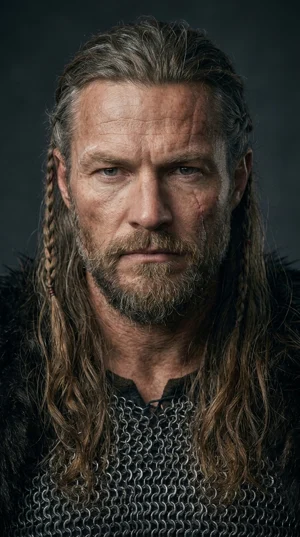
He walked up out of the sea toward me as he had that first morning, water pouring off his boots, cold sun in his hair. He’d braided it fresh at the temples and tied the braids with red. No mail: a blue tunic, a cloak pinned with silver. Two weeks before, he had knelt at the church door, and Father Wigmund, shaking only a little, had made the sign of the cross on his brow. The prime-signing. Not baptism; Thorvald had told the priest plainly he wouldn’t lie about what he believed. But enough that a Christian woman could marry him at her church door, which was the only reason he’d wanted it.
He stopped in front of me, on the frost, at the top of the beach. And he set the chest down at my feet and opened it.
Silver first. Orm came up behind him with his little folding scale and weighed it on the lid of the chest in front of everyone, piece by piece, calling the weight aloud in English and in Norse: more than Cenred’s whole holding had been worth. Then fine blue wool, the colour of my dress. Then, wrapped in linen, a brooch of jet, black and glossy as a wet seal, cut by the old jet-worker at the river mouth in the shape of a barley ear, every grain picked out with a knife’s point.
And last, a strip of parchment, folded. Orm unfolded it and held it up for the village to see, though only the priest could read it. The Frankish clerk at York had written it at Thorvald’s word on the day he swore for his land.
“The high field above her acre,” Thorvald said, “is hers. Joined to the acre. In her name, not mine.”
The village murmured. You could hear them understand it. A bride-price is paid to the bride’s kin; everyone knows that. My father was twenty years dead. My husband’s brother had gone over the moor with what he could carry. There was no one left to pay it to but me.
So he’d paid it to me.
Then he looked at me, and the beach went so quiet I could hear the frost ticking on the boats.
“Aldith,” he said. “Will you marry me?” And then, before I could answer, softer, the words he’d said to me on this beach before anything else, before my name, before his: “Did you agree to this?”
I’d had my answer since the night before he rode for York. Either answer, he’d said. Either one.
“Yes,” I said. “I agree. Every word of it. Yes.”
And the whole of Eskwick cheered, English and Norse, so loud the gulls went up off the sand in one white cloud, and Kolbein, at the front, the healed pink line across his palm, threw his cap into the sea and had to wade in after it.
Father Wigmund married us at the church door with the frost still on the step.
I said the words in English, and Thorvald said them in English too, carefully, each one set down like a stone on a wall. Then he said them again in Norse for his men, and Orm laid a sword across our joined hands, which made Father Wigmund nervous, and we went up the hill to the hall.
The hall where Godric had poured my ale with his hand shaking. Full to the walls again, the fire roaring down the middle, the smoke climbing in its grey rope, and every cup in it filled from my vats. Mildryth danced with Orm, who turned out to dance better than anyone, which nobody had expected, least of all Orm. Kolbein danced with three women in a row and was scolded by all of them. Father Wigmund fell asleep by the fire with a cup in his hand. Somebody sang about a sea-king who married a mermaid and kept house under the water, and everybody else sang the parts they knew, which was mostly the end.

 100 to start reading with.
What did you think?