Brightwater, chapter 4 of One Kiss to Kill the Dragon King
“His eyes,” said Ilka, “have been gold for two days.”
She was sitting on my balcony rail with one boot hooked through the bars and the crossbow across her knees, eating one of my breakfast pears. She had arrived with the tray, as my guard for the day, by order of the king, who had not been seen since he dropped off this same rail at midnight.
“They were gold when he landed,” I said. “I assumed they came that way.”
“They come brown.” She bit the pear. “Like mine. When he’s angry they go red at the middle. When he’s flying, amber. In the hundred and ten years I’ve known him I’ve seen them go gold exactly never, until he lifted your veil at the Last Stone and swore in front of Lord Grennet.”
“He didn’t swear.”
“I swore. He went gold. Same thing.” She looked at me sidelong. “You really don’t know?”
I poured myself tea, because it gave my hands something to do. “In Orlen, the only thing we know about dragons is how much gravy to send.”
Ilka laughed. Then she stopped laughing and looked out over the shaft, and when she spoke again her voice was different, flatter, the way people speak about the weather in a country where the weather can kill you.
“A king’s fire knows its mate,” she said. “It’s the oldest thing we have. When he meets her, his fire answers. It goes gold. He can feel where she is, after a while, as he feels the hoard. Can’t help it. It’s not a choice. It’s not even a feeling, exactly. It’s more like a direction.”
The tea was too hot. I drank it anyway.
“I’m not anybody’s mate,” I said. “I’m a tribute. I was sent.”
“I know. That’s why he made his rule.” She tossed the pear core over the rail; I heard it land in the orchard, nine floors down, a long time later. “The bond seals on a kiss, see. A kiss freely given. Before that it’s only a pull. After it, it’s done, both ways, for good. You’d feel him. He’d feel you. You’d be bound to him like a coin in the hoard.” She shrugged. “A girl sent up the Steps by her chancellor can’t give anything freely. So no kissing. That’s the whole of it. He’s protecting you from him.”
I put the cup down very carefully on the tray, because I wanted to throw it.
“That,” I said, “is the stupidest thing I have ever heard.”
“Probably.”
“Fate. A direction. Gold eyes.” I stood up. “I have been fed poison twice a day since I was six years old, by people who wanted something from me. I know what it is to have something put inside you that isn’t yours. If the king’s fire has made up its mind about me, the king’s fire can go and find another girl.”
Ilka watched me pace. She didn’t seem offended. If anything she looked a little sorry.
“It’s not all roses for us either, if that helps,” she said. “We’re a hot-tempered people with long memories. The very old ones can tear themselves halfway into the shape when they want something badly enough. Wings out of their backs, claws, the lot. It costs them years and they never look right after. Nobody’s done it in my lifetime.” She shrugged. “Fate’s the least of what’s wrong with us.”
“There’s an old test,” she said. “From before my time. When a king’s eyes went gold over a girl, they used to stand her in front of him while he breathed fire, and see if she burned.” She smiled crookedly. “A king’s fire won’t burn his mate. That’s the other half of the lore. Very romantic, if you’re not the girl.”
“How many girls burned?”
“The stories don’t say.” She swung off the rail. “Come on. He wants you. Bring a cloak.”
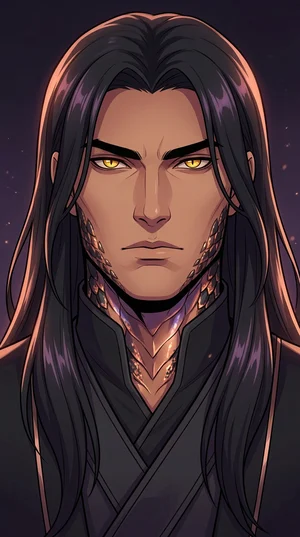
He was waiting on the high ledge outside the palace, above the gate, where the mountain fell away on both sides into cloud. Not a man. The dragon, copper-bellied, black-edged, coiled around the rock with his head resting on his forelegs like a cat in a window, and his eyes on me, and his eyes were gold.
Ilka stopped a long way short of him. I didn’t, because I was angry, and anger is a kind of courage that doesn’t last.
“You left,” I said.
The dragon breathed out through his nose. It ruffled my cloak.
“You asked where I was from and then you jumped off a building.”
A low sound came out of him, under my feet more than in my ears. I realized after a moment that it was a word, or the shape of one. Dragons don’t have the mouth for most of our consonants. It took me another moment to understand that the word was Come.
“Ride him?” I said to Ilka. “In Orlen there are pictures of men riding dragons into battle.”
“Those men are dead,” Ilka called. “Nobody rides a king.”
The dragon lifted one forefoot from the rock. It was the size of a cart, black-clawed, the palm of it copper and creased like old leather. He held it out, flat, open, and waited.
I understood. Not on his back, like a horse. In his hand, like something kept.
I could have refused. I want that on record. He didn’t move the foot closer. He just held it there, steady as a table, and let me choose. In my whole life nobody had ever held anything out and waited for me to choose.
I climbed in.
The claws closed around me. Not tight. A cage of black curved bars with the wind coming through, and under me the hot leather of his palm, and the smell of cloves, and the great slow drum of that heart I’d felt in his throat in the study.
Then the ledge fell away.
I’m not going to describe the flight properly. I can’t. I have tasted ten thousand things and I don’t have words for that one. The cloud, and then the top of the cloud, white and endless and blazing in the sun as if the world had been salted. The mountain under us like a broken loaf. The cold, so sharp it hurt my teeth, and his heat all round me so I never once shivered. My own voice, somewhere, laughing like a child who has been pushed too high on a swing and loved it.
When we came down through the cloud on the far side there was a valley, green and secret, with a river through it and a town.
Brightwater had perhaps six hundred people in it. It had slate roofs and a market and a mill and a schoolhouse, and vines up every south-facing slope. It had women who stopped hanging washing to wave at the dragon, and did not run.
He set me down in a meadow above the town. My legs didn’t work. I sat down in the grass, hard, with my hair blown into a nest and my cheeks stinging, and laughed up at the enormous copper face lowered over me until I got the hiccups.
The dragon watched this with great interest. Then he folded himself into a man, and stood over me in his black clothes with his hair as wild as mine, and offered me his hand. A plain hand. Long fingers. A burn scar across the knuckles, old and white.
“You laughed,” he said. He sounded as if he were reporting a weather event nobody had predicted.
“I was screaming. You can’t tell the difference from up there.”
“I can tell.” He pulled me up. He didn’t let go immediately. “Most of them scream. Mags was sick on my claw.”
“I’m a taster,” I said. “We keep everything down. It’s a professional matter.”
He let go of my hand then, and turned and walked down the hill, and I followed him, and the people coming up to meet us called him by name. Not Majesty. Theron. I hadn’t known it. Nobody in Orlen said it; nobody in Gildenhollow had dared, in my hearing.
“Every bride for three hundred years,” he said. “And their husbands, and their children. Some are dragonkin. Most aren’t. They come here when their year’s up, or they stay on the mountain. Mags stayed. She says she can’t be bothered to learn a new oven.”
A tall woman in a vintner’s apron came out of a doorway to kiss his cheek, and looked at me, and looked at his eyes, and put a hand to her mouth.
“Ottilie,” he said. “Seven years ago.”
“Hello,” said Ottilie faintly, to me. “Oh, my goodness. Hello.”
Over cider, in her kitchen, with the king outside fixing a gate hinge for her neighbor as though that were a thing kings did, Ottilie told me what Mags hadn’t.
“A few of us went home,” she said. “In the early days. To Orlen. To tell our families we were alive.” She turned her cup in her hands. “Their families never heard from them. They didn’t reach home, any of them. One was found in the river at Haverl. The crown said the dragon must have let her go and then changed its mind.” She looked at me. “The crown likes the story, you see. A dragon that eats girls is a reason for taxes. A dragon that gives them vineyards isn’t.”
I thought of the Mistress of Tasters walking down the line with her silver spoon. Of the dye-house getting emptier, forty, thirty-one, twenty. Of nobody explaining the subtraction.
“Why does he let them think it?” I said. “Why not tell everyone?”
“Because a monster’s cheaper to defend than a mountain,” said Ottilie. “His words, not mine. If Orlen thinks he eats people, Orlen doesn’t come up the Steps.”
He walked me back up the hill in the late afternoon. On the way we passed through the little churchyard on the edge of the town, and at the end of it, under a yew, there was a stone.
It was plain gray slate, set upright, waist-high. Cut into it was a list of names. A long list. Families, mostly: four of one surname, six of another. At the top it said only: THE DEAD OF THORNBY. And the year. My year. The year I was six.
I stopped in front of it.
I read down the names. I didn’t know I was looking for one until I found it, two-thirds of the way down. Ada Hallam, baker, and her daughter.
No name for the daughter. Nobody had known it. Everyone in Thornby who would have known it was on this stone.
I put out my hand and touched my mother’s name. The slate was cold. Somebody had cleared the moss from the letters recently, and set a jar of wildflowers at the foot of it, and the flowers were still fresh.
“Who paid for this?” I said. My voice came out wrong.
He was standing behind me. He didn’t answer.
“Who paid for it?”
“I did.”
I turned round. He was very close, and the wind was in his hair, and his eyes were gold and steady and terrible. I had tasted ten thousand things and I had never wanted so badly to know what something was before I swallowed it.
“Did you burn Thornby?” I asked.
The wind moved through the yew. Far below, someone in the town was ringing a bell for supper.
“Yes,” he said.
What did you think?