Burnt Honey, chapter 5 of One Kiss to Kill the Dragon King
I didn’t speak to him on the flight back. I don’t think he expected me to. He set me down on the high ledge in the late light and folded into a man and stood there as if waiting for something, a slap or a knife, and I walked past him into the mountain without looking at his face.
Dorrit was in my rooms. She took one look at me and put down the shift she was mending.
“What happened?”
“I’ll do it,” I said.
“You were always going to do it.”
“I know.” I sat on the floor with my back to the copper bed, because the bed was his and the floor was only the mountain’s. “I’m telling you anyway. I’ll do it. At the Rite. Whatever he says about kissing.”
Dorrit looked at me for a long breath. Then she came and sat beside me on the floor, which she had never done in all the years she’d watched me, and put her shoulder against mine.
“Tonight there’s dancing,” she said gently. “Go and dance with him. I’ll have the spoon ready after.”
I had taken the morning drop at dawn, before the flight, and I could still taste it. I nodded. I didn’t smile. There wasn’t anyone to smile for.
Vesca found me an hour later, in the garden at the bottom of the shaft.
I had gone there to be somewhere without walls. I was sitting on the edge of a stone channel with my feet in the water, which was warm, fed by some spring that came up through the mountain’s heat, and pear blossom was falling on me out of the last of the sun, and I was thinking about a gray stone in a churchyard and how my mother’s name had been the only one on it with no first name for the daughter.
Vesca sat down beside me as if we were friends, and put her own feet in the water, keys clinking.
“He took you to Brightwater,” she said. “He takes all of them. It’s his favorite thing to show.” She tipped her face up to the falling blossom. “Did he show you the stone?”
“Yes.”
“And did you ask him?”
“Yes.”
“And he said yes.” She smiled without opening her eyes. “He always does. It’s the one honest thing about him.”
I watched a petal turn in the current and go under. “Why?” I said. “Why do you want him dead? You’ve kept his keys for three hundred years.”
“Exactly that long.” She swung her feet in the warm water like a girl. “Three hundred years ago, before the Compact, we went down the mountain whenever we liked. The lowlands paid us in fear and grain and gold, and we took what we wanted, and nobody counted coins. Then a young king made a treaty, and sat on top of his hoard, and told us all to be good.” She smiled at the blossom. “I was young then too. I’ve had three hundred years to watch him keep us in a hole in a rock while Orlen grows fat in the sun. Someone has to remember what we are.”
“And Grennet knows that’s what you want?”
“Grennet wants gold. I want the lowlands. We’ll sort out the details when the king’s dead.” She patted my knee. “Business, dear. Ask me your question.”
“Tell me about the Rite.”
“Ah.” Vesca opened her eyes. “Business. Good. The king has told you he won’t kiss you. He’ll have to. The Rite is very old: the bride is presented, I strike her coin, the king holds it on his tongue, in his own fire, and then he kisses her to seal her into the hoard. If he refuses before the whole court, they’ll know why.”
“Why?”
“Because his fire is failing.” Vesca said it calmly, like a doctor. “You saw him in the Hoard Hall. The shaking. The scales that won’t lie down. For three years now, fevers, worse every season. There are nights he can’t find his words. There are nights he can’t find his face. It’s what happens to a king without a mate, in the end. The long dark. First the fevers, then the man goes, and only the dragon’s left, and someone has to put the dragon down before it eats the town.” She looked at me sideways. “His court’s been waiting for three years, little taster. A king who can’t hold his own Rite won’t be king by morning. So he’ll kiss you. He has no choice. And then it’ll be quick, won’t it? Kinder than the long dark.”
I said nothing. I was thinking about his hand shaking at his side while he looked at the pit.
“And after?” I said. “When he’s dead on the floor. What happens to you?”
“Someone has to be regent.” Vesca stood, and shook the water from her feet, and smiled down at me with the sun behind her. “Someone has to keep the keys.”
The Feast of the Third Night was music.
That was the custom, Ilka told me while she laced me into a gown of deep red silk that one of Vesca’s women had brought: the first night you feed the bride, the second you show her the hoard, the third you dance with her. There was a gallery above the long hall full of dragonkin musicians with drums and long bronze horns and fiddles, and the black table had been pushed to the wall, and the floor was full of fire-colored silk spinning.
He came to me at the edge of the floor without a word and held out his hand.
I took it. That was the bargain. In public I was to look at him as if he were the best thing that had ever happened to me. I put my other hand on his shoulder, and he put his on my waist, and the heat of it came straight through the silk, and the drums started.
Dragonkin dance the way they fight, I imagine. Close and fast and with a great deal of turning. I had been taught the court dances of Orlen by a bored master in a cold room, all bows and distances. This had no distances. He turned me and I was against his chest; he turned me again and I was out at arm’s length with my skirts flaring; he pulled me back, and his hand came round the small of my back, and stayed there.
“You’re angry,” he said, low, under the drums.
“You burned my village.”
“Yes.”
“And you paid for a stone.”
“Yes.”
“Do you think that makes it even?”
“No.” He turned me. My back was to his chest now, his arm across my waist, his mouth by my ear, and two hundred dragonkin were watching us spin. “I don’t think anything makes it even. I think you should hate me. I think you’re the only person on this mountain with the right.”
“Then why are you dancing with me?”
“Because it’s the bargain.” His breath was hot on my neck. “And because you’re very good at it, and I haven’t danced in a hundred years, and I’m a selfish creature.”
The music rose. He turned me round to face him again, and pulled me in, and we stopped as the dance stopped, chest to chest at the end of the phrase, with his hand spread on my back and my hand flat on his heart.
It was beating very hard. Not slow and huge, as it had been under my wrist in his study. Fast. Like a man’s.
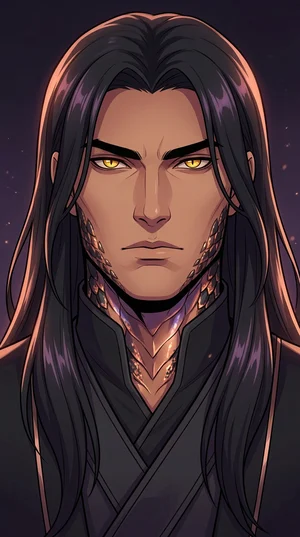
I looked up. His face was close. His eyes were gold, all gold, the pupils blown black, and he was looking at my mouth.
The whole hall held its breath. I felt it in the hinges of my jaw, like a storm coming.
I could have done it then. The poison was in my mouth. I had taken the spoon that morning. One kiss, and a bitten lip, and it was over, here, tonight, four nights early.
I didn’t move.
Neither did he. His hand on my back went tight, and then went loose. He lowered his head an inch, and stopped. I saw it go through him, the stopping, like a man catching his whole weight on one hand. The scales came up at his throat and stayed.
“No,” he said, very quietly, to himself, and let me go, and stepped back, and bowed as the music finished, and the hall breathed out.
He went back to the high table. I followed him because the bargain said I should, and sat at his right hand with my face smooth as a plate and my heart going like the drums.
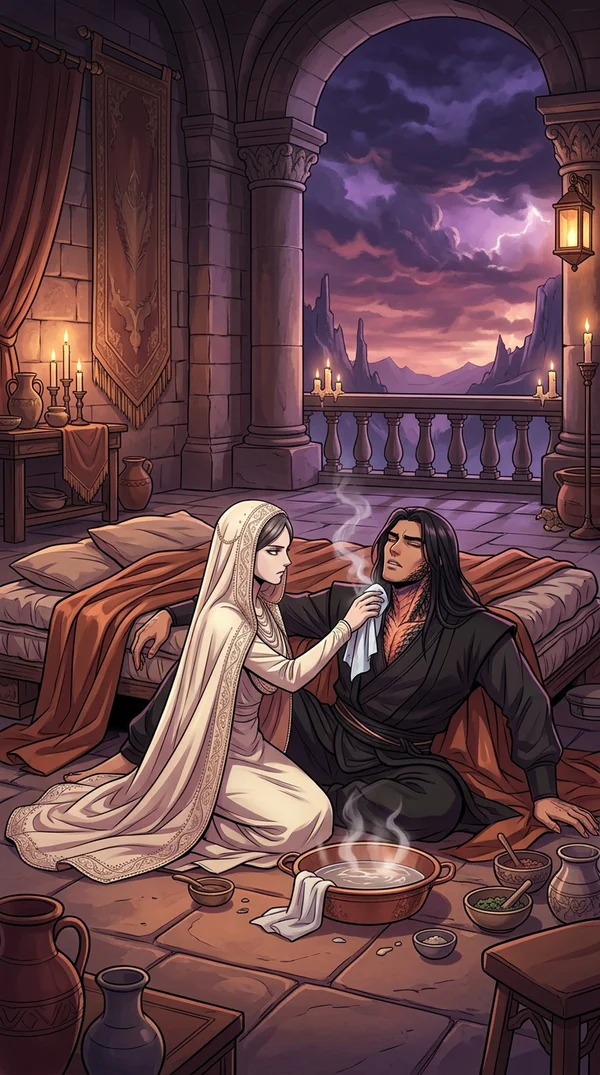
His cup was waiting for him. A great gold thing, heavy, filled with dark wine. He drank from it without looking, like a man trying not to think, and set it down, and pressed the heel of his hand to his eyes.
Sweat stood out on his temple. The hand at his eyes was shaking.
“Majesty?” said Vesca, from his other side, all concern.
“It’s warm,” he said.
It wasn’t. Not for dragonkin. I’d felt the hall all evening: comfortable to them, an oven to me.
I don’t know what made me do it. Training, maybe. Eighteen years of reaching for every cup at the queen’s table before the queen did. I reached across him and took his cup in both hands and said, bright and loud, “A toast! Your Majesty, I’ve been on this mountain three days and nobody’s let me make a single toast.”
The hall laughed. I raised the cup. I put it to my lips.
Burnt honey.
Not my own. Not the ghost of the spoon on my tongue. There, in the wine, under the black currant and the oak and the rough young tannin of Ottilie’s red: the long dark finish of ashlily, sweet first and then not, so faint that no one alive could have found it but a girl who’d been raised on it.
Someone was poisoning him.
Not me. Not tonight. Someone else, slowly, with a little in every cup. For years, maybe. For three years, maybe, as Vesca said: fevers, worse every season, a king who couldn’t find his words.
Not the long dark at all.
“To the king!” I said, and drank.
I drank it all. Every drop, head back, throat working, the way a girl from the river towns drinks to show she can. The court cheered. Somebody banged the black table and it rang like a bell. Ashlily went down my throat, a whole cup of it, and sat in my stomach like any other wine, because I had been eating it since I was six, and it could not touch me.
I set the empty cup down in front of him and smiled.
He was staring at me. So was Ilka, from her place behind his chair, with her crossbow and her brown eyes, and she wasn’t laughing.
Vesca, at his left, was smiling too. Her smile didn’t change at all. That was how I knew she’d seen.
I sat with my hands in my lap and my mouth tasting of burnt honey, and listened to the drums start again, and understood two things, both at once, the way you sometimes taste two flavors in one bite and can’t, for a heartbeat, tell which came first.
Somebody in this hall had been killing him slowly for years, long before Orlen sent a taster up the mountain to do it fast.
And I had just stopped them, in front of everyone, without deciding to, to protect the man I had come here to kill.
What did you think?