Finding Zero, chapter 1 of Please Don't Condemn the Sky
The Steward offered me my parents’ orchard over a cup of tea, and I said yes before it was cool enough to drink.
In my defense, it was very good tea. And it was six in the morning, which is when I make my worst decisions and my best seating charts.
Corin Vasko’s office sits at the top of the Steward’s House in Landing, with a long window that looks spinward along the Ring. At that hour in Turning the Lamp comes up the color of apricot jam, and the land goes up with it: the roofs of Landing, the chapels of Sweetwater, my parents’ orchard terraces at Stem Two, all of it climbing away from you and curving up into the sky until it is blue with distance and hanging over your head. Somewhere up there, eight kilometers above the Steward’s carpet, the Overmere was catching the first light, a long silver lake held on the inside of the world like water in a spun bowl.
I’ve lived under that view for thirty years. I still look.
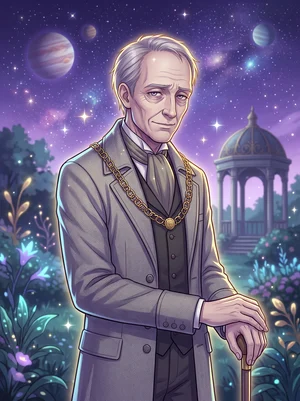
“You’re looking,” said the Steward, pleased, as if he’d made it himself. He poured my tea with his own hands. He is sixty-four and silver and wears cardigans with leather buttons, and when he’s sorry about something he gets very gentle, and he was very gentle that morning.
The loan papers were on his desk. I could read my father’s signature upside down. I’ve been reading things upside down all my life. It comes of growing up here.
“You’ve seen the notice on the boards,” he said. “The Charter Office’s assessor arrives at the Hub Dock at nine. I asked for him myself, on Founders’ Night, after the storm. It reassured people. He’ll look at us for two weeks and write a report.”
“And you want me to do the welcome.”
“I want you to do the two weeks.”
I put my cup down.
“After the storm,” he said, “every newsfeed in the Reach ran the same picture. Your forty couples, Del, standing in Sweetwater in the rain with their veils stuck to their faces. Lightning on Stem Four. We were a joke for a month. Visitors are down by half.” He turned the loan papers on the desk toward me, the way you’d turn a cake to show its good side. “We need him to see what we are, not what went wrong. The gardens. The weddings. The Fair. Keep him happy, keep him in the light, and keep him out of the Underneath. It’s old pipes and old men down there and nothing a man from the Charter Office needs to spend his days crawling through.”
“For fourteen days.”
“Until your Hundred-Couple Wedding at the Turning Fair. His report’s due the morning after. If he goes home thinking well of us, the Ring’s bank forgives the Asante Orchard’s loan. All of it.”
Three bad harvests, a frost fan that cost more than my studio, and two years of water rationing on the terraces while the lake was low. My parents have never once asked me for help. My mother would rather sell her peaches one at a time at the Gate than take a gift.
This wasn’t a gift. It was a job.
“Why me?”
“Because you can make anyone happy for fourteen days,” said the Steward. “I’ve watched you do it to nine hundred couples.”
“Nine hundred and four.”
He smiled, sad and kind, and I said yes. It sounded like a wedding. One guest, two weeks, a venue the size of the world. I’d done harder with less.
You ride up Stem One in a lift with brass doors and windows all the way round, and the higher you go the less of you there is. By the halfway mark I’m half a woman. By the top I’m a suggestion.
This is why I had taped down my hem.
Florist’s tape, green, in a neat ring round the inside of my sundress, so that when I floated out of the lift at the head of the Stem and pulled myself along the guide rail down the Axle to the Hub Dock, I would look like a professional and not like a dandelion. I had a bouquet in a weighted vase: amber dahlias, late roses, three branches of Founders’ Blush with the leaves going gold. I had a smile I could hold through a groom’s mother crying, a cake sliding, and once, memorably, a small fire.
The Hub Dock is a long tube of white ribbing and handholds at the very end of the Axle, where there’s no weight at all and everything you didn’t tie down goes on a little holiday. The morning packet from the Reach had docked early. The arrivals gate was already open, and the first people out were a honeymoon couple in matching blue, holding hands, laughing, letting go of their luggage to kiss.
Their luggage left.
Three cases and a hatbox rose gently off the deck and set off down the dock toward the exit like guests heading for the bar. The bride shrieked. The groom lunged and turned a slow, beautiful, useless somersault.
I had ribbon. I always have ribbon. I hooked my foot under a rail, pulled a length of satin off the spool in my pocket, tied a slip knot one-handed and lassoed the hatbox on the first throw. The cases I caught by their handles as they came past, one, two, three, and clipped them together with the bouquet’s spare wire, and by the time the groom had stopped spinning I was holding out his luggage like a bunch of balloons.
“Welcome to Meadowlark,” I said. “Honeymoon? Sweetwater cottages are on the left as you come down the Stem. Ask for the one with the blue door. Tell them Del sent you, and they’ll give you the bed that doesn’t squeak.”
They thanked me in a pink tangle and floated off. I turned back to the gate, pleased with myself, and found a man watching me.
He was tall, which in no weight means he took up a lot of air. He wore a long grey coat buttoned to the throat, which in no weight was a choice, and he had one hand on a rail and the other holding a small black notebook. His hair was dark and cut short by someone who didn’t care for it. His face was all bones and attention. He was not smiling. He looked like a man who had come to inspect smiling and found it poorly maintained.
“Mr. Reyne?” I held out the bouquet. “Senior Assessor Reyne, from the Charter Office? I’m Del Asante. I’ll be looking after you while you’re with us.”
He looked at the flowers.
During the luggage, the vase’s weight had slipped. A dahlia was easing out of the arrangement like a bridesmaid leaving early. A rose followed it. A single gold leaf drifted up between us and turned over in the air, slowly, showing him both sides.
“No, thank you,” said Bastian Reyne.
He opened his notebook, uncapped a pen with his teeth and wrote something down. I tilted my head. Reading things upside down, as I said.
Finding Zero: unsecured objects in a weightless dock.
“It’s a bouquet,” I said.
“It’s eleven unsecured objects.” Another rose left. “Twelve.”
Then the water came out of the vase all at once in a wobbling silver ball the size of an orange, sailed through the gap between us, and broke over his notebook.
We both watched it. A bead of water ran off the page and floated away with Finding Zero on it, a little.
“I’ll write that down too,” he said.
The ride down was where I learned the second thing about him.
Going down a Stem, the weight comes back into you by degrees, like the tide filling a pool. First-timers press their faces to the windows and watch the whole curving band of the Ring Gardens unroll below them, the lake swinging up into the sky as the floor swings down to meet you. I’ve timed proposals to that lift.
Bastian Reyne stood with his back to the glass, both hands on the rail behind him, and looked at the floor.
I talked. It’s what I do. I told him about the Turning Fair, and about the hundred couples I was marrying on Bride’s Island in twelve days, in the voice you use for the best thing in your life. He said “Mm” at reasonable intervals. His knuckles on the rail were white. When the lift jerked at the bottom, he closed his eyes.
The doors opened on Landing.
He stepped out into the square, into the ordinary morning: the Gate, the bronze founder on her plinth with her trowel and her slide rule, a peach seller, two children chasing a dog. And then, because everyone does, he looked up.
I watched it happen to him. The land rising ahead of him and behind him, going up and up and over, the far side of the Ring hanging upside down overhead with its own roofs and fields and that long bright lake. No lid. No ceiling. Nothing between him and all that sky except the sky.
He went white. Not pale. White, like a tablecloth, and very still, and his hand came out and found nothing to hold.
I have seen exactly that face on eleven grooms. It’s the face just before the knees go.
“Gatehouse first,” I said brightly, and took his arm as if I’d always meant to, and turned him toward the low stone building beside the Gate. “Tradition. Every visitor signs in with Mina. She’ll be very offended if we don’t, and you do not want Mina offended, she remembers things for a hundred years. Mind the step.”
He let me steer him under the roof. In the shade of the doorway he breathed in once, hard, through his nose, and the color started back into his face, and he looked down at my hand on his sleeve.
“There is no such tradition,” he said.
“There is now. I just started it. That’s how all the traditions here began.”
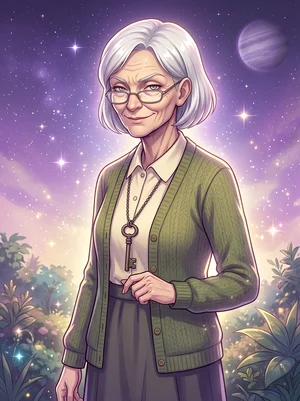
Inside, the Gatehouse was cool and smelled of ink and old wood. Mina Quaile sat at her high desk behind the Walk Ledger, eighty-one years old and the size of a sparrow, with a key on a chain around her neck and her glasses on top of her head. She looked at me. She looked at him. She looked at my hand, which was still on his arm.
Then she got down off her stool, picked up her chalk, went out through the side door to the brass Gate Board, where every morning she writes the odds under the Almanac’s forecast, and wrote, in her big round letters that can be read from the far side of the square:
ASANTE & REYNE, 25 TO 1
“Mina!”
“It’s a fair price,” said Mina, coming back in and dusting her hands.
“I’ve planned nine hundred and four weddings. You have never once posted odds on me.”
“You’ve never once walked in holding on to anyone.”
“Twenty-five to one? That’s insulting. That’s practically a no.”
“He hasn’t smiled,” said Mina, climbing back up onto her stool. “When he smiles, I’ll think again.”
I turned to make a joke to Bastian about it and found that he wasn’t listening. He wasn’t even standing. He was kneeling in the middle of the Gatehouse floor.
Every building the founders put up has one: a disc of thick old glass set into the floor, about a meter across, ringed in brass. The starglass. It sits on top of a shaft that goes straight down through forty meters of soil to a window in the hull itself, out into space, and when you stand on it you see the stars go past under your feet, the whole wheel of them sweeping through the glass once for every turn of the Ring. Ring-born children lie on their stomachs on starglasses and try to count them. You can’t. They go too fast. That’s the point.
He had set a small brass tripod over the glass. From it hung a fine wire and a brass bob, swinging. He had a watch in his hand. His lips were moving.
I walked over. He didn’t look up. A bright star came into the glass from one side, crossed it, and left. He clicked the watch, waited just over two minutes for the same star to come round again, clicked once more, and then he counted the pendulum’s swings against the second hand with an attention so complete I found myself holding still so as not to spoil it.
Then he wrote. I read it upside down.
Finding One.
There was a lot after that, numbers mostly. At the bottom he had written two of them and underlined both.
He stood, folded the tripod, and looked at me properly for the first time, with eyes that were grey and steady and not unkind, which was worse.
“Ms. Asante,” he said. “Every board on this Ring says one weight. Why does my instrument say ninety-six hundredths?”


What did you think?