The Steward's Tea, chapter 5 of Please Don't Condemn the Sky
I went to the Steward at seven the next morning with my procession stopwatch in my pocket like a stone.
He was in his garden behind the Steward’s House, deadheading roses in his cardigan. He saw my face and put the secateurs down and said, “Tea, I think,” and went in and made it himself, and brought it out on a tray to the little iron table under the pergola, with the good cups.
I didn’t touch mine.
“Two minutes ten,” I said. “I timed it myself. In the Sweetwater Chapel, over the starglass, with my own hands. And a pendulum, which I also made with my own hands, out of florist’s wire.”
“Ah,” said the Steward.
“Where’s his instrument?”
“Safe.” He didn’t pretend. I’ll give him that, now. He looked at his roses. “It’s being looked after, Del. Nobody’s been hurt.”
“He’s been hurt. Somebody went through his room.”
“He’s been inconvenienced.” He poured milk into his own cup, carefully, watching it bloom. “It’s a small drift. A few hundredths. The Spinners are old and the ice is expensive and we had a hard spring. My engineers are fixing it, quietly, the way we fix things here. Another season and the boards will be telling the truth again, and nobody will have had to be frightened.”
“Then tell him that.”
“Tell a Charter Office assessor that the Ring is under rating?” He shook his head, so kindly. “Do you know what happens then? He writes it down. It goes on a list in an office on a world neither of us will ever see. And somebody there, who has never stood under this sky, decides it’s simpler to empty us than to wait. The chapels close. The cottages close. Sweetwater goes dark. Your parents’ trees stand there with nobody to water them until they die. Eighteen thousand people on haulers, Del, with one bag each. For a few hundredths, that we’re already fixing.”
I thought of my mother propping branches with forked sticks. I thought of Councillor.
“You’re asking me to lie to him.”
“I’m asking you to do what you’ve always done.” He set his cup down and looked at me, and his eyes were wet, and I believe they were wet honestly, which is the terrible part. “You of all people know how to make a bad day look like a good one. You did it for thirty-eight couples in the rain. You did it for that poor girl in her boots. That’s all this is. Give me nine more good days. Show him the Fair. Let him go home happy, and let me fix it.”
He didn’t mention the loan. He didn’t have to. It was sitting between the cups like a third guest.
I stood up. I said, “I have to get him to the Terraces by nine,” which was true, and which was not no.
He heard that it was not no. He smiled at me as I went.
I gave Bastian a perfect day. It was the worst day I’ve ever planned.
We went to the tea terraces on the Aft Wall, where the bushes grow in stripes up the slope and the pickers sing, and we drank tea in a pickers’ hut with the door open, and I talked. I talked about tea. I talked about the Fair, and the lantern makers, and the cake. I’ve never talked so much in my life, and I am a woman who once kept a congregation entertained for forty minutes while a groom was fished out of the Overmere. Every sentence was a little bridge I built so that I wouldn’t have to stand anywhere near the truth.
He listened. He drank the tea. Halfway through the morning he took off his coat for the first time since the dock, and folded it over his arm, and I saw that his shirt was soft and old and mended at the elbow, and I had to look at the tea bushes very hard for a while.
“You’re quiet,” he said, at noon.
“I’ve been talking for three hours.”
“Yes,” he said. “That’s how I know.”
He put his cup down on the hut’s windowsill and looked at me, not at the slope or the sky, and I understood that he was giving me a door. He’s very bad at hiding things. He’d have made a terrible wedding planner.
“Is there anything you’d like to tell me, Del?”
The pickers were singing up the slope. A breeze came in at the door and moved the steam off the tea. I thought of my father’s signature upside down, and of a man swinging a brass bob over the stars with his lips moving, and of how very nearly it would cost nothing at all to say it.
“The Fair has a pie contest,” I said. “You should enter. My mother wins it every year and she’d love to be beaten by someone she likes.”
He looked at me a moment longer. Then he picked his cup up again.
“I don’t bake,” he said, and the door closed.
I took him to lunch at the terrace kitchens. I took him to see the rice paddies, where the water steps down the wall in mirrors. He looked at each one, one flower at a time, one terrace at a time, and I watched him do it and was proud of him and couldn’t tell him, because I was standing next to him lying with every breath.
I didn’t have a save for this. That was what kept going round in my head. I always have a save. And every save I could think of had the Steward’s gentle voice in it.
We came back through Landing at four, and the Gate Board was wrong.
I saw people seeing it before I saw it myself. A knot of them in front of the brass Board, reading, then looking up at the sky, then reading again. The Almanac writes tomorrow’s sky once a day, in the evening, as it has every evening for a hundred and fifty years. It never writes twice. It never writes in the afternoon.
At the top of the Board, in the old clattering brass letters, above Mina’s chalk, it had written:
AMENDED. TONIGHT’S SKY: CLEAR AND DRY AND THIN. FROST BY FOUR. BRING THE PEACHES IN.
“Frost,” said someone. “In Turning?”
“It’s a joke,” said someone else. “It’s broken again. Like the spring.”
Bastian was reading it with his head on one side. “Is that usual?”
“No,” I said. “None of it.”
Isla Marlowe came across the square at a run, which I’ve never seen her do, with a roll of paper under her arm and Rook behind her carrying a bucket of nails. She was pinning copies to the Gate Board before she’d stopped moving.
“Del. Good. Listen.” Her face was tight. She didn’t look at Bastian at all, which I noticed later. “The Almanac’s been wringing the air again. Pulling every drop it can out of the sky and putting it in the lake, like the spring, only quietly. So the air’s bone dry. And dry air on a clear night lets the warmth go straight up off the ground, nothing to hold it in, like taking the lid off a pot. Clear, dry, still. It’ll freeze in the low places by three or four.” She hammered in a nail with the heel of her hand. “Nobody could write cloud over it, suspended or not. There’s no water in the air to write with. That’s the whole problem.”
“The low places,” I said.
“The orchard terraces at Stem Two are the lowest ground on the Ring this side of the lake.”
My parents’ terraces. The Founders’ Blush, a week from picking, heavy on the forked sticks. Frost on a ripe peach and the skin goes brown by morning and the whole crop goes soft. My parents’ year. The fruit on every wedding cake I’d ever made. The tree Ondine Ferrow planted from a stone in her pocket.
“Smudge pots,” said Rook. “Everyone you know. Every pot you can find. Fans if they’ve got them.”
The map Isla had pinned to the Board was of my parents’ orchard, hand-drawn, terrace by terrace, with crosses where the pots should go. She’d drawn it in the last hour. There was a line at the bottom in her neat rainwright’s hand: VOLUNTEERS TO THE ASANTE ORCHARD AT DUSK. BRING BOOTS. BRING EVERYONE.
I turned round to Bastian and couldn’t do it. I couldn’t look at his face. I looked at his mended elbow instead.
“I’ve got a wedding emergency,” I said. “I’m so sorry. The cake. It’s a cake thing. I’ll see you tomorrow.”
He opened his mouth and I was already gone.
I called everyone. Everyone I’ve ever married. The baker under my studio. The Ferreira sisters. Old Pell, who said he’d bring his grandsons and a crate of oil. Mina, who said she’d send the Gatehouse lanterns and the lost-and-found box, and didn’t ask a single question, which should have warned me.
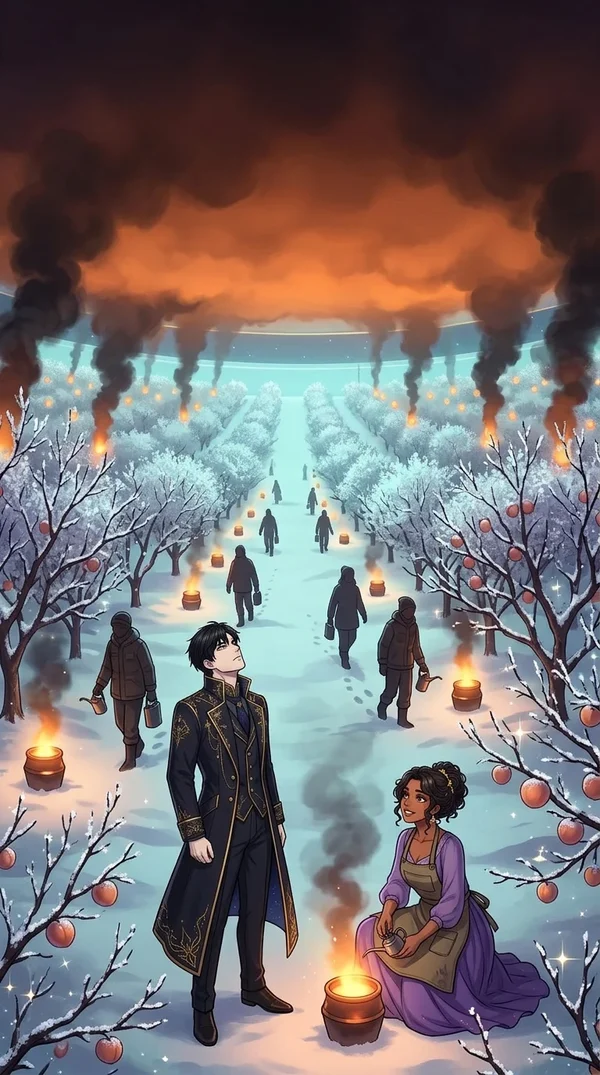
By the time the Lamp started going down, there were sixty people on my parents’ terraces and the pots were coming in on carts. They’re old orchard pots, squat iron things with a chimney, and you fill them with oil and light them and they sit between the trees all night breathing out heat and black smoke. My father had two hundred in the barn. The neighbors brought three hundred more. My mother was handing out gloves and oil cans and apples, giving orders like a general, and kissing every volunteer on both cheeks.
The air was already cold. Thin and dry, just as the Board said. I could feel it on my bare arms as I worked down the lowest terrace with a can, filling, filling, my breath starting to show. Up the slope the first pots were going, little orange flames under the leaves. Above them the sky was clearing to that perfect deep amber of a Turning evening, and the far side of the Ring was going blue, and there was nothing, nothing at all, to hold the warmth in.
I didn’t hear him. I smelled the oil and heard my mother say “Oh!” in the voice she uses for babies and good peaches, and I looked up.
Bastian Reyne was walking down the terrace between the trees in his grey coat and a pair of muddy orchard boots at least two sizes too big for him, which flapped. He had one of Isla’s maps folded in his hand. He had his notebook. He’d come along the lane past the Stem by himself, under all that open sky, and his face was white with it, and set.
He stopped in front of me and looked at the oil can in my hand, and the line of unlit pots, and the cold air smoking on my breath.
“The lost-and-found at the Gatehouse,” he said, of the boots. “Mina insisted.” He held up the map. “Where should I start?”

What did you think?