Astor Street, chapter 4 of Pregnant With the Wrong Billionaire's Baby
I didn’t sleep. At five I put the file back in its box and the box in the hall closet, behind the vacuum cleaner, the way you’d put away a dog that bites. At six I opened the shop. At six-oh-four Callum knocked on the back door with a cup of ginger tea, and I took it from him and said, “Thank you,” and nothing else, and he looked at my face and didn’t ask.
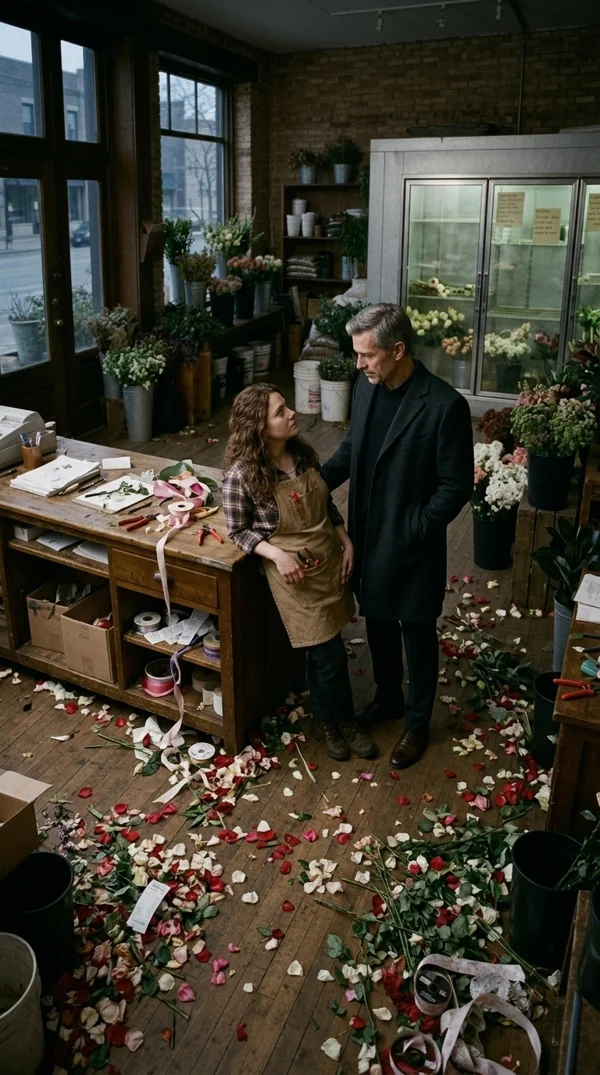
He didn’t ask all that day, or the next. It was the third-busiest week of a florist’s year, after Valentine’s and Mother’s Day. I made forty centerpieces of white amaryllis and cedar for a law firm’s party and a funeral spray for a retired fire captain and a bridal bouquet of red ranunculus for a woman marrying, on December twenty-sixth, the man she’d been engaged to in 1974 and lost track of; both of them were seventy-one. I kept my hands busy. That’s what hands are for.
On the twenty-third, his lawyer called Connie, and Connie called me.
“Results are in,” she said. “I’ll tell you now so you can hear it from your own lawyer and not from his. It’s him. Ninety-nine point nine and a lot of nines after that.”
“I knew that.”
“I know you knew. Now you have it on paper.” She chewed. “They want a meeting. At his house. I said yes, because I’ve never seen the inside of an Astor Street greystone and I’m sixty-seven years old.”
The house was four stories of pale stone on a block of Astor Street where the trees had wire around their trunks and the sidewalks were salted before the snow had even finished thinking about it. It had a black door and a brass knocker shaped like nothing at all, just a ring, and a Christmas wreath so perfect I knew a florist in Lincoln Park had charged eleven hundred dollars for it.
“Magnolia leaves,” I said to Connie on the steps. “Dried and gilded. The bow’s velvet. Look at that bow.”
“You’re stalling.”
“I’m assessing the competition.”
Callum opened the door himself. He was in a gray sweater and no coat and he looked, for the first time since I’d met him, like somebody who lived somewhere. Behind him there was a hall with a black-and-white stone floor and a staircase that went up in a long curl, like the inside of a shell.
The meeting was in a library with no books in it.
There were shelves for them. Floor to ceiling, dark wood, a rolling ladder. And on them, a few framed photographs of buildings, a model of a tower under a glass box, and nothing else. It was the saddest room I had ever seen and I said so, before I could stop myself, and Callum looked around it as if noticing for the first time.
“I keep meaning to,” he said.
His lawyer was waiting there. Theo Achterberg was perhaps sixty, bald, in a suit the color of wet sand, and he stood when I came in and shook my hand and said, “Ms. Dunmore. I’m very sorry about all of this. There’s about a ninety percent chance you’ll find me tedious.”
“Only ninety?”
“I’m conservative.”
Connie liked him at once, which I could tell because she ate four of his housekeeper’s cookies before she said anything. Then the two of them laid it out between the coffee cups like a hand of cards.
In Illinois, Theo said, a child born to a married woman is presumed to be her husband’s. That was the law, and it didn’t care about vials. While I was married to Mark, Mark was the presumed father of this baby, and he’d stay that way until a court said otherwise.
“Which a court will,” Connie said. “It can be beaten. But you have to go to court to beat it.”
“And there’s the other thing,” Theo said, and folded his hands. “There’s a rule that a sperm donor isn’t a parent. It’s there to protect people who use donors. Callum didn’t donate. He stored his own sample for his own use and the clinic took it. Nobody’s ever argued that exact situation in front of an Illinois judge. Nobody knows which way it goes.”
“So what do we do?” I said.
“We go slow and clean,” said Connie. “You finish your divorce. You have this baby. After the birth, we go in together, you and him, with the test and the clinic’s own records, and we ask a judge to name the father. You don’t fight each other, you don’t fight Northpoint in the papers, and you don’t give Mark Haskett a reason to get interested.”
“What are the chances,” I said, “that Mark gets interested?”
Theo looked at Callum. Callum looked at the window.
“If he learns who the father is before the birth,” Theo said, “I’d put it at about forty percent that he becomes a problem. Men who’ve just left their wives are often very interested in money.”
“Mark is always interested in money,” I said. “Mark once returned a Christmas tree.”
When they’d gone, Connie in a cab with a napkin full of cookies, I stood in the hall with my coat half on and Callum stood at the bottom of the stairs, and the house was so quiet I could hear the snow.
“You stopped talking,” he said. “Last week.”
I could have said no. I’d been saying no to men for two months now and I had gotten good at it.
“My file came,” I said. “From Northpoint. Connie told me to ask for all of it.”
I told him. I said it plainly, standing on his stone floor with one arm in my coat, because if I sat down to say it I wasn’t sure I’d get up again. Round one. The two lines. Severe male factor. Four years of the hand in the car. Some women just can’t.
He didn’t say anything while I talked. He stayed at the foot of the stairs without moving, and this was different from the clinic. That had been a man holding himself up. This was a man holding something back. I watched his hand close on the newel post until the knuckles went pale.
“He knew,” Callum said.
“From the start.”
“And he let you—”
“He held my hand,” I said. “Every time. He was so kind about it. I used to tell my mother how kind he was.”
Callum let go of the post. He looked at me without speaking, and then he said, “Come upstairs. I want to show you something,” and when I hesitated he said, “I’ll walk ahead of you. You can leave whenever you like.”
The third floor was empty.
Not empty the way the library was empty, with shelves and a ladder waiting for books. Empty all the way through. Three rooms with bare floors and white walls and long windows looking down on the snow in Astor Street. No furniture. No lamps. The radiators clanked, and that was all.
“I bought this house the year before I got sick,” he said. “Claudia and I. My wife, then. We were going to have children. This floor was going to be theirs.”
He didn’t go in. He stood in the doorway of the front room with his hands in his pockets.
“Hodgkin’s,” he said. “I was thirty-seven. It moved fast, and they needed to start chemo in days. I banked one sample. That was all there was time for, and there wasn’t much in it, because I was already sick. One vial. They told me the treatment would probably end it. It did.” He looked at the bare floor. “Claudia stayed four months. She was very honest. She said she hadn’t signed up to be a nurse.”
“That’s an awful thing to say.”
“It was true. I admired her for saying it.” He finally looked at me. “I came up here once, after I finished treatment. I stood in this doorway and I thought, all right. That’s done. And I shut the door, and I didn’t come back up for eight years.”
“Until last month.”
“Until last month.”
I walked past him into the room. The floor was cold through my boots. Snow-light came in the long windows and lay across the boards in pale bars, and I sat down in the middle of them, in my coat, because my legs had decided to, and after a moment he came in and sat down too, not close, with his back against the wall.
“Six years,” I said. “I’ve thought I was broken for six years. I made jokes about it. I made a joke to my doctor once about being a rental with bad plumbing. She didn’t laugh. I think she knew, and she wasn’t allowed to tell me.”
“You’re not broken.”
“I know that now.”
“No,” he said. “You don’t. You know it on paper. That’s not the same.”
I looked at him across the bars of light. He was right. It was the most annoying thing about him and I’d only known him three weeks.
“How would you know?” I said.
“Because I’ve been told I’m fine for eight years,” Callum said, “and I’ve never once believed it.”
I don’t know which of us moved first. I’d like to say it was him, but it wasn’t. He’d made a promise in the back of a car on Lake Shore Drive and he was a man who kept them. It was me. I crossed the cold floor on my knees in my coat like a fool and put my hands on either side of his face, and found the place under his jaw he always missed shaving, rough under my thumb, and I said, “This is me asking,” and kissed him.
He made a sound against my mouth that I’ll hear for the rest of my life.
Then his hands were in my hair, careful, as if I might break and he’d decided to risk it anyway, and he was kissing me back, slow and then not slow, and the cold floor and the bare walls and the snow all went somewhere else. He tasted like coffee. He kissed like a man who had been very patient for a very long time and had just found out he didn’t have to be. I got a fistful of his sweater and pulled, and he came, and my back met the wall and his body was against mine, warm through all my layers, and his mouth went to my jaw, to the place under my ear, and I heard myself say his name in a voice I did not know I had.
It was the sound of my own voice that stopped me.
I put my hand flat on his chest. Not pushing. Just there. His heart was going like the one on the clinic screen.
He stopped at once. He rested his forehead against mine and breathed, and I breathed, and the radiator clanked.
“That was me asking once,” I said. “It doesn’t mean I’ll ask again.”
“I know.”
“I’m still married. I’m pregnant with a baby that’s legally somebody else’s. I don’t even know what you take in your coffee.”
“Black,” he said. “And you’ll ask again.”
“You’re very sure of yourself.”
“No.” He drew back far enough to look at me, and his eyes were dark and not sure of anything at all. “I’m hoping. It’s new. I’m not good at it yet.”
Malik drove me home along the lake, which was black now, with the city’s lights lying on top of it in long broken stripes. I sat in the back with my fingers on my mouth and felt twenty-two and like a fool, in equal parts, and somewhere around Belmont I started laughing for no reason and Malik, to his great credit, said nothing.
My phone buzzed at Bryn Mawr.
It was a text from Mark. The first in seven weeks. No words at first, just a photograph: grainy, taken through a car window on Clark Street in daylight. My shop. My window, with the red amaryllis in it. And on the sidewalk in front of it, carrying two five-gallon buckets of white roses, one in each hand, with his coat over a dibs chair behind him, Callum Pierce.
Then the words came, one bubble after another.
Neil sent me this. He drove past.
Your lawyer says you’re pregnant by a DONOR.
Is that Callum PIERCE?
Is HE the donor?

What did you think?