Six Large Men, chapter 1 of The Alpha Who Let Me Go
My ex-husband came to my grandmother’s funeral with a buyer for her land.
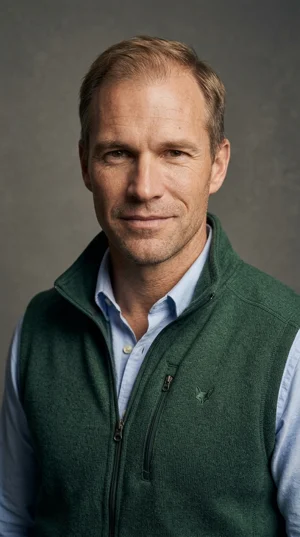
I saw them from the graveside. Graham, in the fleece vest I’d bought him two Christmases ago, crunching up the cemetery road beside a stranger in the same vest and carrying a leather folder, as if the two of them had come to look at a used boat. Snow was blowing sideways off Lake Superior. The pastor was halfway through the committal. Edie’s casket sat on its straps over the hole, and I stood beside it in a Phoenix wool coat that had never met a real November, six weeks divorced, with a fistful of frozen dirt in my glove.
Graham didn’t come to me. He went to the mourners.
“Kurt Dahlberg, Black Spruce Land and Timber,” he told Edie’s friends, in the voice he used on investors. “Hazel’s selling the nine hundred acres. She promised. We just want to make it easy on her.”
Thirty people from a town of fourteen hundred turned and looked at me.
I find stolen money for a living. I hadn’t found the three hundred and forty thousand dollars my husband moved out of our savings and into his app, one polite transfer at a time. And now he’d found my grandmother’s land before she was in the ground.
Kurt Dahlberg held out a card. “Whenever you’re ready, Ms. Halloran.”
Edie’s pallbearers were still standing at the head of the grave. Six of them, in dark suits and work boots. They were very large men.
The one at the front stepped around the casket, took the card out of the buyer’s hand and folded it in half.
“She’s not selling,” he said. “She’s home.”
Twenty-one years ago, on a dock, that same voice had asked me to stay.
He didn’t look at me. He looked at Kurt Dahlberg, and he held the folded card out between two fingers until the other man took it back.
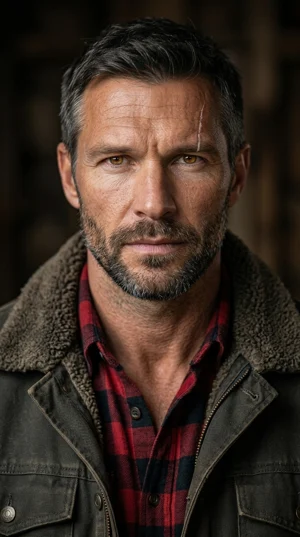
Time had done what it does to a man who works outside. He was broader through the chest than the boy I’d known and gray at the temples, with a short dark beard and a thin white scar through his left eyebrow that hadn’t been there when I was nineteen.
Bowen Rhys.
For a second, as he turned his head, the light did something to his left eye. It looked amber, the color of syrup held up to a window. Then the snow came between us and it was just an eye, dark and steady, and he still wasn’t looking at me.
“Hey, man.” Graham did his laugh, the one that meant a deal was wobbling. “Nobody’s pressuring anybody. I’m family.”
“You’re not,” said the man beside Bowen, who was even bigger and had the patient face of somebody who moves heavy things for a living.
Kurt Dahlberg smiled. It was a soft, regretful smile, the smile of a man who’d been thrown out of nicer funerals than this. He put the folded card in his vest pocket, said, “My condolences,” to nobody in particular, and walked back down the cemetery road without hurrying. Graham hesitated, which he never does, and then went after him.
The young pastor, who had clearly never had a committal interrupted by a land deal, found his place.
“Earth to earth,” he said.
I dropped my handful of dirt on my grandmother’s casket. It was frozen into a single clod and it hit the lid with a sound like a knock on a door.
Lunch was in the fellowship hall of Trinity Lutheran, in the basement, under a low ceiling of acoustic tile. There were two coffee urns the size of fire hydrants, three long tables of pasties under foil, and a man by the window arguing with another man about whether a pasty took ketchup or gravy. They’d clearly been having the argument for forty years.
Everybody wanted to hold my hand. A woman with a gray bob and flour on her cuff introduced herself as Pauline Niemi, from the Lakeview Cafe on Front Street, and held both my hands at once.
“Your grandma fed my kids the winter Ernie got laid off from the mill,” she said. “Brought groceries up our steps every Thursday and told me if I said one word about it she’d stop delivering my mail.” Her eyes filled. “She would have, too.”
“She would have,” I said. Edie had been the Merriman Harbor postmistress for forty years. She liked to say she knew everybody’s business by how thick the envelope was.
My mother should have been the one whose hands they held. The cancer took her six years ago, in Tempe, and Edie had buried her only child before anybody buried her. So I let Pauline hold my hands. I did it for everyone, except a man in a VFW cap who didn’t want to hold anything. He told me Edie had held his mail for a whole summer in 1983 because he owed the post office eleven dollars, and he’d never forgiven her, and then his face crumpled and he went to stand by the coffee. I’d last been in this town four years ago, for three days at Easter, and before that seven years, and before that I’d stopped counting because it was easier. Edie came to Phoenix every Christmas instead, once Mom stopped bringing me north for it: to us, and then, after Mom, to me. She said she liked the oranges on the trees. I’d let myself believe her.
The six pallbearers weren’t at the lunch.
I’d noticed them go. They’d come down the stairs together, and then the biggest of them had touched Bowen’s arm, and all six of them had gone back up into the snow. Nobody in the room remarked on it. Nobody, I noticed, remarked on it in a way that took practice.
Graham found me by the coat rack.
He’d shed Kurt Dahlberg somewhere, and he had the look he gets after a meeting goes badly: hurt, reasonable and wronged. He handed me a cup of coffee I hadn’t asked for. He’d put cream in it. I’ve taken it black for fourteen years.
“That was a lot,” he said. “I’m sorry. Kurt’s a good guy. He flew in on short notice.”
“To my grandmother’s funeral.”
“To help you, Haze.” He lowered his voice. “Two point one million. For the whole parcel, as is. Cash, thirty-day close. You don’t have to do a thing. You’re forty and you’re starting over, and I know I didn’t leave you in a great spot. This fixes that. It’s a lifeline.”
I looked at the coffee with the cream in it.
Here is what I do for a living. When a number doesn’t fit the story it’s attached to, I stop listening to the story. Two point one million for nine hundred acres is about twenty-three hundred dollars an acre, which is roughly what cutover timberland sells for in the Upper Peninsula. That would be a fair price for trees. But Edie’s nine hundred acres didn’t stop at the trees. They ran from Copper Lake all the way to the Superior shore, three thousand feet of sandstone ledge and cobble beach, and lakefront on Superior doesn’t sell by the acre. It sells by the foot.
A timber company offering a timber price for shoreline was either stupid or didn’t care about the price. And men in matching vests who fly in on short notice are rarely stupid.
“How do you know Kurt?” I asked.
“Through the round. One of my investors’ guys.” Graham looked away, which he does when he’s improvising. “Does it matter? It’s a great offer.”
“How did he know Edie died?”
“Haze.” His reasonable voice. “It was in the paper.”
It had been in the Sturgeon County Courier, circulation twenty-two hundred. Graham had never read a newspaper in his life. He read pitch decks.
“Did Edie know you were talking to a buyer?” I said. “Before she died?”
Something moved behind his face. Then he smiled at me, the warm, crinkly, slightly helpless smile that had once made me feel like the only grown-up in a room I was proud to be in.
“Your grandmother liked me,” he said. “Think about it. Thirty days. I’ll be at the Merriman Inn through the weekend.”
He kissed my cheek. I let him, because Pauline Niemi was watching, and I’ve never made a scene in a church basement in my life.
When he’d gone I poured the coffee down the sink in the church kitchen while two old women dried the funeral china around me.
“Ladies,” I said. “The man who led the pallbearers. Bowen Rhys.”
They didn’t stop drying.
“Rhys Marine,” said the one with the dish towel over her shoulder. “Down on the harbor. Docks, boat storage, salvage. His dad had it before him.”
“Why was he carrying my grandmother?”
The other one put a cup in the cupboard and shut it.
“He looked after Edie,” she said. “Plowed her out every winter. Fixed her roof. Those Rhys boys always looked after her.” She smiled at me with great kindness and absolutely nothing in it. “You’d have to ask him the rest, hon.”
He was at the grave.
I’d known he would be. I don’t know how I knew. I’d driven back up to the cemetery at four because I couldn’t stand the motel room and couldn’t stand Edie’s house, and the light was already going, all at once, as it does up here in November. The sexton had told me at lunch that he’d got her in just before the ground set; another week, and she’d have waited in the vault till May. The diggers had filled the grave and left. The snow had stopped. Out past the bluff the lake had gone the color of a cast-iron pan, and the wind coming off it smelled of nothing at all, just cold and distance.
He was standing at the foot of the grave in a canvas work coat, with his hands in its pockets. He heard me on the gravel. He didn’t turn around.
“Hazel,” he said.
Nobody had said my name like that since I was nineteen. Like it was a word he’d been keeping somewhere safe.
I stopped beside him, a careful arm’s length away. My eyes were stinging and I decided it was the wind.
“You carried her,” I said.
“Yes.”
“Why?”
“Because she asked me to.” He was quiet for a moment. “Two years ago. She had it written down.”
Of course she did. Edie wrote everything down. I looked at the mound of raw dirt, and I thought of her at her desk with one of her green ledgers, making a note to have the boy who broke her granddaughter’s heart carry her to the cemetery, and I didn’t understand it at all.
“You folded that man’s card,” I said.
“He shouldn’t have brought it.”
“And you told thirty people I’m not selling. You don’t know what I’m going to do. You don’t know anything about me. You haven’t known anything about me since I was nineteen.”
He turned then, and looked at me properly for the first time all day, and it was worse than I’d thought it would be. His face did nothing. His eyes did everything.
I hadn’t meant to say it. I’d had half my life to decide not to say it, and I’d done a good job, right up until then.
“You left me.”
“I was ordered to,” Bowen said. “I don’t take orders anymore.”
He held my eyes for one more breath. Then he walked away down the cemetery road into the dark, and I stood at my grandmother’s grave and tried to think who on earth could have given him an order like that.
What did you think?