The Walking Order, chapter 1 of The Beast That Wouldn't Kneel
The beast had learned what the bell meant. Iona could tell because it had stopped looking at the gate.
It stood in the furthest corner of the transport pen, its left shoulder against the masonry, with three of its feet on the ground. The fourth hung clear. Under the forward edge of its harness, a strip of flesh had swollen around a buckle. Every time it breathed, the buckle disappeared.
The yard corporal rang the bell again.
“That won’t mend the foot,” Iona said.
He turned. His glove was new enough to creak around the bell handle. Most things in the yard were new: the flags, the lime on the stable walls, the sign announcing the dissolution of the Imperial Siege Corps. The animal behind the fence was thirty years old, perhaps forty. Nobody had thought to ask it.
Iona had read the transport sheet upside down in the cart from the detention house. Glass Kiln, forty miles south. Beneath that, a line of its own: final disposal, furnace chamber three.
“It walks at six.”
“Then it should have been unharnessed at four.”
“You can take that up with the lieutenant.”
Iona put her bag on the mounting block. The corporal watched her hands as she unfastened it. He had watched them all the way from the detention house, as though the paper he carried named something worse than disobedience. It did not. Disobedience had been enough to cost her everything.
She laid out a knife, two wooden wedges, a length of felt and a little jar of grease.
“You’ll leave the knife here.”
“Certainly. You can cut the girth.”
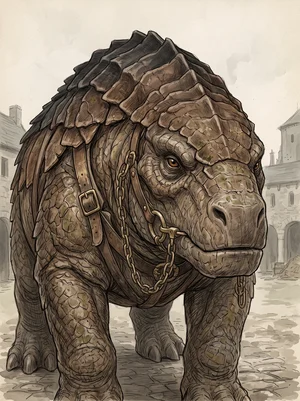
Inside the pen, the beast shifted. Its armor moved in overlapping plates, dull brown at the edges and almost black along the spine. Mud had dried in the seams. Something beneath the shoulder plate clicked, a small, precise noise that made the corporal look at the gate fastening.
He returned the knife.
“I’ll be watching.”
“Watch the left forefoot. If it starts to come down, tell me.”
She picked up her bag and went in sideways.
There had once been forty-three siege beasts at North Yard. Iona had fed eight, trained four, and buried one. The stalls stood open now. Tack had been sold by weight. A team of bricklayers was making the western pens suitable for cavalry horses, who would probably object to the smell for another generation.
The last beast waited by the wall.
It was called Seventeen on the transport sheet. There was a space for a name, ruled neatly between stock number and condemned destination, but the clerk had drawn a line through it. Iona had not worked with this one. Its handlers had come from the eastern companies, dissolved first and paid last, and none remained to say whether it preferred its grain wet or which side it tolerated a stranger on.
She stopped beyond the sweep of its head.
“I’m going to look at that strap.”
The small eye nearest her stayed shut. The other faced the wall. Its mouth was closed around the bronze bit the corps used for older animals, with a chain passing under the heavy jaw to the chest yoke. A line of pale saliva stretched from one ring.
She set the grease jar on the ground and stepped back.
Nothing happened.
Outside the fence, the corporal lifted the bell.
Iona looked at him.
After a moment, he put it down.
The beast opened its eye. It considered the jar, then her boots. Its nostrils tightened and released. There was an old scar on its upper lip, where a command hook had once been pulled in the wrong direction.
“Yes,” she said. “We’ve all met him.”
She waited until the beast moved its head a finger’s width toward her. Then she approached the shoulder.
The swollen skin was hot. She touched the plate above it with the back of her hand, felt the tremor underneath, and took her hand away. Not anger. Exhaustion, perhaps. You could decide too quickly about an animal that weighed more than the cart meant to carry its food.
She slid one wooden wedge beneath the girth and leaned her weight against it. The buckle emerged. Green pus marked its lower edge.
“Who tightened this?”
“It was trying to lie down.”
She looked through the rails. The corporal’s expression closed before she said anything else.
Iona took out the knife.
The leather parted with a noise like a boot coming out of mud. The harness sagged. For a breath she thought the beast would fall, and she put out a hand as though her hand might prevent it. Then the left forefoot settled, carefully, onto the dirt.
“It’s down,” the corporal said.
“I noticed.”
The animal breathed out through its nose. Warm air stirred the hair at her temple. Its shoulder no longer shook.
She cleaned what she could with water from the trough, folded the felt over the injury and threaded a longer strap through the yoke. Work made the yard smaller. There was a buckle to move, a stitch to open, a knot that must lie on the outside. While her fingers had something useful to do, she could avoid thinking about the folded order in the corporal’s pocket.
A door slammed near the mounting block.
“Rusk.”
Lieutenant Orren had removed the siege insignia from his coat. Pale thread remained around the empty place. He carried the brass command fork in a fitted case, as though he had come to conduct a demonstration for people with clean shoes.
Iona wiped her hands on her trousers.
“It needs three days.”
“It has three days.”
He held out the order through the rails. She did not take it until she had capped the jar.
The destination was Glass Kiln. Two days’ march and a morning’s work, according to whoever had drawn the itinerary. Right side up, the line about the morning’s work read no better.
Below it was the alternative sentence for the assigned handler.
“You said transport,” she said.
“It is transport.”
“You have wagons.”
“We have wagons that belong to the cavalry. We have bridges repaired to cavalry specifications. We have an animal that won’t enter a wagon, and one remaining handler who declined to teach it the correct response.”
“I declined to hang a boy from a feed gantry.”
The corporal began to find something interesting near his boots.
Orren kept his voice level. “Your conviction is not under review. Complete the assignment and the remaining term is commuted. There is a berth on the return supply cart. Present the disposal receipt at the detention house and collect your belongings.”
Her belongings were a winter coat, three letters and a comb with two teeth missing. She had thought about them each night for six months. The coat in particular. A person could have foolish ambitions.
“And if I don’t?”
He tapped the second line of the order.
She read it. It was brief enough that she read it again.
Refusal or failure by the assigned handler: commutation withdrawn. Remaining term extended to twelve years, at labor, at a works camp to be assigned.
The lieutenant opened the case.
Seventeen moved before the fork came out. Its neck drew back against the yoke. One hind foot scraped a shallow trench in the pen floor.
Orren held the instrument by its leather handle. Two bronze tines curved around a sliding weight. The fittings were polished; the leather was dark where other hands had used it.
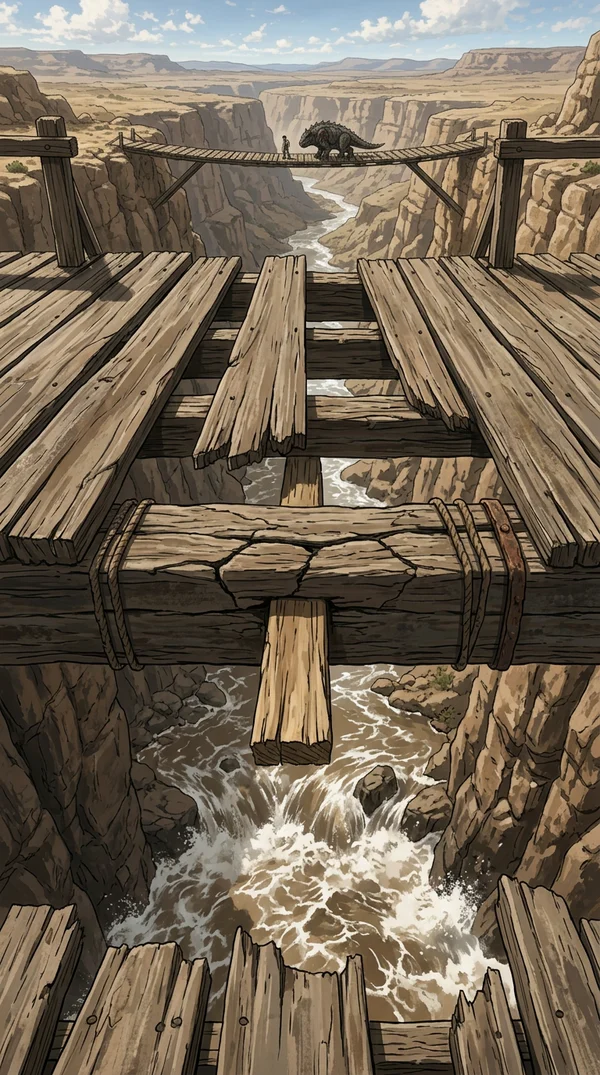
“You’ll need this at the narrow bridge.”
“I’ll need a route without a narrow bridge.”
“The southern road is the route authorized.”
He struck the fork against the rail.
Iona felt the note in her back teeth. The animal’s bronze bit answered with a thin rattle. Its front legs stiffened. Under its jaw the chain pulled taut, pressing into the soft hinge where the plates ended.
“Kneel,” Orren said.
Seventeen did not kneel.
Its injured shoulder began to bleed through the fresh felt.
“It’s standing on the wound.” Iona reached for the fork. Orren stepped back and struck it again.
The beast opened its mouth as far as the bit allowed. No roar came out. It made a dry, baffled clicking noise. Behind it, mortar sifted from the wall.
The corporal put his hand on the gate bolt.
“Leave that alone,” Iona said.
Orren was watching the animal’s legs. “It knows the order.”
“Yes.”
She took hold of the chest chain. The vibration ran into her wrists. The release pin sat behind the right-hand ring, bent at its tip. Somebody had hammered it over to prevent an accidental opening.
She put her knife through the ring and used the blade as a lever.
“Rusk.”
The pin moved. The knife broke.
One piece fell between her boots. The other remained in her fist, useless, while the chain slipped free of the yoke. Seventeen jerked its head sideways and the bronze bit struck the ground hard enough to leave a square dent.
The note stopped.
The animal stood breathing. It had not advanced an inch.
Orren stared at the open fastening.
“Put it back.”
“The pin’s broken.”
“Find another.”
She looked at the beast, at the four planted feet and the strip of red spreading through the felt. Its eye followed the command fork. It knew exactly where the thing was.
Six months in a locked room had taught Iona the value of saying nothing. She tried it now.
“You’re determined to make this difficult,” Orren said.
“It has to walk forty miles. You can hurt it until it lies down, or you can let me keep it standing.”
For the first time he looked at the shoulder dressing.
Beyond the yard, the barracks clock struck six. Men were waiting at the southern gate with a feed cart and a sealed packet for the kiln. Orren had an itinerary to complete. He had already removed the insignia from his coat.
He closed the case.
“The fork travels with you. So does the corporal. He holds your papers, the receipt form and the keys to your sleeping irons. If the animal stops, you use the fork. If it leaves the road, you use the fork. You understand the order.”
Iona understood it very well. She also understood what he had not said: that every siege officer signed for two forks, one to travel with the animal and one to keep, and that Orren had never in his career given up both.
The lieutenant left the broken bit where it lay. The corporal followed him as far as the mounting block, where they spoke quietly over the transport sheet.
Iona picked up the pieces of her knife. There was only a little blood on her palm, a straight cut beneath her smallest finger. She rinsed it in the trough and tore a strip from the felt to bind it.
Something touched her elbow.
Seventeen had lowered its head. Without the bit, its mouth looked oddly unfinished. A narrow tongue moved against the damaged place on its lip, and its breath came softly through the nostrils.
“Don’t thank me yet.”
It nudged her elbow again.
She held still. The yard smelled of limewash, wet leather and old grain. From the gate came the scrape of a feed cart being turned. She let the animal smell the damp binding on her hand.
Its tongue touched the cloth.
The yard vanished.
She was standing in water up to her chest, though her knees were wrong and there was too much of her behind them. Heat pressed against one side of her face. A rope, no, several ropes, cut across her shoulders. Ahead of her a woman in a yellow apron held a child on a windowsill. The window was sinking. The woman was trying to lift the child higher.
A bell rang.
Iona tried to step forward. Something pulled her head away.
Then a man said, very distinctly, “There were no houses at Leth Ford.”
She was back beside the trough with one knee in the mud.
The beast had withdrawn its head. It stood a pace away, watching her. Her hand stung where the cloth had loosened.
“Rusk?” the corporal called.
She got up by holding the trough. Water ran off her sleeve. Across the yard, Orren was returning to the office, his empty insignia patch bright in the morning light.
There were no houses at Leth Ford. Everyone knew that. Nine years ago the river had flooded an abandoned crossing, and the army had lost a pontoon bridge. She had read the account. She had copied it into a stable ledger when someone asked why two companies had returned without their animals.
She could remember writing the words.
She could also remember the woman reaching down for another child.
The corporal lifted her bag from the mounting block.
“Ready?”
Iona looked at the transport order in his other hand. Glass Kiln. Furnace chamber three. Final disposal.
“Open the wide gate,” she said.
What did you think?