The Road Marked South, chapter 2 of The Beast That Wouldn't Kneel
The corporal made her wait while he collected the broken bit.
He lifted it with a piece of sacking, avoiding the wet rings, and fitted it around the command fork’s case in his pack. The release pin hung from its little chain. When he pulled the strap tight, bronze struck bronze.
Seventeen stopped in the open gate.
“Wrap it again,” Iona said.
“It’s on the inventory.”
“I didn’t ask you to lose it.”
He found another sack. She waited until the animal lowered its head, then walked through the gate without touching it. Behind her came four slow footfalls, unevenly spaced.
The feed cart stood in the road. A grey mule leaned into its traces while the driver, a woman wearing a man’s cavalry coat, counted sacks against a slate. She stopped counting when she saw the beast.
“That all you’re taking?” Iona asked.
“That all they’re paying for.”
There were six sacks, a barrel of water and a rolled tarpaulin. Iona put her hand into the nearest sack. Cracked barley. Dust lay beneath it like flour.
“It needs rough feed.”
“Then it can eat the countryside. I have a delivery to South Weigh and a return load of roof tiles. I’m Bess. You don’t have to tell me your name.”
The corporal consulted his transport sheet.
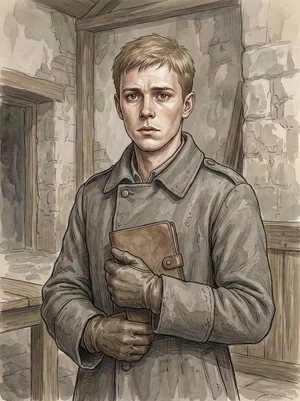
“Pell,” he said. “Corporal Dain Pell.”
Bess looked at him, then at Iona. “That one needed telling.”
They set off through the waking town. Shopkeepers stood holding their shutters while Seventeen passed. At the baker’s, a boy came out with a broom and forgot what he meant to sweep. The animal’s shoulder brushed a hanging bunch of empty baskets. It flinched, and the boy ducked behind his broom.
Iona caught a basket before it fell.
“Mind the string,” she told him.
He reached for it. His sleeve slid back, showing a pale wrist, and she had to look at the basket until he took its weight.
At the last houses the street widened into the southern road. Iona walked on Seventeen’s left, where she could watch the dressing. Dain kept to her other side. The keys on his belt made a bright, irregular noise.
For the first mile she counted steps. The beast shortened every sixth one. By the second mile it shortened every fourth. The new felt had slipped, exposing a dark edge of blood.
She stopped beside a drainage ditch.
Dain stopped too. “We’ve only just left.”
“You can carry the shoulder for a while.”
He looked toward the cart. Bess had already pulled onto the verge.
Iona loosened the replacement strap and moved the felt. Seventeen allowed her to work until she reached across its face. Then it drew away, pulling the harness with it.
She caught herself against the nearest plate. Her bandaged palm stung.
Water. A yellow sleeve. A child’s foot knocking a window frame.
She let go so abruptly that Dain reached toward her.
“What?”
“Nothing.”
His hand remained suspended between them. She found the loose end of the strap and threaded it through the buckle. The vision had not returned. Her own memory of it had been enough.
“You went down in the yard,” he said.
“I got up.”
“I have to record an injury.”
“Then record this one.” She pointed to the shoulder.
He put his hand down.
They ate beside the road near noon. Bess cut bread with a knife that was longer and better cared for than Iona’s had been. Iona watched the blade go through the crust.
“You need something?” Bess asked.
“To borrow that.”
“You can borrow it here.”
Iona trimmed a rough edge from the shoulder pad while Bess watched. When she returned the knife, the driver wiped it before cutting her own bread.
Dain sat on a milestone with his pack between his boots. He counted coins into two piles. One pile had eleven pieces in it. The other had three. He considered them, then moved a coin from the larger pile to the smaller.
“Your mother won’t notice,” Bess said.
“It’s for lodging.”
“Then your landlord won’t.”
He folded a paper around the smaller pile. Iona saw a column of deductions: coat, boots, winter quarter, replacement bell. Beneath the bell was a fresh blank line.
“They charged you for that?” she asked.
“I signed for it.”
“The old one was cracked.”
“I signed for the new one.”
He put the coins away. A little later, when he thought she was watching the animal, he took the paper out and checked his addition.
Bess went to loosen a mule trace. Dain took the opportunity to unfold another sheet.
“I have to confirm your effects,” he said.
“They’re not here.”
“For collection on return. One wool coat, brown. One comb. Three items of correspondence.”
“Three letters.”
He glanced up. “That’s what correspondence means.”
“Then write letters.”
He made no alteration. His finger moved to the next line.
“Any claim for missing items?”
She remembered handing over her belongings in the detention house. The clerk had put the coat in a basket, then asked her to remove its buttons. Brass could be filed into things, he said. She had spent ten minutes working them free with a borrowed pair of scissors. One had rolled under his desk. He made her find it.
“Are the buttons listed?”
Dain turned the sheet over. “Separate packet. Seven.”
“Eight.”
He counted something on his fingers. “It says seven.”
“There were eight.”
He found a space in the margin and wrote the claim. She watched until he added his initials beside it.
The letters were from her sister. Iona knew the hand from the envelopes the detention clerk had shown her before adding them to the basket. For six months she had imagined three increasingly impatient descriptions of a leaking roof, the price of lamp oil, a cousin’s unsuitable marriage. She had also imagined news she would not be able to bear. Sometimes not having the letters had felt like the only kindness left in the place.
“Anything else?” Dain asked.
She looked at the seven buttons on his sheet, and the eighth he had allowed to exist in the margin.
“No.”
He folded the paper. She turned back to the beast before he could see how closely she followed it into his pocket.
The land fell toward the river. Orchards crowded the slopes, their upper branches white with dust from the road. Seventeen reached into one and stripped a twig before Iona could stop it. It chewed with an absorbed expression while a farmer shouted from the trees.
Dain offered him a transport chit.
The farmer looked at the seal. “That corps doesn’t exist.”
“The account does.”
“Then let the account eat my apple tree.”
Bess gave him a copper. She wrote something on her slate afterward.
At the bridge, she wrote several more things.
The old crossing had been stone. Its piers remained, blunt and wide, but the deck between them had been replaced with planks resting on new timber. A painted sign listed permissible loads. Below the sign, a smaller notice prohibited stopping on the span.
Seventeen stopped before either notice.
Iona walked to the edge and crouched. Between two planks she could see the water, brown and swift. The nearest beam had split around a bolt. Someone had packed the split with a wooden shim.
Dain joined her with the itinerary unfolded.
“It’s the designated crossing.”
“For cavalry.”
“The lieutenant knew what we were taking.”
She picked up a stone and dropped it through the gap. It took longer to reach the river than she liked.
Bess led the mule onto the bridge. The cart followed, its wheels thumping over the joins. At the second pier the deck flexed. Seventeen backed into an orchard fence, snapping a rail.
“Don’t bring it forward,” Iona said.
Dain had caught the lead rope. He looked down as if surprised to find it in his hand.
Bess reached the opposite bank. She turned the mule and waited.
“One at a time!” she called.
Iona stood. “You can come back.”
“What?”
“The bridge won’t take it.”
The driver stared across the water. Then she looked at the load sign, the beast and the new timber. She swore with enough care to make herself heard.
Dain’s thumb found the strap of his pack.
“Don’t,” Iona said.
“If it moved steadily—”
“I could make it step onto the bridge. The first span might hold. Then we’d find out about the second while it was standing on it.”
He released the strap, but not the rope.
A pair of orchard wagons had accumulated behind them. Their drivers climbed down. The broken fence owner arrived at a run, carrying the snapped rail like evidence of a personal insult.
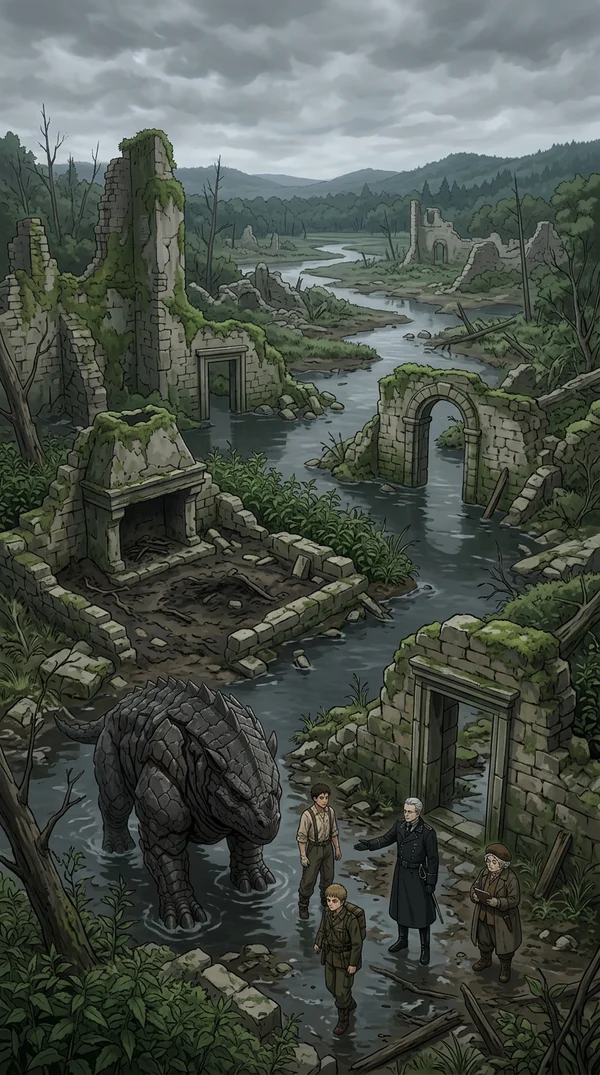
There was another crossing three miles north, someone said. Closed since spring. An old stone bridge west of here, perhaps nine miles, but the approach went through a village lane. A ford downstream. Nobody used that one.
“Why?” Iona asked.
The men looked at one another.
“Road’s gone,” said the fence owner. “It’s Leth.”
Her fingers tightened around the edge of the load sign.
“Leth Ford?”
“There another?”
She turned toward the river. Downstream, beyond a stand of alder, the water spread into a pale band. An old embankment ran toward it through the orchards. Grass covered its crown.
Dain followed her glance.
“That’s not south.”
“It reaches the south bank.”
“If it’s passable.”
“We can look.”
“With what time?”
Bess had brought the cart back. She listened while Iona explained, her face giving away nothing. Then she set the brake and climbed onto the load.
“Two sacks,” she said. “The little water keg under the seat. You can have that.”
“We paid for six sacks.”
“You paid for six delivered at South Weigh. My wheels go on roads. My mule goes on roads. My tiles won’t load themselves while I look for a ford.”
Dain spread his papers across the cart’s sideboard. He searched through them, his lips moving. Bess waited. The orchard men began shifting their wagons past Seventeen, giving its feet more room than its head.
“A route variation needs an officer,” Dain said.
“Find one,” Bess replied.
He looked toward North Yard. It lay six miles behind them.
Iona went to the beast. It had turned its head toward the river. Its tongue moved over the scar on its lip. She took the lead from Dain’s slack hand and unfastened it from the chest ring.
“What are you doing?”
She began walking along the old embankment.
For several steps nothing followed. She could hear Dain behind her, folding and unfolding the order. Seventeen cropped another apple twig. The farmer shouted again.
Then the ground answered beneath her feet.
She kept walking. The animal caught up beside her, its head low, following the smell of water or the old road or something she had no means of knowing. She did not touch its mouth.
“Rusk.”
She stopped.
Dain stood by the cart holding out a form. There was a space at its foot for her mark.
“You accept responsibility for the variation.”
“Yes.”
“The transport allowance is forfeited.”
“Yes.”
“And any additional expense may be charged against—”
“I have a coat.”
He stopped reading.
She returned to the cart and signed. Her hand shook enough that the final stroke ran into the ruled line. Dain watched the pen, but said nothing about an injury.
Bess lowered the sacks. One of the orchard men helped Dain sling them from the sound rear portion of the harness, keeping their weight clear of the left shoulder. Iona checked both knots twice. When she straightened, Bess was holding out a short knife with a chipped wooden handle.
“Found that under the seat,” she said.
Iona took it. The blade had recently been sharpened.
The driver climbed onto her cart before Iona could answer. She took the return copy of the variation form, tapped it against Dain’s sleeve and went over the bridge with the food they would not get to eat.
Dain watched until the cart disappeared into the trees.
Then he lifted the water keg, grunted at its weight, and came after them.
What did you think?