I Work for You Now, chapter 2 of The Bodyguard My Ex-Husband Hired
Nobody sleeps after a stranger tries their back door. I can tell you that for free.
I sat up in the kitchen with a chair wedged under the knob and a cast-iron skillet on the table in front of me, because it was the heaviest thing I owned that I knew how to swing. Dobro slept against my feet. Every time a car went by on the street I turned my head, and every time I turned my head the black truck was still there, dark, with the shape of the man behind the wheel not moving at all.
At six the sky over the shed went the color of weak tea. I made coffee because my hands needed a job.
I made two mugs. I’m not going to pretend I know why. Something my mother would have done, maybe: you feed the men who dig the grave, even if you don’t like them. I put milk in mine and nothing in his, because he looked like a man who drank it black, and I carried them both across the street in my jeans and Dalton’s old Carhartt, which was the warmest coat I had and the only thing of his I’d kept besides a grudge.
He rolled the window down before I got there.
I held the mug up. He looked at it, and then at me, and then he took it.
“Thank you.”
“I didn’t poison it,” I said. “I thought about it.”
“Figured.” He drank. “It’s good.”
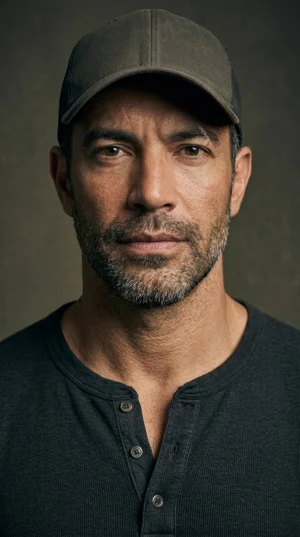
Up close in daylight he was older than I’d thought at noon, closer to my age than not, gray coming in at the edges of the beard, a scar through one eyebrow that had healed white. Big through the shoulders in a way that had nothing to do with a gym. He’d been awake all night, and it showed only in the eyes. The rest of him looked like it could sit there another week.
“So,” I said. “Who are you?”
“Gabe Navarro.”
“That’s a name. I asked who you are.”
He thought about it like it was a real question. “I do protection. Close protection, mostly touring acts. Before that, the Army.” He reached over to the passenger seat and came back with a manila folder, and held it out through the window. “And this is why I’m here. You should see it.”
I didn’t take it right away. “You’re just going to show me.”
“You asked.”
The folder had my name on the tab, typed. Inside was my driver’s license photo, blown up until it was all pores, and my address, and the make of my car, and my hours at Bellweather, which I had not told anyone, and a page headed Subject Background that I read standing in the street with the coffee going cold in my other hand.
Subject has a documented history of harassing the principal since the dissolution of the marriage. Subject is emotionally unstable and has made statements perceived as threats. Subject may attempt to approach the principal or his family. Recommend visible presence.
I laughed. It came out of me ugly, like a cough.
“I’ve sent that man one text in three years,” I said. “It said happy birthday. I put a cake emoji on it. That’s the threat. The cake.”
He didn’t say anything. He watched me read the rest.
There was a second page, shorter, not typed so nicely. Somebody had written it in a hurry. Be visible. Log her movements. Do not engage unless engaged. She’ll fold in seventy-two hours.
“She’ll fold,” I said.
“That’s what they told me.”
“And you took it.” I shut the folder and held it against my chest, because I didn’t want to give it back and I didn’t know why. “You read that and you thought, sure. Big man in a truck. Make the crazy lady cry.”
“I read that and I thought it was a job.” He didn’t look away. He had a way of not looking away that felt less like staring than like standing in the rain without an umbrella: he’d just take it. “Firm called me Tuesday. Harpeth Protective. I’m a contractor; Gil Mabry sends me work. Gil said a principal’s ex-wife had made threats and the principal wanted eyes on her. Paid well. I said yes. I’m telling you because you’d find out, and I’d rather you heard it from me.”
“Why?”
“Because I don’t lie to people I’m sitting outside of.”
I stood there in Dalton’s coat with my mouth a little open. Twenty years in writing rooms and I’d never heard anybody put a line that plain. It didn’t scan. It didn’t rhyme with anything. It was just true, and it sat there in the cold air between us.
“Did you listen to it?” I asked. “The memo.”
“Four times.”
“Why four?”
“Wanted to know if they were lying to me.” He drank the last of the coffee. “They were.”
A garbage truck groaned past at the end of the street. Somewhere a rooster that wasn’t supposed to be legal in Davidson County started in.
“I watched him win at Robert’s,” I said, and I don’t know why I told him that, except that he’d told me something. “On the TV over the bar. I’d ordered a beer I couldn’t afford because I thought if I was going to watch it I should at least be holding something cold. I didn’t drink it. I just sat there and let it go warm.”
He nodded, slowly, like he was filing it somewhere.
“Ma’am,” he said. “Can I look at your back door?”
He didn’t come inside. He asked before he stepped off the street onto my patch of grass, and he asked again before he went around the side of the house, and he walked the way I imagine he walked a lot of places, looking at everything once and remembering it.
At the back door he crouched. The frame was old pine painted green, and right beside the strike plate there were two fresh bright gouges in the paint where something flat and metal had gone in and tried.
“Pry bar,” he said. “He tried the knob first, didn’t like the deadbolt, thought about the jamb. Then he heard me.”
“How do you know he heard you?”
“Because he stopped.” He pointed at the dirt bed under my kitchen window, where my tomato plants had died in September and I hadn’t had the heart to pull them. In the soft dirt, between the black stalks, there was a boot print. One clean heel. And next to it, where the other foot should have been, a long smear, like a brush stroke. “He drags the right. Bad knee, or a hip. He’s done this before. He’s not scared of houses.”
I looked at the smear. I thought about the pale jacket at my window and the patient way the knob had turned, and my stomach went somewhere south of my knees.
“Do you know who he is?”
He was quiet just slightly too long. I’ve spent my life listening for that. Anybody who’s ever written a song with somebody knows the sound of a man deciding how much to say.
“I know Highwater uses more than one firm,” he said finally. “I don’t know him. Yet.”
“Yet.”
His phone rang.
He took it out of his jacket and looked at the screen, and his face didn’t change, but something in his shoulders did. He looked at me. Then he pressed the screen and held the phone out flat between us, on speaker, in my backyard, in front of my dead tomatoes.
“Navarro,” he said.
“Mr. Navarro.” I knew the voice before he finished the name. Soft as a church usher’s, a little damp, the sound of a peppermint clicking against teeth. Wendell Shaw had been in my house for Thanksgiving dinner four years running. He’d carved. “Wendell Shaw. I wanted to call you myself and say how much we appreciate the work. Gil tells me you’re the best he’s got.”
“What do you need, Mr. Shaw?”
“Straight to it. I like that.” A small wet click. “The situation’s changed. The young lady isn’t folding. I’d like to move things along. She’ll be at a friend’s tonight. Junie Rucker’s, over in Inglewood. Supper. She does it most Fridays. You’ll have two hours, maybe a little better.”
I stared at the phone. I had never told anyone about Fridays at Junie’s. I had never had to. You don’t announce your life when nobody’s watching it.
“Two hours for what,” Gabe said.
“There’s a document. An old electric bill. She’s got some writing on the back of it she thinks is worth a great deal. It’s in that house somewhere, and I’d like it to be in my office. That’s all. Nobody needs to be inconvenienced. You go in, you find a piece of paper, you leave. Twenty thousand for your trouble, on top of the rate. Cash, if you like that better.”
Gabe looked at me while Wendell talked. Not at the phone. At me. Standing in my own backyard in my ex-husband’s coat, with the folder that called me unstable held against my chest, hearing a man I’d cooked turkey for price my whole life at twenty thousand dollars and a supper’s worth of time.
“No,” Gabe said.
There was a pause on the line. Then a small, patient sigh, the kind a man gives a waiter who’s brought the wrong wine.
“All right. That’s fine. Not everybody’s comfortable with that kind of work. I understand. Just step back, then, and I’ll have my other fellow handle it. You can keep the truck there, if you like. It’s useful, her seeing it.”
“Your other fellow,” Gabe said. “He drag his right leg?”
The pause was longer this time.
“I don’t know what you’re asking me, son.”
“Yes, you do.” Gabe’s voice hadn’t risen at all. If anything it had gone lower, and slower, the way a road goes quiet before a storm comes over the ridge. “Mr. Shaw. I’m off this. Call Gil and tell him. Tell Dalton. Tell whoever you want. I’m not your eyes, and I’m not your hands, and I’m not sitting in that truck so she can be scared of it.”
“Now, Mr. Navarro. I’d think about that. This is a small town. People talk. A man who walks off a job—”
“I’ve thought about it.”
“You won’t work in Nashville again.”
“Then I won’t.” He hung up.
The backyard was very quiet. The rooster had stopped. Dobro was sitting on the back steps, watching us through the screen with his good ear up.
Gabe put the phone in his jacket. He looked at the gouges in my door frame and the smear in the dirt, and then he turned around and looked at me, and I had the sense, standing there, of a door swinging shut behind me that I hadn’t known was open.
“I can’t afford you,” I said. My voice came out small. “I want you to know that. I’ve got six hundred dollars and a dog.”
“Didn’t ask you to.”
“Then what—”
“Hattie.” It was the first time he’d used my name. He said it like he’d been carrying it around a while and finally had somewhere to set it down. “I work for you now. Nobody gets near you.”

What did you think?