Lights Out, chapter 3 of The Bodyguard My Ex-Husband Hired
I made him wait on the back steps while I decided.
That was petty, and I knew it, and I did it anyway. A man had sat outside my house for twenty-four hours because somebody paid him to, and now he was going to sit on my steps for five minutes because I said so. I stood at the kitchen sink and washed the two mugs very slowly and watched him through the window. He sat with his forearms on his knees and his hands loose between them, looking out at the alley, as patient as a fence post. Dobro had gone out to him. Dobro had his head on the man’s boot.
Traitor, I thought, and dried the mugs, and went out.
“Here’s how it goes,” I said. I stayed on the top step so I’d be taller than him for once. “You don’t come in my house unless I ask. You don’t lie to me, not even the polite kind. You don’t call me ma’am. I’m forty-three, not ninety.”
“All right.”
“And I’m paying you. I don’t care what you say. I’m not going to owe one more man in this town.”
He turned that over. Then he looked up at me, squinting a little against the white sky.
“The beer,” he said.
“What beer?”
“At Robert’s. The one you couldn’t afford.” He said it plainly, like a rate on an invoice. “When this is over, you buy me that one. Cold.”
I opened my mouth to tell him that was ridiculous and found I didn’t have anything to say. It was the most expensive beer in Nashville. It had cost me nine years.
“Fine,” I said. “You’re hired.”
“Yes, ma’am.”
“Gabe.”
The corner of his mouth went somewhere. “Hattie.”
The bill lived in my guitar case.
I’d never told anybody that either. I carried the case out to the kitchen table and opened it, and the old Gibson lay there in its crushed-velvet coffin looking smug, and I lifted the little lid on the accessory pocket under the neck where other people keep picks and capos and spare strings. Inside was a gallon Ziploc bag, and inside the bag was a pink envelope, and folded inside the envelope, so the creases had gone soft as cloth, was the bill.
Gabe stood in the kitchen doorway. He’d asked. I’d said yes.
I didn’t take it out of the bag. I didn’t have to. I could see my handwriting through the plastic, ballpoint going hard and then faint where the pen had started to die, a coffee ring over the second verse, PAST DUE in red across the top of the other side. And under it, in the corner of the bag, the hospital bracelet. White plastic, my name and a date. I’d cut it off on the fourth day, finally, and then I hadn’t been able to throw it away, so I’d put it in with the song.
Gabe looked at the bracelet. He didn’t ask. I was grateful for that in a way I couldn’t have said out loud.
“Not here,” he said.
“It’s been here six years.”
“Nobody knew it was here for six years. Now everybody knows it exists.” He nodded toward the back door, the gouges. “He’ll come back for it. Bank?”
“I’ve got a checking account with a hundred and twelve dollars in it.”
“They’ll still rent you a box.”
They did. We took my Honda, because by then his truck had been on Channel 4 behind a reporter. The branch on Gallatin had a woman named Doreen at the desk who’d heard the memo on the radio driving in, and she looked at me the way you’d look at somebody’s widow, and charged me sixty dollars a year for a steel drawer the size of a shoebox. I took a picture of the bill through the bag with my phone before I let go of it. Then I put it in the drawer and watched Doreen lock it into the wall, and I stood there in the cold back room of a bank feeling exactly like I had the day I signed the divorce papers. As if I’d just put something I loved in a place I couldn’t reach.
Gabe waited by the door with his back to the wall, watching the lobby.
When we got home, he asked if he could look at my car.
He lay on his back on my driveway in the gravel and the oil stains and put his whole arm up into the rear wheel well of my Honda, and felt around up there like a vet, and came out holding something the size of a deck of cards. Black plastic. A magnet on one side.
“How long has that been on there?” My voice did something.
“Since before I got here.” He turned it over in his big fingers. “Battery’s good. It’s been with us all day.”
“All day,” I said. “The bank.”
“All day.” He looked at it a second longer, and something went across his face that I couldn’t read, and then he got up and walked to the end of the street, where Metro’s garbage truck was idling at the corner, and set the tracker on the truck’s back bumper as gently as a man setting down a bird.
The truck pulled away toward Gallatin.
“Let them follow that for a while,” he said.
By three o’clock I didn’t have a song anymore.
I mean that literally. I opened my phone to look at the memo, at the number, which had gone past nine million sometime while I was in the bank, and where my voice had been there was a gray box. This content has been removed in response to a copyright claim by Highwater Music Publishing.
I sat down on the kitchen floor.
Not because I fainted. My legs just decided the floor was where we were going, and I went. My own voice. Me at two in the morning, crying in my own kitchen, taken down as an infringement of a song I’d written while my husband slept upstairs. As if I’d stolen it from him. As if I’d broken into his house and sung his grief.
The phone rang in my hand. Tammy at Bellweather Beds.
“Hattie, hi! Hi. Listen, so. This is so awkward.” Tammy was twenty-nine and said so the way some people breathe. “So we’re just going a different direction with the fall campaign, and with the jingles generally, and we’re just going to have to pause your contract? Like, indefinitely? It’s not about the thing. It’s totally not about the thing.”
Wendell Shaw played golf with Bellweather’s CEO on Sundays at Belle Meade. Dalton used to go along and lose on purpose.
“Thank you, Tammy,” I said, and hung up, and sat there on my kitchen floor with six hundred and twelve dollars, a dog, and a bodyguard I’d hired for one beer.
Gabe came and stood in the doorway. He looked at me on the floor. He didn’t tell me it would be all right. He went to the stove and filled the kettle and put it on, and stood with his back to me while it heated, so I could cry without anybody watching.
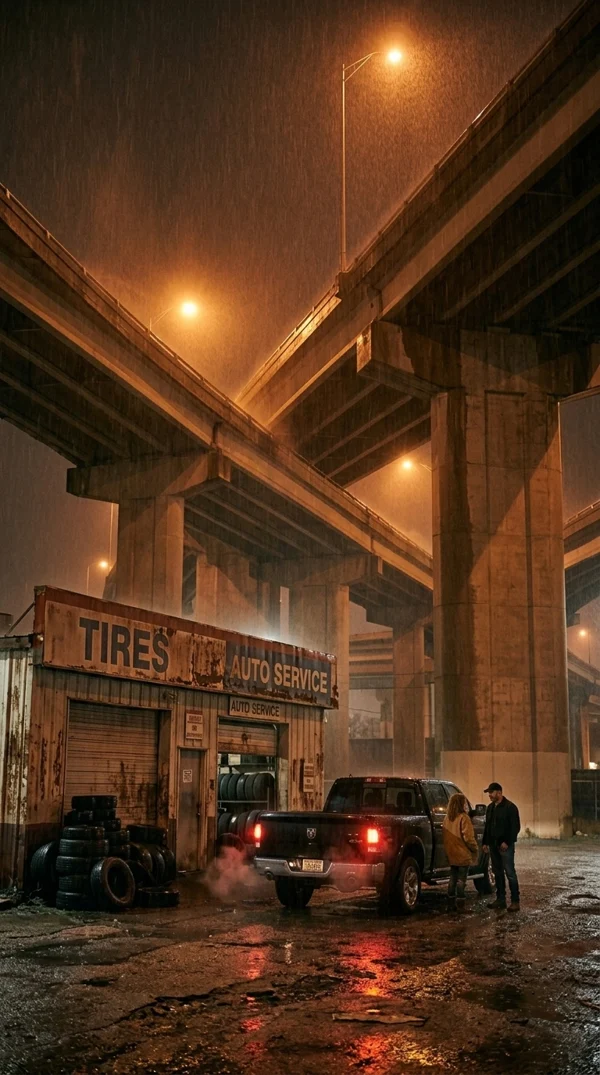
It rained after dark, a cold steady October rain that rattled in the gutters. He was on the back steps under the little overhang, getting wet anyway. At ten I opened the door.
“Come in,” I said. “Before you rust.”
He came in and stood dripping on my mat and looked at my kitchen table like it might bite him.
“Sit,” I said. “It’s just a table.”
“It’s the table.”
I’d told him in the bank, waiting for Doreen. I don’t know why. That it was the only thing I’d asked for. That I’d written the song on it. He’d listened the way he listened to everything, completely, and then not said a word about it, and now here he was, refusing to sit at it.
“Sit down, Gabe.”
He sat on the side I never sat on. I sat across from him. Dobro lay down on his feet. We didn’t talk much. He drank tea out of my good mug and I pretended to write a jingle for nobody, and the rain came down, and around midnight I was almost asleep in my chair when every light in the house went out at once.
The refrigerator stopped humming. The clock on the stove went black. Dobro started barking, high and frantic, deaf in one ear and barking at the wrong door.
Through the front window, the streetlight was still on. The neighbor’s porch was lit.
Only my house.
I didn’t hear him move. One second he was across the table and the next his hand had closed around my wrist, not hard, and I was up and out of my chair and in the hallway with my back flat to the wall, and he was in front of me. All of him. His shoulders blotted out the kitchen. His body was between me and the back door, and his hand was spread flat on my stomach, pressing me to the plaster, keeping me still.
“Don’t move,” he breathed.
I didn’t move. I couldn’t have. I could feel his breath on my hair. I could feel every place he was touching me and every place he wasn’t, and my heart was going so hard I was sure he could feel it through his palm. He smelled like rain and the tea and something warm under it, skin and cotton. He was listening. I could feel him listening, the way you feel a big animal go still in the woods.
Out back, a car door shut, soft. An engine started in the alley. Tires on wet gravel, going away.
He stayed where he was until it was gone. Then he stayed a little longer.
“Stay here,” he said, and then he was gone too, out the back, and I stood in the dark of my own hallway with the shape of his hand still warm on me.
Two minutes later the refrigerator shuddered back on. The stove clock blinked 12:00, 12:00, 12:00. He came back in soaking wet, holding a padlock in his fingers, the hasp cut clean through.
“Main breaker,” he said. “On the panel by your meter. He cut the lock and threw it.”
I was shaking. It had just started, the way it does after, and I couldn’t stop it. I was standing in my kitchen under the overhead light, shaking like a wet dog, and he put the padlock down on the table and came and stood in front of me. Not touching. Close.
I put my hand up and touched his face. I don’t know why. His beard was wet and softer than it looked. He went completely still under my hand.
He was so close. I could have counted his eyelashes. I could see the place where the scar went through his eyebrow, and the rain on his mouth, and I thought, very clearly, I want to. I swayed toward him. He didn’t move away.
And then he took my wrist, gently, and lowered my hand.
“Not tonight,” he said. His voice was rough. “You’re scared.”
“I’m not scared.”
“You’re shaking.”
“Maybe that’s not what that is.”
His eyes went dark at that, and for one second I thought I’d won. Then he let go of my wrist.
“When you want me,” he said, very low, “you’ll want me in the daylight. And you won’t be shaking.”
He took out his phone. He’d put a camera on my porch post that afternoon while I was on the kitchen floor; I hadn’t even noticed. He turned the screen to me. A still from the back of the house, gray and grainy with rain. A man at my electric panel in a pale jacket, bolt cutters in one hand, his face turned up toward the motion light for one careless second.
“I made some calls tonight,” Gabe said. “That’s Ronnie Sykes. Used to be a deputy up in Sumner County, till they let him go. Now he does things for Wendell Shaw.” He put the phone away. “Men like that aren’t paid to scare people, Hattie. They’re paid to make things disappear. Tomorrow, we find the rest of your proof before he does.”
What did you think?