Same as Last Time, chapter 1 of The Bride He Waited For
Mrs. Whitcomb waited until the funeral ham was cut before she offered to buy me off again.
She did it in my mother’s diner, between the pie case and the register, in her church hat, with half of Bellamy County watching over their paper plates.
“Adele,” she said, and pressed a folded check into my hand the way you’d tip a girl who’d parked your car. “Sell the place to the bank, sweetheart, and go on back to Charlotte. It’s what’s best. Same as last time.”
Same as last time.
I was twenty-two the last time. I’d been standing on my mother’s porch with a duffel bag, waiting for her son to pick me up so we could drive to the courthouse in Macon and get married without anybody’s permission. Instead, Mrs. Whitcomb’s Lincoln had pulled up. She’d handed me a letter in Beau’s handwriting saying he’d changed his mind, a check for five thousand dollars, and a bus ticket.
I’d taken all three. I hadn’t come back once in nineteen years, not until my mother’s heart stopped on a Tuesday in the walk-in cooler.
I opened my mouth to tell Lorraine Whitcomb exactly where she could put her check.
Then the bell over the door rang, and the room went quiet in a different way.
Beau Whitcomb had grown into his shoulders. He was in uniform, the sheriff’s star on his chest and gray in his beard, and he was looking at the check in my hand. Then at his mother. Then at me, like a man doing arithmetic he didn’t want to finish.
“Same as last time?” he said.
Nobody answered him.
He took the check out of my fingers and tore it in half.
“I waited at that courthouse till they locked the doors, Dell,” he said, very quietly. “You’re not getting on a bus this time.”
The two halves went into his shirt pocket, behind the star, and he buttoned the flap down over them like evidence.
Somewhere behind me a plastic fork hit the floor. Nobody bent to get it.
I’d imagined this. I’m not proud of that, but I’d had nineteen years and a lot of long nights driving home from close on I-77, and in the version I’d worked out I was thinner, and he was sorry, and I said something so cool and final that he had to sit down. In none of the versions was I holding a ham knife. I set it on the register.
“You wrote me a letter,” I said.
“I never wrote you a letter in my life.”
“Beau.” That was his mother, gently, the way you’d say a dog’s name when it has its nose in the trash. “Not here.”
He didn’t look at her. He was looking at me, and I was finding out that I still knew his face better than my own. Like the house you grew up in, even after somebody has painted it a color you’d never have picked. The beard was new. The lines at the corners of his eyes were new. The look was old. It was the one he used to give me across this counter at two in the morning when he’d come in off a bad call and didn’t want to talk, and I’d pour his coffee and not ask.
“Say what you meant by it, Mama,” he said, still to me.
Lorraine Whitcomb had buried a husband, run a bank for twelve years and outlasted two pastors. She was not going to be caught out in a diner. She smoothed the fingers of her gloves, one, then the other.
“I meant that Adele took my money once and went on and made a fine life with it, son, and I was trying to help her do the sensible thing again.” She turned to me with a face as kind as a church fan. “The offer stands through Friday, sweetheart. Tate Gatlin can draw up whatever you need.”
She went out. The circle ladies parted for her the way they’d part for a hot dish coming through, and the bell rang behind her, and through the front window I watched a Lincoln, newer than the one I remembered but the same pearl color, ease away from the curb in front of the courthouse as if the curb had been poured for it. It more or less had. Whitcomb Farmers Bank sat on the east side of the square with its name cut into the limestone, and the bank held paper on half the buildings in Merritt, and as of a letter I’d opened on Thursday at my mother’s kitchen table, it was fixing to sell this one on the courthouse steps.
Then the room started up again, because a room always does. Ice settled in cups. A man by the window asked his wife, too loud, whether that was the Tolliver girl, and his wife said, “Hush, Harold, eat your ham.”
“Get out of my mother’s diner,” I said.
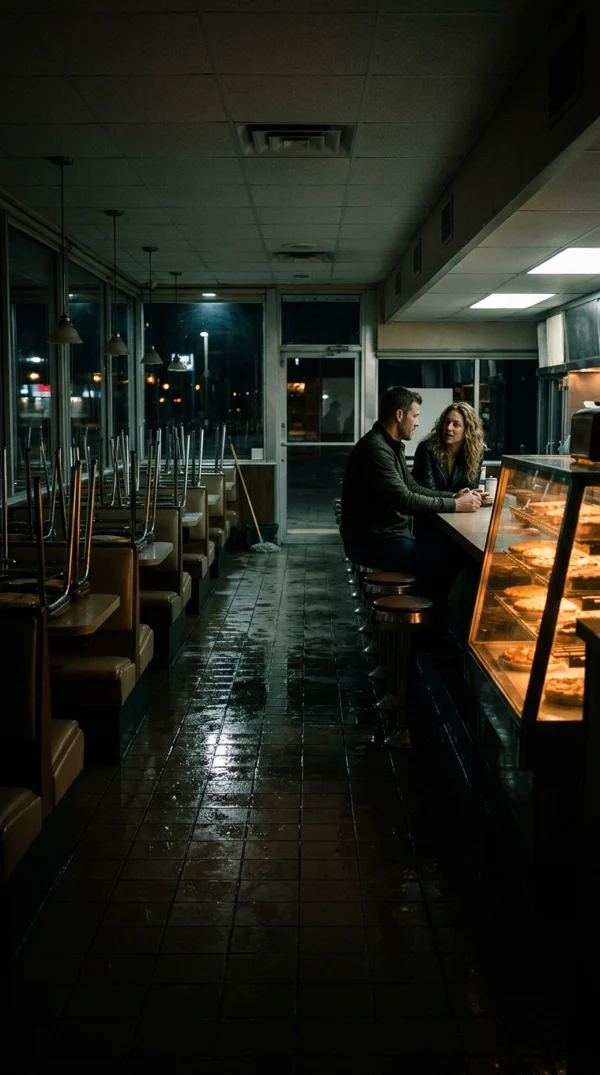
Beau looked around at it: the pie case with its three tiers of lemon chess and coconut cream that the Methodist women had brought, the twelve red stools, the grill window, the board above it where my mother had written the specials in her round blue capitals on the last morning of her life. TUES: CHICKEN & DUMPLINS. PEACH COBBLER. GOD IS GOOD. Nobody had wiped it. I hadn’t let anybody.
“I’ll go,” he said. He went as far as the door and stopped with his hand flat on it, under the bell, so it wouldn’t ring. “I’ll be back when they’ve all gone.”
“I won’t be here.”
“You will,” he said, not unkindly. “You’ve got eighty plates to wash.”
Then he was gone, and the bell hadn’t made a sound.
“Lord God,” said Luanne Ferrell at my elbow. She had worked the counter at Margie’s for twenty-five years and been my mother’s best friend for longer, and she wore her reading glasses on a beaded chain so she could whip them on to read a check or a face. She had them on now. “Lord God, Adele. I have waited my whole adult life to see somebody tear up something of Lorraine’s.”
“Luanne.”
“In front of Brother Pettigrew, too. I am going to be on the phone till midnight.”
“Luanne, please go tell people there’s more tea.”
She went, because she was a professional. I watched her work the room the way my mother had taught both of us: a hand on a shoulder, a refill before anybody asked, a word in an ear that sent a whole table to its feet and out the door without anybody feeling pushed. Inside of forty minutes she had half the county out on the sidewalk saying what a beautiful service it was.
I scraped plates.
I am good at this. I run four restaurants in Charlotte, or I run them for the man whose name is on the door, and on a Saturday night I can stand at the pass and tell you which table is about to send back its steak before the server has made it to the table. I know what a room needs before it does. I know food cost to the penny and how long a walk-in can hold at forty-one degrees with the compressor down and how to fire twelve tickets at once without anybody’s fries going cold. What I didn’t know was how to stand in my mother’s diner without her in it, so I gave my hands a job and let them have it.
Paper plate, trash. Fork, bus tub. Deviled eggs, wrapped, for Calvin to take home.
At the back of the kitchen, past the dish pit and the mop sink, was the walk-in. A steel door, a chrome latch, a strip of tape on the frame where somebody had written SHUT IT in marker years ago. I had been home since Wednesday. I had not opened that door. I’d had the funeral home and Luanne and the Methodist women and a cousin of my mother’s from Dublin to talk to, and every one of them had wanted to tell me how she’d looked when they found her, and I’d let them all get as far as Calvin went in for the butter before I found a reason to be somewhere else.
By three the room was empty except for the smell of ham and the hum of the pie case.
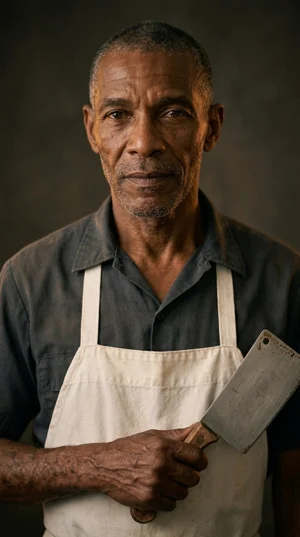
Calvin Mott was at the flat-top, scraping a griddle that was already clean. He had cooked at Margie’s for thirty-one years. He was sixty-three and built like a fence post, with forearms speckled from decades of grease, and he talked to the fryer the way some men talk to dogs.
“Don’t you start,” he told it now, and turned it off, though it had never been on.
“Go home, Calvin.”
“In a minute.” He set down the scraper. He wiped his hands on his apron, then on a towel, then on the apron again. “Dell. I ain’t told nobody this. Not Luanne. Not the funeral man.”
I put down the bus tub.
“When I found her,” he said, “she had the box down. The gray one she kept up top in the back corner, behind the buttermilk. Since the fire. You remember how she’d say it.”
“Nothing burns in a cooler,” I said. My mother had kept her deed and her will and her one good necklace in a cash box in the walk-in since a grease fire in the nineties, and nobody had ever talked her out of it.
“She had it open on the floor by her.” Calvin looked at the board, at the blue capitals. “And she had an envelope in her hand. Your name on it, and your Charlotte address, and stamps. Two stamps, like she wasn’t sure one would get it there.”
The pie case hummed. Out on the square the courthouse clock started in on the quarter hour.
“I put it back in the box,” he said. “And the box back up top. It wasn’t mine to open.” He picked the scraper up again and didn’t use it. “She was fixing to mail you something, Dell. She just didn’t get to the post office.”
I looked past him at the steel door with SHUT IT on the frame.
“It’s still in there,” Calvin said. “Where she left it.”



What did you think?