Meatloaf Thursday, chapter 5 of The Bride He Waited For
The inspector from county environmental health came Wednesday at two, a tall woman with a clipboard who had eaten my mother’s chess pie at every church supper for twenty years and told me so while she checked the walk-in thermometer.
“Thirty-eight,” she said. “Margie always ran it cold.” She wrote on her clipboard and didn’t look up. “I’m sorry, honey. She was a good woman. Your sanitizer’s too strong in that third bucket.”
That was the whole of my grief counseling in Bellamy County. I dumped the bucket.
We opened Thursday at six. I wiped the specials board at five-forty, finally, with a wet side towel, and wrote the new one myself in my mother’s blue marker, trying to make the capitals round. THURS: MEATLOAF. BUTTER BEANS. FRIED OKRA. PEACH COBBLER. I stood back and looked at it and then added the last line, because she would have. GOD IS GOOD. Then I flipped the sign.
For an hour it was the regulars, and the regulars were testing me. Old men in feed caps who’d had the same breakfast at the same stool since before I was born, who ordered by grunting and watched to see if I knew what the grunt meant. Two eggs over, bacon crisp, grits with a pat on top and not stirred in. Biscuit and gravy, side of tomatoes. Coffee, black, refilled before the cup hit half or don’t bother coming back. I knew. I had been raised on those grunts. Every time I got one right I watched a man relax about a quarter of an inch.
Then at seven-fifteen the Methodist men’s breakfast came through the door, twenty-two of them, because their church kitchen was being painted and somebody had decided, out of loyalty or curiosity, to bring it to Margie’s. And at seven-twenty a road crew from the state came in off the bypass, nine men in orange vests who’d been patching asphalt since four and were hungry the way only men who’ve been patching asphalt since four can be.
Thirty-one covers in ten minutes, in a room that seats forty-eight, with one cook, one waitress, and me.
I have worked brunch in Charlotte on Mother’s Day. I have run a three-hundred-cover Saturday with two line cooks out with food poisoning and a fryer on fire. And I can tell you that there is nothing in the restaurant business like a little room in a small town, full of people who knew your mother, waiting to see whether you are any good.
“Behind,” I said to Luanne, and went around her with four plates.
The rail filled. My mother’s ticket rail was a strip of aluminum over the pass, and the guest checks hung from it like laundry, and I read the line of them left to right, the way my mother taught me. Calvin was on the flat-top and the fryer at once, talking to both. “Come on now. Come on. Don’t you do me this way.” Eggs going in three directions. Biscuits out of the oven in a cloud.
“How many chicken?” I called.
“All day, four,” Calvin said.
“Make it six, the crew’s going to want lunch to go.”
“Country ham’s gone,” said Luanne.
“Eighty-six country ham,” I said, loud enough for the room, and three Methodists groaned like I’d announced a death in the family, and one of them laughed, and then all of them did, and something about the room let go.
I don’t remember the next hour. I remember my hands. I remember pouring coffee with my left and ringing a check with my right, and Calvin’s hymn coming out of the kitchen off-key, Leaning on the everlasting arms, and Luanne going by me with six plates up her arm saying, “Table four says your gravy’s as good as hers, table six says it’s not, and table six is a liar.” I remember that nobody’s eggs came out cold.
At eight-forty the room was half empty and every stool had a tip under the saucer and my feet hurt like they hadn’t in years, and I stood at the register and found I was smiling at nothing.
At eleven-thirty an old woman came in by herself.
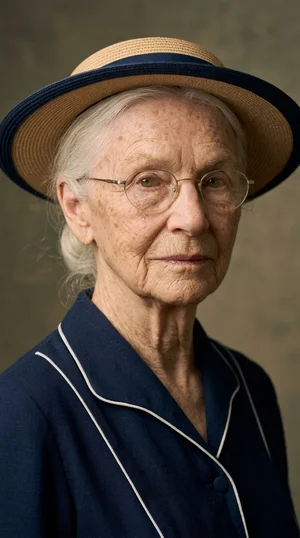
She was small and very upright, in a navy dress with white piping and a hat the size of a saucer, and she went straight to the second booth by the window like it had her name on it. Luanne took her a menu she didn’t open.
“Meatloaf,” said Luanne, coming back, “same as every Thursday since the Carter administration. That’s Opal Dukes. She was head teller at the bank forty-two years.” She lowered her voice. “She hasn’t been in since Margie.”
I brought the plate myself. Meatloaf, butter beans, okra, a square of cornbread. Opal Dukes looked me over, not unkindly. Her eyes were very pale behind her glasses, the color of weak tea.
“You favor her,” she said.
“Thank you, ma’am.”
“It wasn’t a compliment exactly. She had a hard face when she wanted one.” She picked up her fork. “So do you.”
She ate everything. She didn’t say another word. When she left she put her check face down on the table under her water glass with a twenty-dollar bill, and the plate came to eleven.
Luanne picked it up and turned it over twice.
“Forty years,” she said, “that woman has left exactly one dollar.”
That night Beau took the fourth stool from the end at closing, same as he had at twenty-four, as if the vinyl still had his shape in it. Maybe it did. My mother never threw anything out that could be wiped down.
“Kitchen’s closed,” I said.
“I know. I watched Calvin leave.”
“Then what are you having?”
“Whatever you’re having.”
What I was having was the end of a pan of banana pudding, standing up, with a soup spoon. I got another spoon and slid the pan down the counter, and he caught it without looking, the way a man catches keys.
I had a question. I’d had it since Monday night, when his mother stood on my sidewalk in lilac linen and told me to ask him what that bank was worth. I’d carried it around for three days like a plate too hot to set down.
“Your mama says you’d have gotten the bank,” I said. “If you’d married me.”
He put his spoon down. Beau Whitcomb had a way of going quiet that made other people talk to fill it, and I’d watched three grown men do it at this counter over the years, confessing to things he hadn’t asked about. I didn’t fill it. I ate my pudding.
“My granddaddy’s trust,” he said. “His voting shares came to me when I married, or when I turned forty. Whichever came first.”
“And you knew that. At twenty-five.”
“No.”
“Beau.”
“I found out at forty, in Tate Gatlin’s office, with my mother sitting beside me in a hat. He read it out loud. Upon his marriage or his fortieth birthday.” He turned the spoon over on the counter, once. “I signed her proxy that same afternoon. Wanted to get out of the room.”
“Why?”
“Because I’d just found out I could have had a bank for a wedding present.” He looked at me then. “I didn’t want it then either.”
I had been lied to by better-looking men in better light. Sterling could tell you a lie with his whole face, with a little catch in his voice he could probably do on cue, and I’d believed him about a hundred things for eleven years because believing him was cheaper than the alternative. This was a man who’d rather have kept a thing to himself telling it because I’d asked.
“Okay,” I said.
“Okay?”
“I don’t know yet what I think. But okay.”
He nodded, like that was a fair price, and picked his spoon back up.
We finished the pudding. I reached for the pan and he didn’t let go of it right away, so we were both holding it across the counter with the register light on our hands, and that’s all it was, a dirty Pyrex dish, and I was forty-one years old and could feel my pulse in my fingertips.
“Dell,” he said.
I leaned in. I’d like to tell you I didn’t, that I was a woman who’d learned something, but I leaned across my mother’s counter until I could smell the heat on his shirt and the rain that hadn’t come yet.
He stopped an inch from my mouth.
“Not till you’ve decided,” he said.
“Decided what?”
“Whether I wrote it.”
I let go of the dish. He put it in the bus tub himself, and laid four dollars by the register for a pudding nobody had charged him for.
“What are you waiting for?” I said to his back. It came out meaner than I meant, which meant it came out exactly how I meant it.
He stopped at the door.
“I’ve had some practice,” he said, and went out.
The next week I worked every shift. I closed every night and opened every morning, and I counted the drawer at the end of each day the way my mother had, on the counter, in stacks, with a rubber band, and wrote the number in her ledger in a column under her own last column, which stopped on a Monday in June. The first day we did eleven hundred dollars. By the next Wednesday we were doing sixteen. I’d raised the price of the meatloaf a dollar and put the peach cobbler on every day instead of three, and I’d stopped Calvin from frying the okra in oil he should have changed on Tuesday, and he’d stopped speaking to me for one full lunch over it and then said, “It’s better,” and gone back to talking to the fryer.
On Wednesday afternoon I drove to Macon in my mother’s old Buick, because my car smelled like Charlotte, to see a woman named Corinne Lattimore at Ocmulgee Valley Credit Union.
She was about my age, in a sleeveless blouse and reading glasses she didn’t use, and she read my file the way I read a P&L, from the bottom up.
“Your mother’s numbers were fine until March,” she said. “Then they fall off a cliff.”
“She was sick. She didn’t tell anybody.”
“And yours?”
I gave her the ledger page. She read it twice.
“I can do ninety,” she said. “Against an appraisal, with your mother’s three years of returns and a full month of these. You’d need to bring the rest.”
“I’ve got forty-one.”
She did the arithmetic on a pad in front of me without a calculator. “That clears the payoff. Barely. If nothing changes.” She looked at me over the glasses. “Whitcomb Farmers doesn’t usually let things go to the courthouse steps on a building like that. Not with a borrower who’s paid for six years.”
“No,” I said. “They don’t.”
She asked for my license for the file. I took my wallet out and slid it from its slot, and something came out behind it and fell on her desk, face up. A small stiff rectangle of card stock, gone soft and gray at the corners.
“Is that a bus ticket?” said Corinne.
“It’s old,” I said, and put it back.
Driving out of downtown I went past the courthouse. I hadn’t meant to. It was just there, the big columned front, the steps, the lawn, and I had to pull into a loading zone on the next block and sit with my hands on the wheel and the engine running and the air conditioner blowing hot until a man in a city truck tapped on my window and asked if I was all right.
That night, at my mother’s kitchen table on Pecan Street, I took the ticket out.
I’d kept it behind my license for nineteen years. Through four apartments and a marriage and two divorce lawyers. I’d told myself it was to remind me never to be that stupid again. I’d never read it. It was a bus ticket. What was there to read?
MACON GA – CHARLOTTE NC. ONE WAY. ADULT. A fare. A gate. And along the bottom, in faded purple, the date and time it was issued, and CASH.
I looked up the calendar for that year on my phone.
The ticket had been bought on the Wednesday, at fourteen minutes past noon.
On Wednesday at two in the morning Beau had been sitting on the fourth stool from the end of my mother’s counter, kissing me over the pie case, saying Friday, and we hadn’t told a soul. The letter said he’d thought hard about it all night, Thursday night, and changed his mind.
Lorraine Whitcomb had bought my ticket out of town a day and a half before her son could have changed his mind about anything.

What did you think?