One Term, chapter 2 of The Cowboy Who Bought My Ranch
The Rafter G house sat at the top of a long hay meadow with its back to the foothills, log on the bottom and stone above, built by somebody who’d expected a big family and gotten one man and a dog.
He gave me the room at the end of the upstairs hall. It had a quilt on the bed in blues and browns, hand-stitched, and a window that looked down the meadow toward Little Goose Creek, and if I pressed my cheek to the cold glass I could see, three miles off, the dark line of cottonwoods where my own house was. Where Grant was. Where the girl was, probably, with her blue nails, in my kitchen.
I didn’t sleep. I lay on top of the quilt in my clothes and listened to the house. It was a quiet house in a way I didn’t like, the quiet of rooms nobody went into. Halfway down the hall there was a door he’d walked past without opening, and I’d noticed he walked past it the way you walk past a grave.
At four I gave up and went down.
He was already in the kitchen. Of course he was. A rancher’s kitchen at four in the morning is the same everywhere: one light on over the stove, the coffee maker ticking, a man in his socks with his shirt not tucked in, looking at the weather on his phone like it owed him money. He looked up when I came in and didn’t seem surprised.
“How do you take it?” he said.
“Black. Little bit of cold water in it so I can drink it right away.”
He poured it and ran the tap and put a splash in and handed it to me, and I drank half of it standing there, and it was right.
He didn’t ask again. Not the next morning or any morning after. I’d been married sixteen years to a man who still asked if I wanted cream.
Frances Ackley came at nine in a Buick older than some of my cows.
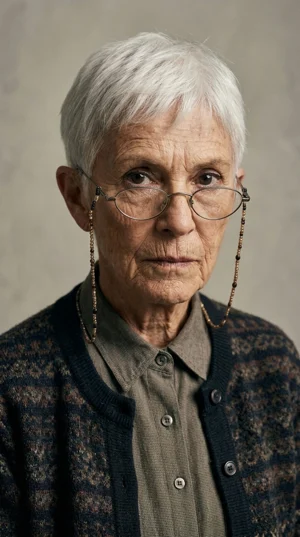
She’d been my grandmother’s lawyer for thirty years, a small sharp woman of seventy-one with white hair cut like a boy’s and reading glasses on a beaded chain. She’d quit smoking in 1994 and had been chewing nicotine gum with a kind of grim fury ever since. She sat at Wade’s kitchen table and spread out the papers like a hand of cards and looked at me over the glasses.
“Josephine,” she said. “I should have seen this coming, and I didn’t, and I’m going to be sorry about that later on my own time. Right now, sit down.”
I sat down.
“Here’s what he did.” She tapped the first page. “Grant listed Seven-Bar with the auction company on a durable power of attorney. That means a paper where you supposedly gave him the right to sign for you on anything to do with the land. Selling it included.”
“I never gave him that.”
“I know you didn’t. Look at the signature.”
I looked. It was my name. It looked like my name the way a scarecrow looks like a man.
“It’s notarized,” Frances went on. “April ninth. At Goose Valley Title in Sheridan. The notary’s stamp says Shayla Ostler.”
I didn’t know the name. Wade did. I saw it go across his face like a cloud shadow over a field.
“Blond,” he said. “Young. Works the front desk at Goose Valley.”
The puffer vest. The phone. The hand in the back pocket.
“She’s the girlfriend,” I said. “Isn’t she. The one at the sale.”
Frances chewed her gum. “She is.”
I put my coffee down. I’d been holding it so tight the heat had gone into my palms and I hadn’t noticed.
“So here’s where we are,” Frances said, and her voice went flatter, the way my grandmother’s used to when she was telling you what the vet bill was. “Yesterday Wade signed a purchase agreement at the sale barn. He put down ten percent. That’s two hundred thousand dollars, in escrow.” She looked at him. “At Goose Valley Title.”
“Where the girlfriend works,” I said.
“Where the girlfriend works. Closing is set for thirty days. The Monday before Thanksgiving. If we can prove that power of attorney is forged before then, the sale is void. It never happened. You never lost a thing.” She held up one finger, bony and ringless. “If we can’t, then on that Monday Wade either pays the other ninety percent, and your husband walks off with two million dollars of Wade’s money, or Wade backs out and loses the two hundred thousand, and the auction company calls the backup bidder.”
“The man from Denver,” I said.
“The man from Denver.”
Forty-acre ranchettes. Log gates with the name burned in.
I looked at Wade. He was leaning against the counter with his arms folded and his coffee forgotten beside him, and he was looking at me, not at Frances.
“Why would you do that?” I said. “Put that much money where he can get at it?”
“Because it’s the only thing that kept the place off the market for thirty days.”
“You don’t even know me.”
“I know you well enough.”
“From ten years of letters that say no.”
“They were good letters,” he said. “Short.”
Frances snorted into her gum.
He pushed off the counter and came and sat down across from me. He set both hands flat on the table, like a man showing a horse he wasn’t holding anything.
“Here’s my offer,” he said. “Whatever the court does, Seven-Bar goes back to you. If we prove it, it’s yours like it always was. If we don’t, and I have to close, I’ll deed it over to you the same day. Either way. You have my word, and Frances can write it down so you have more than that.”
I opened my mouth. Nothing came out.
“One term,” he said.
There it was. I’d been waiting for it. I’d been married long enough to know there was always a term.
“Go on.”
“You live here. You work here. Until it’s proved.” His eyes didn’t move off mine. “You don’t go back to that house while he’s in it. He’s got a key and he’s got a paper that says he can sign your name. I don’t want you three miles away in the dark with that.”
“And?”
“And you don’t sign anything without somebody reading it first.”
Something hot went up the back of my neck.
“I’ve already had one man tell me what to sign,” I said. “Sixteen years of it. I’m not trading him for another one.”
He went still. Not offended. More the way a horse goes still when a plank shifts under its foot on a bridge.
“Your lawyer, then,” he said, slower. “Not me. Frances, or anybody you pick. I don’t care if it’s me or not. I care that somebody reads it.”
Frances made a small approving noise and wrote something down.
I sat back. My hands had quit shaking. That was something. I looked around his kitchen, at the coffee can of fence staples on the windowsill and the vet calendar two months behind, and I thought about my own kitchen, my grandmother’s kitchen, with the girl in it.
“I’m not a charity case,” I said.
“I didn’t think you were.”
“Then you’ll pay me. Top hand wages. I’ll ride, I’ll doctor, I’ll calve your heifers in February if this runs that long. I’ll do your books, because I bet you anything they’re a mess.”
The corner of his mouth moved. “They’re a mess.”
“My own room. My dog. And when Frances comes, I sit at this table. Not in the other room while the men talk. Here.”
“Done,” he said. “All of it.”
“And I’m not sleeping with you.”
“I didn’t ask.”
“You were going to.”
He picked up his coffee at last and drank some of it, cold. “Not this week,” he said.
Frances choked on her gum so hard Wade had to get up and get her a glass of water.
We drove to Seven-Bar at noon, because Mule was there, and my clothes, and because I wasn’t going to let him tell me what was mine.
The cattle guard rang under the tires. The lane ran a mile along the creek through the bottom pasture, my pasture, the cottonwoods bare now and gray as smoke, the creek low and clear and talking over its stones. My heifers were in the trap by the barn. Somebody had fed them, finally. I saw the hay strung out in a line and thought, not enough, before I could stop myself.
The house stood where it had stood since 1924, white clapboard and a green roof, with my grandmother’s lilacs gone to sticks along the porch.
Grant’s truck was in the yard. So was a little white SUV with a Goose Valley Title parking permit on the mirror.
Mule came off the porch before I’d got the door open. He was eleven years old, a red heeler with a gray muzzle and one ear that had never stood up right, and he hit my knees so hard I sat down in the gravel and let him wash my face, and I’m not ashamed of that. Wade stood by the truck with his hands in his coat pockets and looked at the barn so he wouldn’t have to look at me.
The kitchen door was unlocked. It always was. That had been a point of pride with my grandmother.
The girl was sitting at Gran’s table.
She was wearing my barn coat. My old brown Carhartt with the torn pocket and the burn on the cuff from the branding iron, the one that hung on the hook by the door, and she had it around her shoulders over the robin’s-egg vest, and she was drinking out of my blue mug.
She stood up so fast she sloshed it.
“Grant,” she called, not taking her eyes off me. “Grant.”
He came in from the front room with a beer in his hand at noon on a Sunday, which was new. He stopped in the doorway, looked past me at Wade on the porch, and smiled.
“Well,” he said. “That was quick.”
“I came for my dog,” I said, “and my clothes.”
“Take whatever you want, honey.” He waved the beer. “Long as it’s not on the listing.”
I went past him into the front room. I didn’t look at the couch. I went to Gran’s rolltop desk in the corner, where the Seven-Bar brand book had lived my whole life: a ledger bound in green cloth gone black at the corners, every brand inspection and tally and transfer since the 1920s, Gran’s hand and her father’s and mine. I rolled the top up.
The shelf was empty.
I turned around.
“Where is it?”
“Where’s what?”
“Gran’s brand book. Where is it, Grant?”
He took a long drink. “Sold with the place, Jo. Brand and all.” He smiled again. “You’d know that if you ever read anything.”
Mule growled.
I’d never heard him do that. Not at Grant, not in eleven years. A low sound, deep in his chest, the hair standing up along his back in a ridge. Grant looked down at him as if the floor had cracked.
“You never wanted the business side,” Grant said, to me, softer. Almost kind. That was the worst thing he did to me that day: he said it kindly. “You’ll be fine. You were always better with cows.”
I heard the porch boards take Wade’s weight.
He didn’t come all the way in. He stood in the kitchen doorway with the cold coming in around him, and he looked at the girl in my coat, and she took it off without anybody asking her to and laid it over the back of the chair.
Then he looked at Grant.
“She lives on my place now,” he said. He didn’t raise his voice. Men who own that much land seldom have to. “Anything of hers you’ve touched, you put back where it was by Friday. The book. The coat. Whatever you’ve got.” A pause, while the clock on the stove ticked. “Or I come and get it myself.”
Grant laughed, a little high. The girl didn’t.
I picked up my barn coat off the back of my grandmother’s chair, and I picked up Mule’s leash off the hook, and I walked out between them with my face hot and my hands steady, and I knew one thing for certain that I hadn’t known when I walked in.
Grant hadn’t taken the brand book because it went with the place.
He’d taken it because he needed something inside it.
What did you think?